Industrial Humanoid Robot Market Could Reach $8 Billion by 2034
04 October 2026 | Report | By Editor Robotics Business NEWS <editor@rbnpress.com>
Growing adoption of embodied AI, robot learning and advanced manipulation is pushing humanoid robots from demonstrations toward industrial deployment.
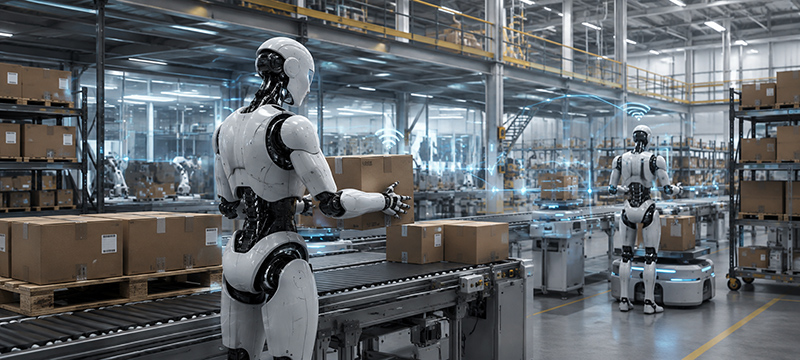
The industrial humanoid robot market is moving closer to commercial-scale deployment, as manufacturers explore humanoid robots for material handling, machine tending, assembly, inspection and intralogistics.
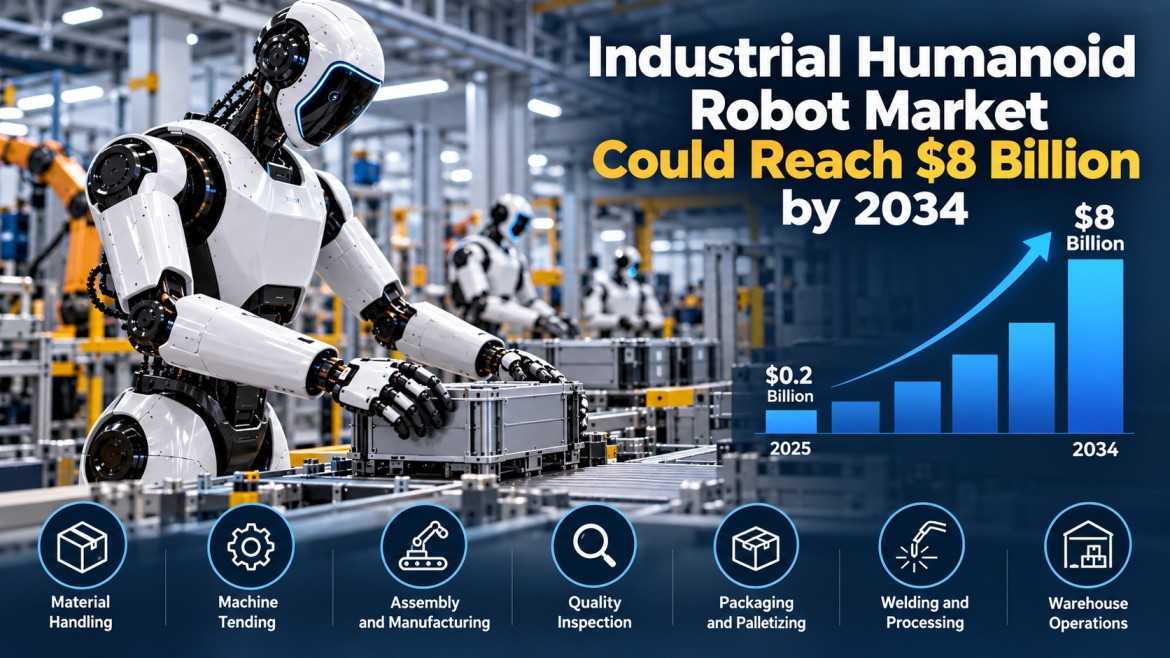
According to a recent Strategic Market Report, the global Industrial Humanoid Robot Deployments Market was valued at approximately $0.2 billion in 2025 and is projected to reach nearly $8 billion by 2034, representing a compound annual growth rate of around 50%.
Humanoid Robots Enter Industrial Automation
Humanoid robots are attracting attention because their human-like form allows them to work in environments already designed for people.
The market is being developed around several applications, including:
- Material handling and logistics
- Machine tending
- Assembly and manufacturing
- Quality inspection
- Packaging and palletizing
- Welding and industrial processing
- Warehouse operations
These applications could allow manufacturers to introduce flexible automation without completely redesigning existing production environments.
Embodied AI Drives the Next Stage
A major factor behind the growth of industrial humanoids is embodied AI.
Advances in vision-language-action models, computer vision, dexterous manipulation and robot learning are helping robots understand their surroundings and perform tasks with less manual programming.
Unlike traditional industrial robots that often perform highly predefined movements, AI-powered humanoids are being developed to adapt to different objects, tasks and working conditions.
However, industrial deployment still requires high levels of precision, reliability, safety and real-time performance. Recent research also highlights these requirements as major challenges for bringing embodied AI into industrial environments.
Automotive and Manufacturing Lead Early Adoption
Manufacturing is expected to remain one of the most important markets for humanoid robots.
The Strategic Market Report identifies automotive manufacturing, electronics and semiconductor manufacturing, general manufacturing, logistics and warehousing, aerospace and defense, and consumer goods as major industry segments.
Structured factories provide an attractive starting point because tasks can be clearly defined and performance can be measured.
From Pilot Projects to Scaled Fleets
The market is developing across several deployment stages:
Pilot deployments → Limited production deployments → Scaled industrial deployments
Robotics-as-a-Service (RaaS) is also emerging as a potential model for companies that want to introduce humanoids without making large upfront investments.
The market includes different types of humanoid systems, including full-size humanoids, industrial humanoid manipulators, mobile humanoids and dual-arm humanoids.
Companies Competing in the Market
The report identifies a growing group of companies involved in the industrial humanoid ecosystem, including Tesla, Figure AI, Apptronik, Agility Robotics, Boston Dynamics, Fourier Intelligence, UBTECH Robotics, Unitree Robotics, Sanctuary AI, 1X Technologies, NEURA Robotics and XPENG.
Competition is increasingly moving beyond robot hardware. Companies are also focusing on AI models, perception, manipulation, motion control, simulation and industrial software.
The Road Ahead
The projected growth from $0.2 billion in 2025 to nearly $8 billion by 2034 highlights the rapid expectations surrounding industrial humanoid robots.
At the same time, market growth will depend on whether these robots can deliver reliable performance and a clear return on investment in real production environments.
For manufacturers, the key question is no longer simply whether humanoid robots can perform industrial tasks. The bigger question is whether they can perform those tasks safely, reliably and economically at scale.
As embodied AI continues to improve, humanoid robots could become an important new layer of industrial automation alongside robotic arms, autonomous mobile robots and traditional factory systems.