Güdel US and Titan Robotics Advance Large-Scale Robotic Grinding and Surface Finishing
16 October 2026 | Interaction | By Editor Robotics Business NEWS <editor@rbnpress.com>
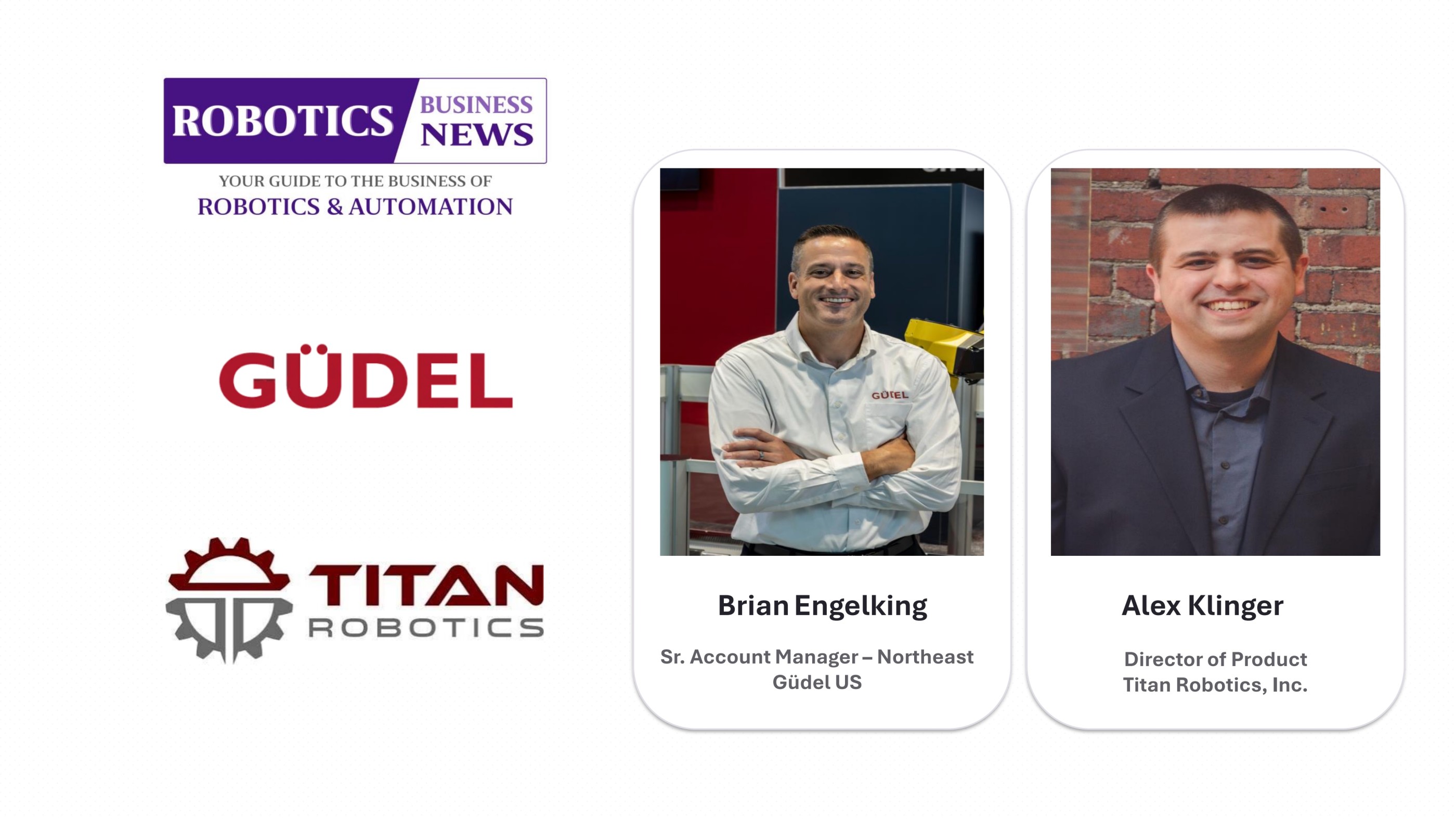
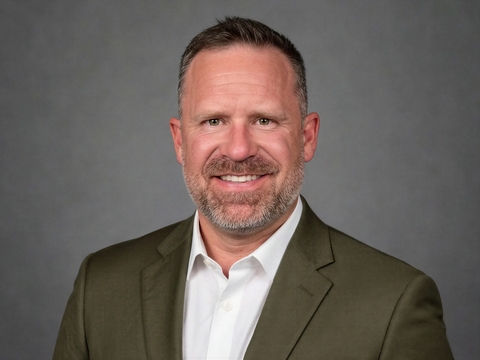
Brian Engelking of Güdel US and Alex Klinger of Titan Robotics discuss integrated motion systems, precision automation and expanding robotic grinding across heavy industries.
Robotics Business News spoke with Brian Engelking, Senior Account Manager – Northeast at Güdel US, and Alex Klinger, Director of Product at Titan Robotics, Inc., about their collaboration to advance large-scale robotic grinding and surface finishing. The discussion explores how integrated vertical and horizontal motion capabilities enable industrial robots to process large workpieces across shipbuilding, aerospace, energy and heavy manufacturing.
The interview examines how precise motion control, flexible gantry systems and robotic automation help manufacturers address labor shortages, improve finishing consistency and reduce manual grinding work. Engelking and Klinger also share insights from Automate 2026 and discuss how scalable robotic solutions could expand automated surface finishing into more manufacturing applications.
Güdel is positioning its solution as “grinding beyond stationary robots.” What industry challenges inspired the development of integrated vertical and horizontal motion capabilities, and how does this approach differ from conventional robotic grinding systems?
Brian Engelking: Over the last decade, Güdel has seen a large increase in automated systems using industrial robots. As companies become more comfortable with traditional six-axis arms mounted on static structures, they are beginning to see the benefit of moving those arms through larger spaces to perform the same processes on larger parts.
At the same time, robot manufacturers are designing and building larger six-axis robots. Together, these developments are allowing manufacturers to introduce larger workpieces into automated processes. Consequently, it is becoming more common to build single- and multi-axis linear gantry systems with robots mounted on them.
Essentially, this opens the door to using industrial robots mounted on gantries to process and handle any large component that requires grinding or finishing.
Alex Klinger: To echo what Brian said, we are talking about big industries and big workpieces. Shipbuilding is definitely one of the major applications, but the potential extends beyond that.
Grinding is a targeted application for Titan Robotics, but we also see closely related opportunities in the composites and energy industries. Examples include wind turbine blades and aircraft or aerospace structures, where manufacturers may need to grind or finish composites in ways that are similar to grinding metallic structures.
Within the metals sector, we are looking at energy production, shipbuilding and machinery manufacturing. These industries require us to take technologies developed at a smaller scale and expand them to much larger workpieces.
Many manufacturers struggle with flexibility when automating finishing processes. How does Güdel’s technology help manufacturers handle larger, more complex, or variable workpieces without sacrificing precision?
Brian Engelking: The pre-engineered nature, modularity and repeatability of our products make it easy to combine these building blocks into increasingly large linear automation systems while maintaining the quality and precision the application demands. Güdel’s modular components allow manufacturers to expand their systems to accommodate very large work envelopes.
What were the biggest engineering hurdles in combining multi-axis movement with consistent grinding performance, and how did your team overcome them?
Alex Klinger: Titan Robotics develops complete robotic solutions, but the control system at the heart of each solution creates the consistency. It must account for the scale of the parts and coordinate movement across multiple axes to achieve the desired outcome.
We start by defining that desired outcome. From there, the control system may need to manage tens or hundreds of elements extending from the physical interaction between the tool and the part back through the system. That requires very reliable motion. When the control system determines how the robot should move, it needs to know what to expect from the hardware.
The precision Brian mentioned allows us to predict how the hardware will behave. One of the biggest hurdles is managing the complexity of these systems. All the different elements have a necessary role in producing the desired outcome. The challenge is making them work together seamlessly without overcomplicating the system for the end user, while still delivering a return on investment.
Simplifying complexity is the challenge Titan addresses. We use Güdel equipment to provide precise motion and reduce the need to compensate for inaccuracies or a lack of precision. As systems become larger and incorporate more degrees of freedom, managing that complexity becomes increasingly important. Choosing the right equipment is central to doing that successfully.
As labor shortages continue to affect manufacturing worldwide, what role do you see advanced robotic grinding solutions playing in helping companies maintain productivity and quality standards?
Alex Klinger: In my conversations with customers and potential customers, I am seeing a desire to keep highly skilled welders welding more and grinding less. It is very difficult to find people in the labor market who are willing to grind metal all day. As a result, many companies also use their welders as grinders: the same person welds the part and then grinds it to the desired finish.
Welders generally want to weld. Manufacturers are therefore looking for ways to keep them welding as much as possible while transferring the grinding work to advanced automation. That is the main driver we are seeing in the marketplace.
This approach creates a more consistent product through the benefits of automation. It can also produce shorter lead times and lower costs by making labor requirements more predictable and keeping skilled welders focused on skilled welding work rather than grinding tasks they do not enjoy doing.
Can you share specific customer use cases or industries where integrated motion grinding systems have delivered measurable improvements in throughput, consistency or operational efficiency?
Alex Klinger: Titan provides the robot as a tool that customers can fit into their workflows in whichever way works best for them, much like a CNC machine in a manufacturing facility.
Our customers identify portions of the work that were previously performed entirely by hand but which the robot can perform effectively. They then incorporate the robot into their workflows and aim to have it complete as much grinding or sanding as possible before an operator takes over to perform the remaining finishing work.
Titan Systems have reduced manual tool-in-hand time for finishing operations by 100% in some applications with the average reduction being approximately 80%, depending on the application and the workpiece. That is how I like to present what the robot can do: we have taken the tool out of the person’s hand and allowed the robot to perform the dirty, dull, dangerous and physically demanding work. This is on top of the improved consistency that people have come to expect from automation.
Artificial intelligence and advanced sensing are increasingly influencing industrial automation. How is Güdel incorporating intelligent capabilities into its grinding solutions to improve adaptability and process optimization?
Brian Engelking: Güdel builds the mechanical systems rather than the electrical systems. Our capabilities allow us to automate larger work envelopes and work with integrators that are solving challenging applications in those spaces. Mechanically, we can support a very wide range of applications.
Visitors at Automate 2026 saw this technology firsthand. What key demonstrations or capabilities were you most excited to showcase, and what do you hope attendees took away from the experience?
Brian Engelking: From Güdel’s perspective, we wanted customers to see that large automation systems can be implemented without being intimidated by their scale. We are a partner in these projects, and we are very comfortable working with large-scale automation. Some manufacturers may be comfortable with a small automation cell but feel intimidated when considering automation on the scale of a football field. We wanted to demonstrate that Güdel can execute systems of that scale without risk.
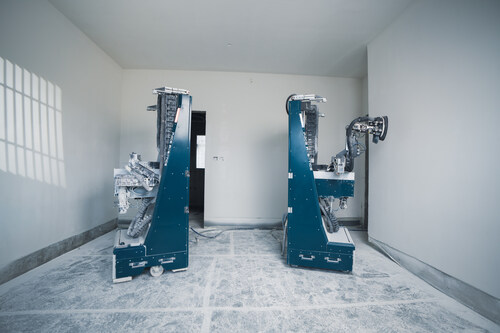
Visitors could see what Titan was demonstrating in our booth: an industrial robot mounted on a vertical tower that moved along a horizontal base. They saw that a robot could move vertically and horizontally and then began asking whether they could hang it upside down over a large shipbuilding, naval or military component and automate work on that.
Our answer was yes. It prompted visitors to think about what else they might be able to automate. They may previously have assumed they could only automate an area of a certain size, but the demonstration showed that they might be able to work across an area two or three times larger.
Alex Klinger: From Titan’s perspective, the partnership with Güdel at Automate gave us an opportunity to demonstrate that these large systems are also manageable from the control-system side. We can provide a control system that automatically programs the robot, enabling it to perform the required work at any scale.
Güdel demonstrated that the robot can move horizontally or vertically, operate underhung on a gantry, or travel farther along the floor. Titan demonstrated that the control system can program and coordinate the robot across those different physical configurations.
Looking ahead, how do you envision robotic surface finishing and grinding evolving over the next five years? And what role will Güdel play in shaping the future of automated manufacturing?
Alex Klinger: From Titan’s perspective, tThe technology is ready and the market is right. Robotic grinding is still a relatively immature market. There are not many automated grinding solutions in high-mix, low-volume job shops. They are more commonly found in very high-end or very high-volume metalworking facilities.
We expect enabling technologies to bring robotic grinding into a much larger market. The areas we discussed earlier, including transportation, heavy equipment and other metal-fabrication industries, are likely to be among the first to adopt these systems. We then expect adoption to expand across metal fabrication more generally.
Brian Engelking: Güdel’s role will centre on scalability and its ability to work with automation companies operating in larger spaces and processing larger parts.
We come from the automotive industry, which was at the heart of our business for the last couple of decades. We are now seeing automation expand across many other industries. That is creating opportunities for Güdel to participate in a much wider range of large-scale and large-part applications and we expect that trend to continue.