Wandercraft Advances Humanoid Robotics with Its Deploy-First Strategy
28 October 2026 | Interaction | By Editor Robotics Business NEWS <editor@rbnpress.com>
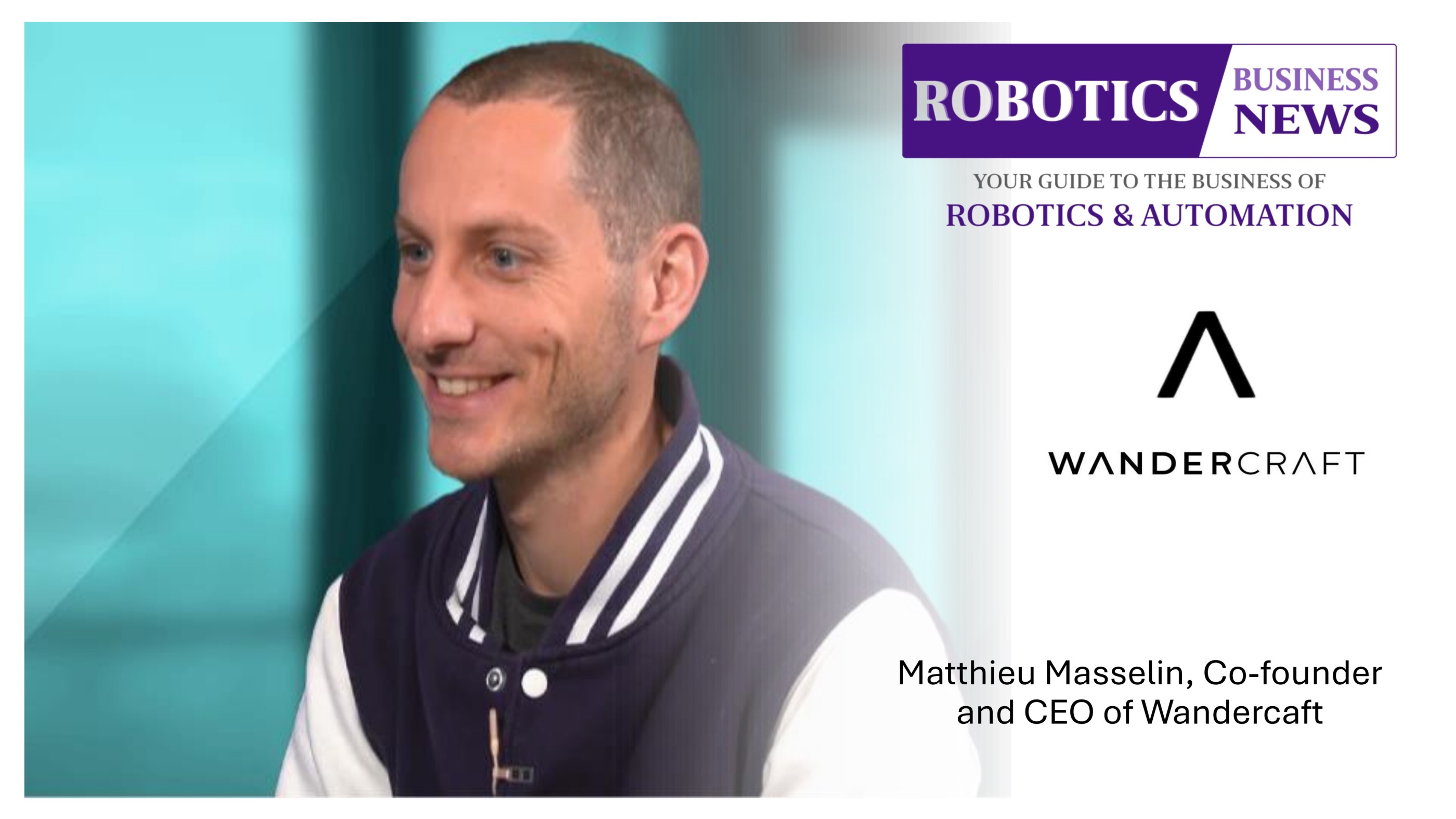
Matthieu Masselin explains how Calvin-40 combines physical AI, industrial safety and real-world deployments to scale humanoid robots.
In an exclusive conversation with Robotics Business News, Matthieu Masselin, Co-founder and CEO of Wandercraft, discusses the company’s Calvin-40 humanoid robot and its strategy for industrial deployment.
Masselin explains how physical AI, operational data, medical robotics expertise and manufacturing partnerships can help Wandercraft improve robot reliability, expand capabilities and scale commercial adoption.
Wandercraft has secured 12 customers for its Calvin-40 humanoid robot. What do these early commercial commitments indicate about the current readiness of humanoid robots for real industrial environments?
We are seeing tremendous interest, with customers becoming increasingly sophisticated in their approach. A year ago, a customer told us, “We are learning to become a good humanoids customer.” They wanted to test the technology in their own facilities and understand where it would fit. Our top accounts have identified specific applications, the business case for humanoids, the metrics they will use to evaluate ROI, the sites where they are piloting, and the exact case for scaling.
On the technology side, we believe there is a practical middle ground between traditional robotics and fully general-purpose AI. By combining proven approaches, such as model predictive control (MPC), which continuously optimizes a robot's movements, with advances in physical AI, we can deploy robots today, deliver value, and use real-world experience to expand their capabilities.
We call this Deploy First to Generalize (DFTG). Our view is that humanoids will not scale because they become general. They will become general because they scale.
Many humanoid robots have demonstrated impressive capabilities in controlled environments. What are the biggest challenges in ensuring that Calvin-40 can perform safely, reliably and repeatedly in real-world industrial operations?
The challenge is moving beyond performative demonstrations to robots that can function as part of an industrial operation. A robot might execute a staged task beautifully, but that doesn't mean it is ready for a factory environment. It must integrate with existing production systems and workflows while respecting cybersecurity norms, operate reliably alongside people, and meet demanding safety and reliability requirements. Safety cannot be an afterthought. It has to be built into the robot's architecture from the start.
This is where our medical robotics experience gives us an advantage. We have spent over a decade developing systems where safety, balance, and reliability are essential and where failure can have serious consequences. We bring that same engineering discipline to Calvin-40.
Wandercraft is focusing initially on specific, commercially valuable tasks rather than pursuing general-purpose capabilities from the start. Why do you believe this approach is the most effective path toward developing more capable humanoid robots?
I would slightly modify that premise. We are absolutely pursuing broader capabilities. We believe the best way to achieve them is through deployment.
That is the thinking behind DFTG. We start with tasks that have clear commercial value, establish reliable performance, and use what we learn in real-world operating environments to expand the robot's capabilities. Each new application exposes the robot to different objects, workflows, and operating conditions, creating opportunities to improve its performance and develop additional capabilities.
Rather than waiting for a robot that can theoretically do everything, we are building toward generalization through practical experience. Our approach ties technological progress to the work customers actually need.
The company plans to use data generated from real-world deployments to continuously improve Calvin-40. How important is this operational data in building a long-term competitive advantage in physical AI?
Operational data is central to our strategy, but its value lies not in simply accumulating more of it. The quality and diversity of that data matter. By deploying robots across diverse tasks and environments, we gather the information needed to identify performance limitations, refine our physical AI capabilities, and expand the range of tasks our robots can perform.
But there is a second, equally important form of learning that goes beyond the data collected by the robot itself. We learn how customers operate, where integration is difficult, what operators need, and how systems must be maintained. That practical knowledge helps us improve not only the robot's capabilities but also how we deploy and support it.
Together, these two forms of learning create a powerful competitive advantage. Our DFTG strategy lets us turn real-world deployment into both technological progress and a deeper understanding of what it takes to deliver customer value.
Wandercraft has more than a decade of experience developing self-balancing medical robotics. How has the company's experience with safety, balance and reliability in medical exoskeletons influenced the development of Calvin-40?
Our medical robotics experience gives us an advantage in managing heavy loads while maintaining balance and safety. Atalante X and Eve support people weighing up to 220 pounds (100 kg) and help them stand and walk. Calvin-40 applies our expertise in balance, actuation, and whole-body control to a different challenge: handling industrial payloads of up to 88 pounds (40 kg).
This is physical AI in practice. The challenge is not simply generating enough force to carry a heavy load. A robot must continually account for weight distribution, balance, motion, and its interaction with the surrounding environment. Our experience developing self-balancing exoskeletons gives us a strong foundation for applying AI and advanced control systems to these demanding physical tasks.
Our history of helping people with severe mobility impairments has also shaped our approach to safety, reliability, system design, verification, testing, and operator training. We have spent years developing medical devices under rigorous regulatory and quality requirements, including FDA clearance. We are bringing that combination of strength, balance, physical AI, and safety-oriented engineering to Calvin-40.
As Wandercraft prepares to increase production, what are the biggest challenges in moving from successful customer deployments to manufacturing humanoid robots at commercial scale?
At first glance, scaling humanoid robotics seems like a manufacturing challenge. But the real test is broader: can you produce robots economically, deploy them efficiently, and enable customers to operate and maintain them successfully?
Manufacturing at scale requires a stable design, consistent quality, and a supply chain that can support higher volumes while driving down costs. We have a significant head start. Approximately 90% of our supply chain is European, providing a foundation for responsive, cost-competitive production. Our partnership with Renault Group brings additional industrialization and design-to-cost expertise, and our new Paris facility expands our manufacturing capabilities.
But producing more robots is only part of the equation. Customers need to operate them independently, and the robots must be maintained and serviced wherever they are deployed. Our medical robotics business has already given us extensive field experience and a global service infrastructure, further strengthened by our October 2026 acquisition of Ekso Bionics.
So, scaling doesn't end when a robot leaves the factory. It succeeds only when the customer can put the robot to work and keep it running.
The humanoid robotics industry is becoming increasingly competitive. What will ultimately determine which companies succeed commercially—robot performance, reliability, cost, AI capabilities, manufacturing scale, or the ability to secure real-world customers?
Performance is the starting point. If your robot cannot reliably perform the work customers need, nothing else matters. But the industry is already moving beyond performance alone. Cost competitiveness, manufacturing scale, and integration with existing factory systems are becoming decisive. Companies that cannot demonstrate a credible path to delivering robots economically and at scale are already falling behind.
This is where Wandercraft has an advantage. We have invested in the industrial infrastructure needed to scale, including our new manufacturing facility in Paris and our partnership with Renault Group. With our acquisition of Ekso Bionics, we have also added established exoskeleton manufacturing capabilities in the United States, along with additional engineering expertise and a global service infrastructure. Together, these capabilities give us a robust industrial foundation on both sides of the Atlantic.
Another factor I believe the industry undervalues is technological sovereignty. As robots become integral to industrial operations, customers will increasingly need to know who controls the software, operational data, critical components, and infrastructure they depend on.
Ultimately, the winners will not simply be those with the most advanced robots. They will be the companies that can deliver the right capabilities at a competitive cost, manufacture and support them at scale, and give customers confidence in the technology and infrastructure behind them.