Robotic Surgery Expands Options for Complex Hernia Repair
23 October 2026 | Interaction | By Editor Robotics Business NEWS <editor@rbnpress.com>
Dr. Michael R. Freund explains how robotic technology improves precision, access and outcomes in challenging hernia procedures.
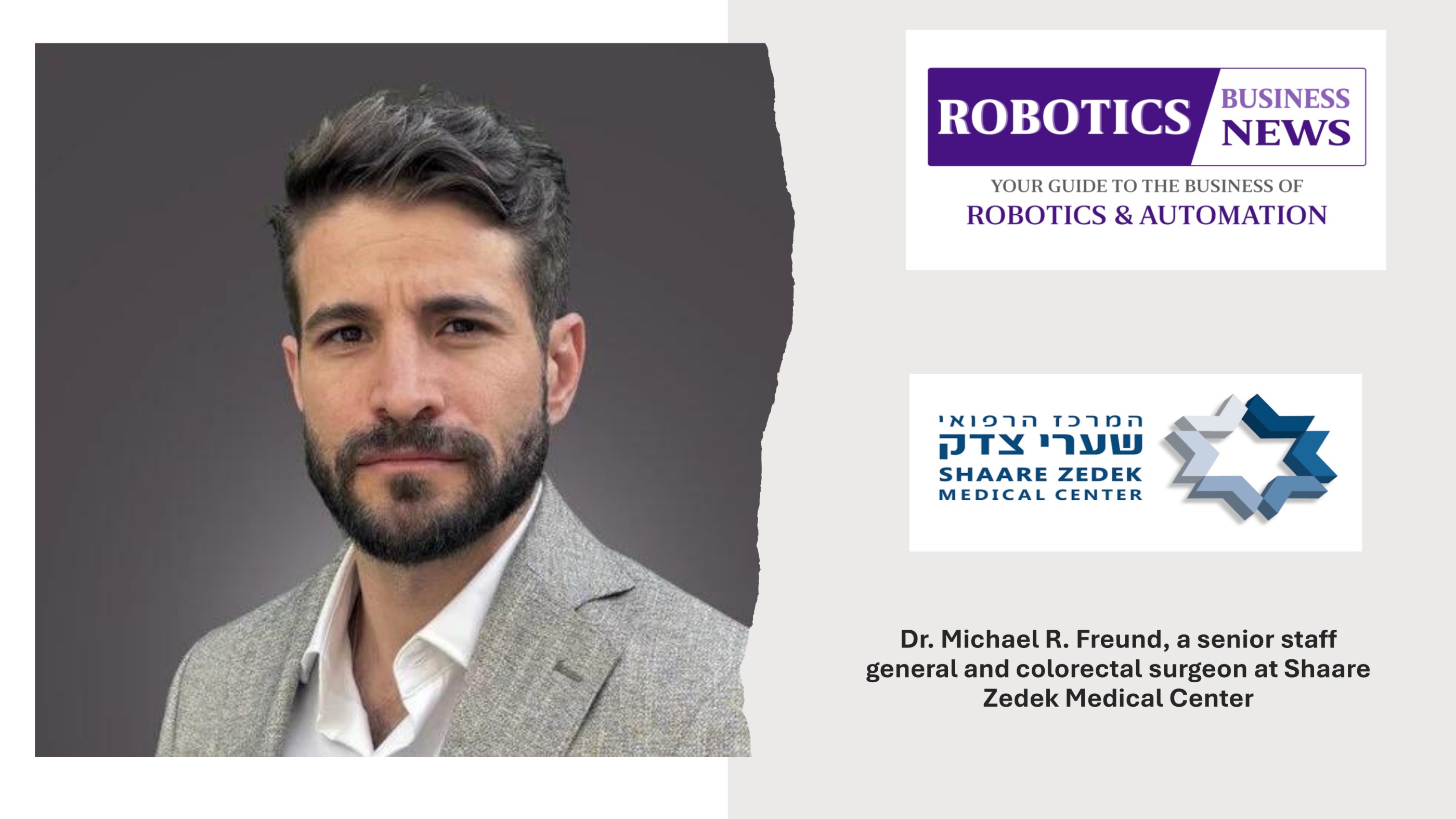
In an exclusive conversation with Robotics Business News, Dr. Michael R. Freund, a Senior Surgeon in the Department of General and Colorectal Surgery at Shaare Zedek Medical Center, affiliated with the Faculty of Medicine at the Hebrew University of Jerusalem, discusses how robotic-assisted surgery is expanding treatment options for complex abdominal hernias.
Freund shares insights into surgical precision, three-dimensional visualization, patient recovery, surgeon training and healthcare costs. He also explores how artificial intelligence, autonomous surgical systems and remote collaboration could shape the future of minimally invasive surgery.
What motivated your team to investigate robotic-assisted surgery for repairing complex abdominal hernias, particularly those located in anatomically difficult-to-reach areas?
My background is actually in robotic colorectal surgery. Early in my career, I began to recognize the tremendous potential of robotic surgery in abdominal wall reconstruction and hernia repair and started learning these techniques from my mentor, Professor David Hazzan.
As our experience grew and we completed more advanced training, we gradually realized that the robot could allow us to tackle increasingly complex hernias that would traditionally require open surgery. We began pushing the boundaries of what could be achieved robotically, eventually expanding into lateral abdominal wall hernias, among the most technically challenging defects to reconstruct.
Today, we are able to reconstruct even extremely complex lateral hernias robotically. Our motivation for this study was to share that experience and demonstrate what has become possible with this technology.
How does robotic-assisted surgery help surgeons access challenging abdominal hernias, and what technical advantages does it offer compared with conventional laparoscopic approaches?
Conventional laparoscopy has revolutionized abdominal surgery, but it has certain limitations, particularly when operating in anatomically restricted areas. Suturing laparoscopically often means performing a three-dimensional maneuver while looking at a two-dimensional screen, using long, rigid instruments with limited freedom of movement.
Abdominal wall reconstruction presents an additional challenge. When operating from inside the abdomen, the surgeon is essentially looking upward and trying to suture the “ceiling.” This is an extremely challenging maneuver with conventional laparoscopic instruments. With the robot, we can even invert the image and reorient the controls, effectively turning the “ceiling” into the “floor” on our screen. A stitch that once felt upside down suddenly becomes much more natural.
Combined with true three-dimensional vision and wristed instruments, this gives us far greater freedom of movement and precision, even at difficult angles and in confined spaces.
For me, that is the real difference: instead of fighting the angle of our instruments while trying to place a stitch, we can concentrate on the repair itself.
What were the key findings of your research regarding the safety and effectiveness of robotic-assisted abdominal hernia repair?
Perhaps the most encouraging finding was that all 39 procedures were completed robotically, without a single conversion to open surgery, despite the complexity of these hernias.
Recovery was also remarkably quick. Most patients went home within a day or two, blood loss was minimal, and none of the repaired hernias returned during the follow-up period of approximately 14 months.
Of course, these are complex operations and complications can occur. Most were minor, although two patients developed bowel obstruction requiring another operation. Both were treated minimally invasively and recovered well.
One of these cases even led us to change our routine: we now take additional care to close certain small instrument entry sites. For us, that is an important part of the study’s value: learning from complications as well as successes.
Which patient groups and types of complex hernias could potentially benefit most from robotic-assisted surgical techniques, based on your findings?
From our experience, patients who may benefit most are those whose hernias developed after earlier operations, particularly kidney surgery or surgery involving the bowel or a stoma, and those whose defects followed an injury.
We also treated Spigelian hernias, which develop along the side of the abdominal wall. Some defects are relatively small but lie in awkward places, such as just below the ribs or near the pelvic bone. A hernia in one of these locations can be harder to repair than a larger one in the middle of the abdomen.
What guides our decisions is not size alone, but the scars, the condition of the surrounding muscles, and whether there is enough room to position the reinforcing mesh properly. Those details often tell us more about the difficulty of a repair than its measurements.
How does robotic technology improve surgical visualization, instrument maneuverability, and precision when operating in confined anatomical spaces?
At the console, I can magnify the view of the tissues and judge depth much more naturally than on a flat screen. That matters when separating the thin layers of the abdominal wall and recognizing small blood vessels or nerves before they are injured.
The instruments also translate my hand movements into very small, deliberate motions inside the patient. I can scale down a movement, keep the camera steady, and make subtle adjustments without repeatedly shifting the entire instrument.
In practical terms, this helps at the most delicate moments: finding the correct layer to work in, placing stitches in difficult positions, and laying the mesh exactly where it belongs. The robot does not replace surgical judgment; it helps us put that judgment into practice.
What challenges remain in establishing robotic-assisted hernia repair as a routine procedure, particularly regarding surgeon training, operating time, and healthcare costs?
I believe the greatest challenge is proper training. Having access to a surgical robot does not automatically make someone a robotic surgeon. These procedures require advanced robotic skills, a thorough understanding of abdominal wall anatomy, and extensive hands-on experience. There is a significant learning curve, and proper training, mentorship, proctoring and gradual progression from simpler to more complex procedures are essential.
Operating time is another consideration. Initially, robotic procedures may take longer, but as surgeons progress along the learning curve, they become increasingly efficient.
Cost remains a significant obstacle. Currently, the da Vinci system dominates the surgical robotics market. Hopefully, as more robotic platforms enter the market, increased competition will make this technology more affordable and accessible.
We should also consider the bigger economic picture. If patients recover faster, spend less time in the hospital, and return to their normal lives sooner, some of the additional costs may be offset.
Ultimately, the goal is not to use the robot for every hernia, but to use it where it offers a meaningful advantage for the patient.
What additional clinical studies or long-term outcome assessments are needed to strengthen the evidence supporting robotic-assisted repair of complex abdominal hernias?
One year of encouraging results is only the beginning. A successful hernia repair needs to withstand years of everyday movement, lifting, and physical strain.
We need to follow patients over several years to understand whether these repairs remain durable over time, whether hernias recur, and how patients experience their recovery, particularly regarding long-term pain and quality of life.
We also need larger studies comparing robotic surgery with traditional open and laparoscopic techniques, not only in terms of surgical outcomes, but also recovery time, patient satisfaction, and overall costs.
Because these unusual hernias are relatively uncommon, cooperation between hospitals will be essential. Combining the experience of different surgical teams is how we can move beyond promising early results and provide more reliable answers for patients.
Looking ahead, how do you see advances in surgical robotics transforming complex hernia repair and other minimally invasive abdominal procedures over the next five years?
I believe we are only beginning to explore the full potential of robotic surgery. Over the next five years, I expect the technology to become smarter, more accessible, and increasingly integrated with artificial intelligence.
Perhaps the most fascinating development is autonomous surgery. Researchers have already trained robots by showing them videos of surgeons operating, enabling them to perform complex surgical tasks independently in experimental settings. For example, a robot has successfully performed a major part of gallbladder surgery without human intervention. This is remarkable, although we are still some way from fully autonomous operations on patients.
AI could also become an invaluable assistant during surgery, identifying critical structures such as nerves and blood vessels in real time, and even warning the surgeon when an instrument is getting dangerously close.
Another development I find particularly exciting is remote collaboration. Imagine a surgeon performing a complex procedure on the other side of the world who needs an intraoperative consultation. I could connect securely through an application, see exactly what that surgeon is seeing, and provide guidance in real time. Early versions of this technology already exist, and I believe they will become increasingly accessible.
The real revolution is not the robot itself, but what it allows surgeons to accomplish for their patients.