LG Innotek and TDK Partner to Advance Physical AI Sensing for Robots
Strategic collaboration will develop next-generation vision sensing and tactile sensing modules to enhance robotic perception, intelligence and automation.
Image Courtesy: Public Domain
- LG Innotek and TDK align on a strategic partnership in the physical AI sector
- Developing next‑generation vision sensing modules integrated with TDK sensors to maximize recognition performance
- Developing a tactile sensing module that acts as the skin of a robot
- CEO Moon Hyuksoo: "We will expand cooperation with TDK across multiple physical AI domains."
LG Innotek is developing not only the "eyes" of robots but also their "skin."
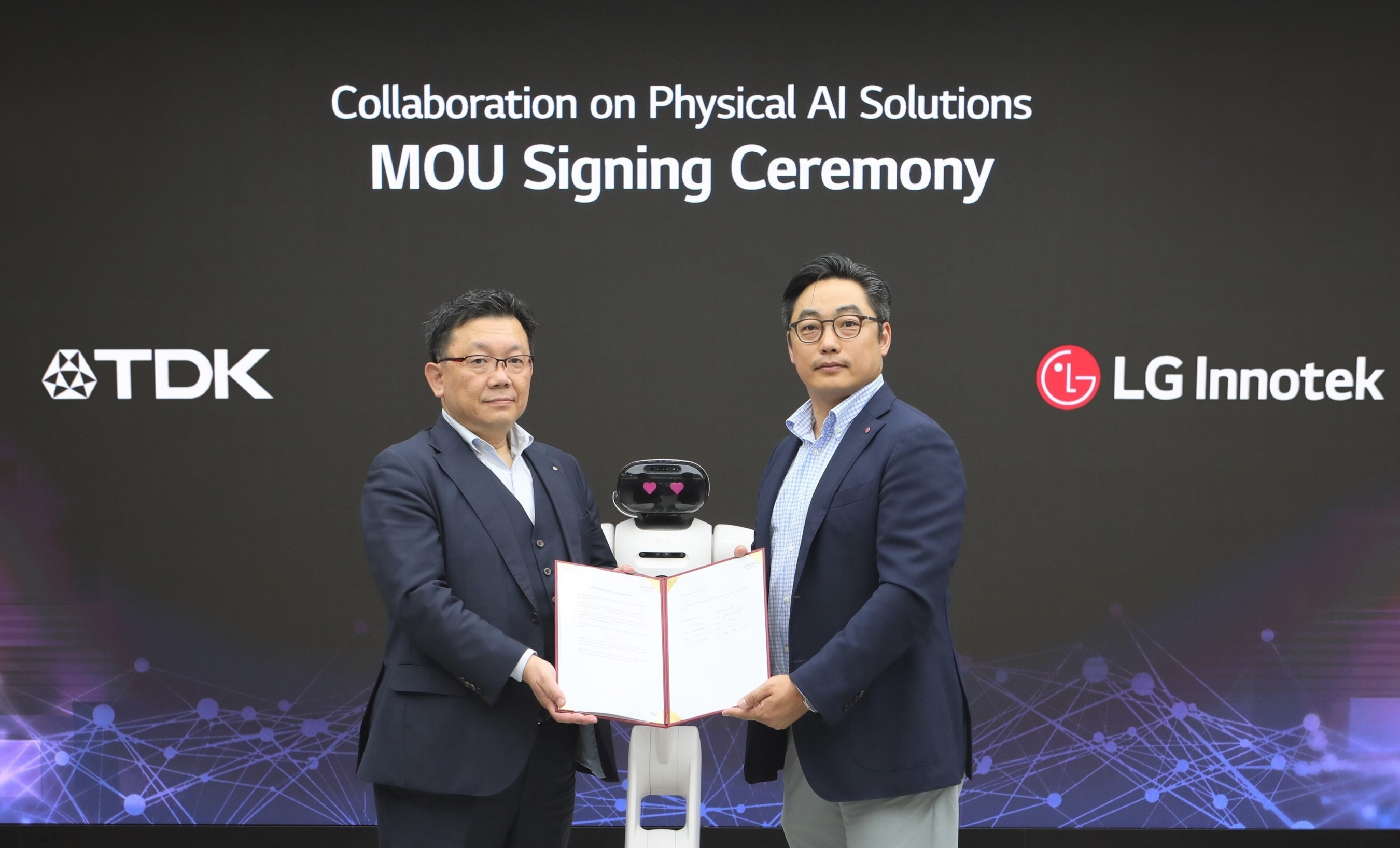
LG Innotek (CEO Moon Hyuksoo) announced on July 28 that the company has aligned on a strategic partnership in the field of physical AI with TDK Corporation, a global electronics company (President and CEO Noboru Saito).
Under the agreement, the two companies plan to deliver a range of physical AI solutions, including next-generation vision sensing modules and tactile sensing modules, by combining LG Innotek's optical and ultra-precision module design technologies with TDK's diverse set of sensor technologies.
TDK Corporation (TSE:6762) is a global technology company and innovation leader in the electronics industry, based in Tokyo, Japan. It has been actively expanding its sensor business over the past two decades. In particular, TDK is known for its broad sensor portfolio spanning inertial, directional, temperature and pressure and position sensing, which can be applied to a wide range of physical AI use cases.
- Developing next‑generation vision sensing modules integrated with TDK sensors to maximize recognition performance
With this partnership, the two companies plan joint advanced research to integrate LG Innotek's vision sensing modules with TDK's various sensors, including inertial and position sensors and microphones. Through this collaboration, the two companies plan to launch a next‑generation vision sensing module that offers expanded functionality and significantly improves recognition performance compared to existing solutions.
This next‑generation vision sensing module aims to maximize robots' recognition accuracy by fusing data on movement, position, and sound, going beyond traditional vision data collected from only image sensors.
For example, when TDK's Inertial Measurement Unit (IMU) is integrated into the vision sensing module, it is expected to enable motion blur compensation and image stabilization, while also preventing visual blind spots through high-frequency tracking and dead reckoning.
From the robot manufacturers' perspective, the integrated module also offers significant convenience, as various sensors are combined into a single solution. This eliminates the need to purchase and connect multiple sensors individually, reducing both complexity and implementation burden.
An LG Innotek official said, "There are numerous types of next‑generation vision sensing modules that can be created through our partnership with TDK, which offers dozens of advanced sensor technologies. As a first step, in 2027, we plan to launch a module equipped with an inertial sensor."
- Developing a tactile sensing module that acts as the 'skin' of a robot
Under the partnership, the two companies plan to work together to develop a tactile sensing module by 2027.
This tactile sensing module functions almost like human skin. Mounted on the robot's hands, arms, and body, the module allows it to detect contact with objects and the pressure it exerts when manipulating them.
The module relies on advanced manufacturing, ultra‑thin form factors, and flexible structures, making it a high-value‑added component that is very technically challenging to develop. Recently, the tactile sensing module, together with the vision sensing module, has become one of the core components of robots.
LG Innotek will provide its module design and digital signal processing capabilities, while TDK is willing to contribute its ultra‑precision sensing technology from diverse industries, including consumer and automotive businesses, aiming to create a high‑performance tactile sensing module tailored to the operating environments of robots.
- Broadening cooperation across multiple physical AI domains
The two companies plan to expand their cooperation into multiple physical AI fields, particularly real‑time processing and sensor data analysis.
TDK President and CEO Noboru Saito said, "I am pleased for TDK to join hands with LG Innotek, a world‑class leader in physical AI sensing. By combining TDK's diverse fundamental technologies and sensors with LG Innotek's core capabilities, we will add value for customers and bring truly revolutionary products to the global market."
LG Innotek CEO Moon Hyuksoo said, "In the robotics industry, multi-sensing—the integration of numerous sensors into a single system—is expected to become increasingly important. Through our collaboration with TDK, which offers a broad portfolio of sensor technologies, we aim to help shape the ecosystem for core robotic components."
He added, "We will continue to partner with a wide range of companies to enhance the core technologies powering robots' vision and hands, and accelerate our efforts to establish a leadership position in the Physical AI market."
Meanwhile, LG Innotek is actively exploring physical AI sensing markets with its composite sensing modules, which combine multiple sensing components such as world‑class camera modules, LiDAR, and radar into a single solution. Leveraging its differentiated competitiveness in cameras, LiDAR, and radar based on proprietary technologies, LG Innotek is strengthening its cooperation with other global big tech firms as well, including Boston Dynamics.