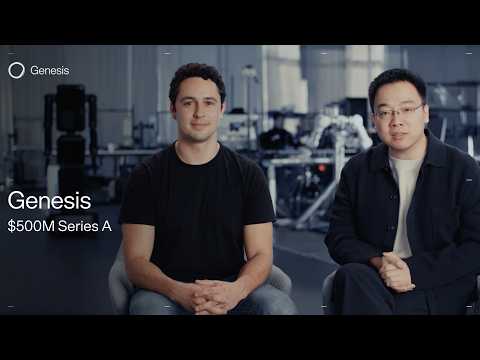
Genesis AI Raises $500 Million in Series A Funding at $3.5 Billion Valuation to Scale General-Purpose Robotics
Co-led by Premji Invest, Khosla Ventures and Eclipse, the funding will accelerate development of Genesis AI's full-stack robotics platform, expand production of its Eno general-purpose robot and advance human-level physical manipulation capabilities.
Image Courtesy: Public Domain
Genesis AI, a global robotics company, announced it has raised $500 million in Series A funding at a $3.5 billion post-money valuation. The round was co-led by Premji Invest, Khosla Ventures and Eclipse, with participation from Durable Capital Partners, T. Rowe Price Associates, Inc.¹, Bpifrance, HSG, NVIDIA, AMD Ventures, Zoom, Samsung Next and Ericsson, as well as visionary leaders including former Google CEO Eric Schmidt, Zoom CEO Eric Yuan, Jerry Yang, former CEO of Yahoo!, French tech entrepreneur Xavier Niel, and former Tesla CFO Zach Kirkhorn.
"Our mission is to remove the physical limits on human ambition," said Zhou Xian, Co-Founder and CEO of Genesis AI. "To accomplish this, we're working to build the world's best general-purpose robot, one that works reliably in the real world, day after day. That requires the intelligence, hardware, and everything that goes into training and testing the robots to work as one system. By building it all ourselves, we can obsess over every detail and improve the entire robot faster in one closed loop. This funding will accelerate our efforts to deploy our robots in the real world at scale."
The funds will fuel the company's next phase of growth, with a focus on:
- Expanding data acquisition and large-scale training to vastly extend the range and complexity of tasks robots can perform
- Solving human-level physical manipulation in robots across a full range of environments and use cases, unlocking true physical AI
- Deploying Eno, the company's AI-powered general-purpose robot, at scale with customers
- Hiring additional world-class AI researchers, robotics experts and engineers to build the next generation of general-purpose robots
Advancing from Development to Deployment
"What stood out to us was watching Genesis robots complete long, multi-step tasks on their own at the same speed a person would, with smooth and natural movement," said Vedant Agrawal, Partner at Premji Invest. "Completing full tasks in real time, not just short clips, is what turns a robot into something a business can rely on."
"General-purpose robotics has the potential to fundamentally transform how we live and work, and Genesis is helping shape that future," said Eric Schmidt, former CEO of Google and Genesis investor. "I've believed in this team's vision since the beginning, and what they've accomplished in such a short time is extraordinary. This funding marks an important milestone as Genesis moves closer to bringing robots with human-level capabilities into the real world at scale."
Genesis is currently ramping up production of Eno, which the company is initially focused on rolling out in industrial environments including manufacturing, logistics and laboratories, before expanding into the hospitality and healthcare industries, followed by consumer and outdoor applications.
The Full-Stack Approach to Unlocking General-Purpose Robotics
As robots move from individual tasks to months of autonomous operation across entire workflows, reliability becomes a much harder challenge. The system is only as reliable as its weakest part, from hardware and controls to AI, data and evaluation. That's why Genesis builds the entire stack in-house: to optimize every layer together, avoid supplier constraints and improve faster in one closed loop. This integrated approach enables a seamless customer experience and a scalable robotics ecosystem serving a wide range of industries and applications.
"The next generation of robotics won't be built by improving hardware or AI models in isolation. It requires rethinking how AI, data and hardware work together," said Vinod Khosla, Founder of Khosla Ventures. "Genesis uniquely understands this, and its full-stack approach gives the company a real opportunity to solve the challenges that have held back general-purpose robotics for years."
"General-purpose robotics is a systems problem, and Genesis is attacking the whole system: a data engine built for massive scale, world-class simulation, human-like dexterity and Eno's remarkably beautiful form factor." Charly Mwangi, Partner at Eclipse. "Each layer makes the others better. But my strongest conviction is in the team. The talent density, speed of execution and obsessive attention to detail are exceptional. They understand the physics, sweat the details and build at a pace few teams can match. They far exceeded my expectations from a year ago."
The company recently unveiled its full stack of innovation in rapid succession, including:
- GENE, its AI foundation model and the industry's most advanced robotic brain, enables robots with human-level physical manipulation capabilities to perform the most complex tasks ever achieved by robots.
- Genesis' dexterous hand and data collection system that seamlessly work together for robot training. The robotic hand closely matches a human hand and Genesis' data collection glove. Together, the human hand, glove and robotic hand create a 1:1:1 mapping, allowing robots to learn from data collected as people wear the gloves while performing their regular work.
- Genesis World, the company's simulation platform that serves as the ultimate accelerator for learning by allowing robots to quickly train and test skills across a vast range of virtual scenarios before applying them in the real world.
- Eno, Genesis' general-purpose robot that challenges conventional humanoid design, favoring human capability over human appearance. By co-engineering its hardware and AI from the ground up, Genesis has optimized Eno for performance, reliability, mass production and real-world deployment at scale.
Together, these technologies form a continuous learning loop, each reinforcing the others. Human data trains GENE, Genesis World accelerates evaluation and improvement, and Eno puts that intelligence to work in the real world. Feedback from deployment improves the AI, simulation and hardware, creating a faster path to next-generation robots that are more capable, reliable and adaptable.