NXP Semiconductors Introduces Unified Robotics Platform to Accelerate Physical AI Development
The open-source platform combines AI, connectivity, motor control, security, and energy management, enabling developers to build initial drone functionality in just 30 minutes.
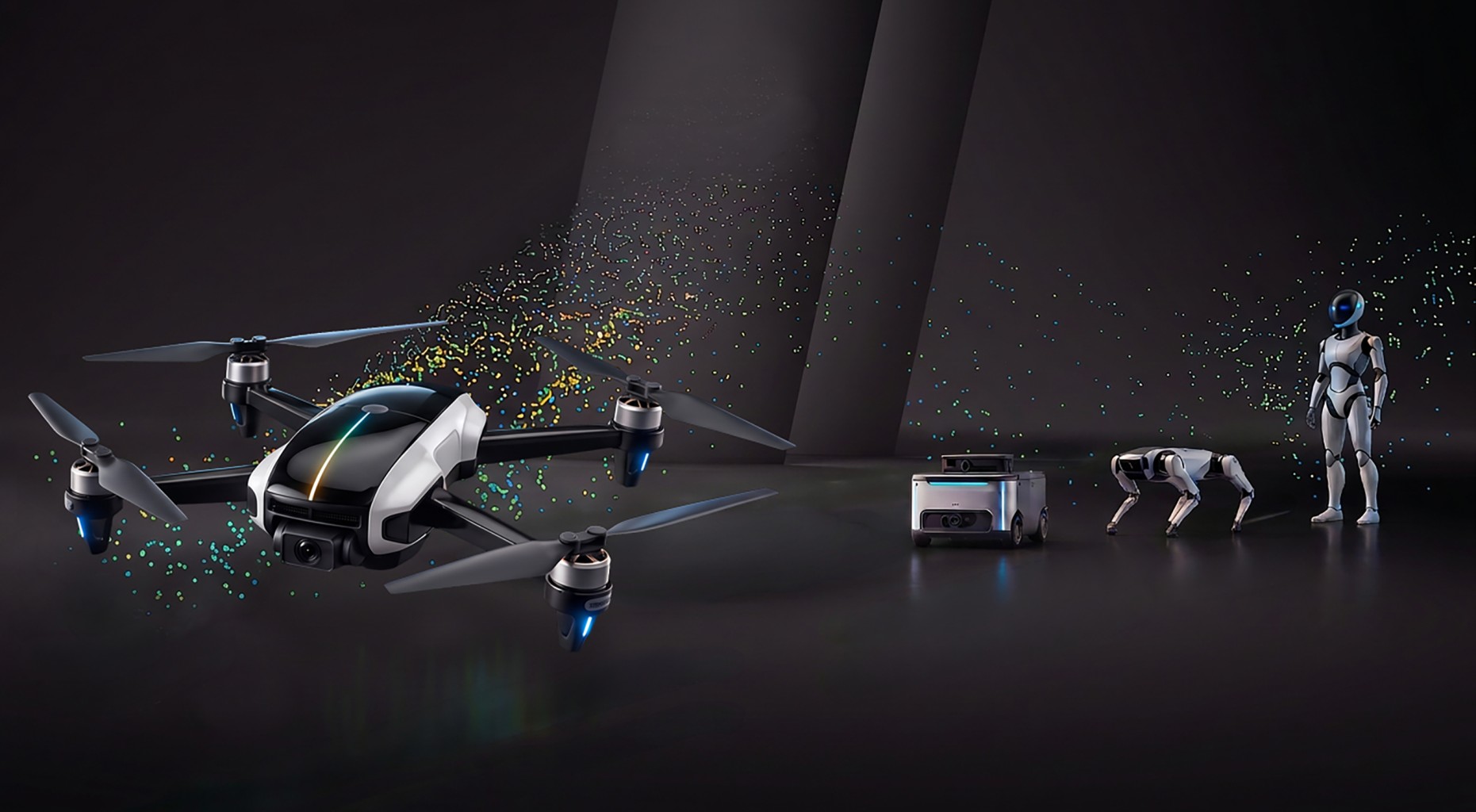
Image Courtesy: Public Domain
- Develop robotic systems faster with a modular, open-source SDK and ready-to-use reference designs built on NXP’s Neural Axis Architecture, integrating AI, connectivity, motor control, security and energy management
- Simplify integration with software and pre-validated interoperable subsystems that scale from individual functions to complete systems
- Enable an initial drone functionality in 30 minutes out of the box, with support expanding to service robots and autonomous systems
NXP Semiconductors N.V. announced its new unified robotics platform built on NXP’s Neural Axis Architecture, a distributed foundation that securely connects sensing, real-time control, AI processing and communications across robotic systems. The platform delivers a unified hardware and software ecosystem combining NXP’s secure, safety-enabled technologies.
Using a single validated development experience, developers can quickly scale from single functions to complete trusted physical AI systems. For example, a developer may begin by evaluating a motor control subsystem, which has been tested and validated with the SDK. Using the unified robotics SDK, reference designs and platform architecture, developers can then easily add AI-based perception, flight control and navigation to build a complete autonomous drone faster.
Robotic subsystems must work together seamlessly across every form factor, which can take developers months to integrate and validate. NXP’s unified robotics platform cuts this effort to days or weeks through pre-integrated software and validated subsystem interoperability, built on a secure hardware foundation drawn from NXP’s broad portfolio, freeing developers to differentiate and innovate.
“As autonomous robots increasingly move beyond controlled environments and into the spaces where people live and work, trust becomes a prerequisite for adoption,” said Jerome Legros, Vice President and General Manager, Robotics, NXP Semiconductors. “To deliver that trust, developers need a foundation designed with security, functional safety, real-time control and full lifecycle reliability in mind. NXP's unified robotics platform brings together these non-negotiable capabilities in a scalable architecture that helps developers build the next generation of trusted physical AI systems.”
“For drone developers, speed is critical. Markets evolve quickly, customer requirements change rapidly and new autonomous capabilities are constantly emerging,” said James McClearen, CTO, blueflite. “NXP's unified robotics platform is a ready-to-build foundation that shortens development cycles, allowing us to evaluate new ideas, prototype faster and bring innovative solutions to market more efficiently.”
“In high-performance robotics, particularly drone systems, processing power alone isn’t enough,” said Srdjan Kovačević, CEO & Co-Founder, Orqa. “You need efficient communication between computing elements, predictable behavior and extremely low latency. Working closely with NXP helps us address these challenges at an architectural level, giving us a stronger foundation for the next generation of robotic systems. This matters even more when the real-world demands on advanced unmanned systems are more challenging than ever before.”
Designed to work with industry-standard robotics frameworks, NXP’s unified robotics platform establishes a common hardware and software foundation for robotics development. The open-source, modular SDK provides supported drivers, middleware integration, reference applications, configuration tools and reusable software components. This includes integrations with established open-source technologies including PX4, Zephyr and ROS 2. The platform’s reference designs incorporate secure processing, deterministic real-time control and safety-ready system architectures built from NXP’s broad hardware portfolio, enabling developers to build robots capable of operating safely and reliably in real-world environments.
From Design to Drone Within 30 Minutes
The platform’s prototype-ready reference designs combine NXP’s secure, safety-enabled solutions. The first reference designs under the unified robotics platform support drones, including autonomous compute and flight control using the NavQ95 based on the i.MX 95 applications processor; flight management using the Tropic VMU/FMU based on the i.MX RT1064 crossover MCU; intelligent sensor networking using the 100Base-T1 Sensor Node based on the MCX N947 MCU; and motor control using the AM32-compliant electronic speed controller based on the MCX A13 MCU. Each includes the safety and security enablement of the design’s primary processor, which can be enabled independently of robotics-specific functionality. Supported by the robotics SDK, these reference designs allow developers to deliver an initial drone functionality within 30 minutes out of the box.
While the first designs support drones, the platform will extend across a multitude of autonomous systems requiring perception, navigation, motor control, connectivity and safe real-time operation. Future designs will address service robots, autonomous mobile robots (AMRs), and other autonomous systems.