Teradyne Robotics Partners With Sereact to Scale Physical AI Across Industrial Automation
The partnership combines Sereact’s Cortex AI platform with Universal Robots arms to automate complex logistics and manufacturing tasks, including returns handling, piece-picking and goods sorting.
Image Courtesy: Public Domain
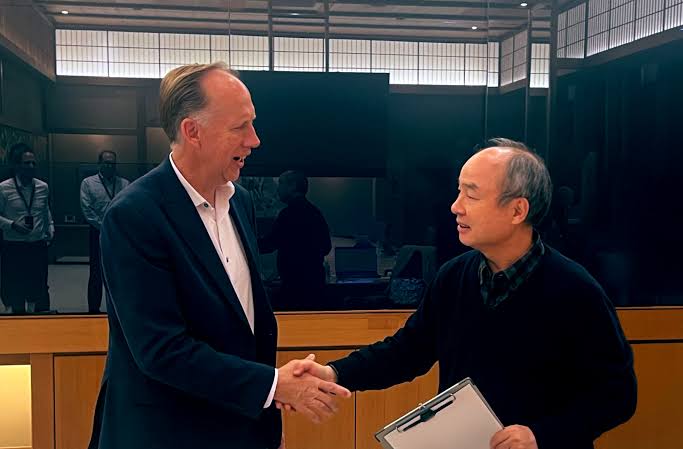
Teradyne Robotics – the company behind Universal Robots and Mobile Industrial Robots – and Sereact, a pioneer in physical AI for robotics, announced a new, official partnership to accelerate industrial AI solutions in retail, logistics and manufacturing.
Through this partnership, Sereact's physical AI platform, Cortex, runs robot arms from Universal Robots to give retailers and logistics providers a proven way to automate unstructured tasks such as returns handling and piece-picking.
Together, the companies have already shipped hundreds of UR robots in dual-arm systems to live customer sites across Europe.
Jacob Pascual Pape, Chief Commercial Officer of Teradyne Robotics, said:
“Physical AI only matters when it performs in real-world operations, and that is where Universal Robots has always been at home. Our robots are built for the AI era: open, connected and proven through more than 100,000 industrial deployments. That is why Sereact has chosen our platform,” he said. “When combined with Sereact’s Cortex, the joint solution handles mixed goods, unknown items, and varied packaging. This has moved well beyond the demo or pilot stage with the technology now usefully deployed at real customer sites. Our technologies are a natural fit and through our partnership we will scale these AI-powered solutions fast across applications, industries and markets.”
To serve the rapidly growing demand, Sereact this summer opened a US HQ in Boston, Massachusetts, to also bring the joint solution to North America.
One model, many applications
The Sereact and Teradyne Robotics solutions deliver impact across a variety of critical logistics and manufacturing use cases, including returns handling, store replenishment, piece-picking and sortation, order induction, machine tending, bin consolidation, kitting, packing and goods handling.
“Returns, replenishment, kitting: with Cortex, every one of these applications runs on the same production model. One brain serves every robot, with no retraining for each new item or task. And what one robot learns, every robot benefits from,” said Dr. Ralf Gulde, CEO and Co-Founder, Sereact. “Partnering with Teradyne Robotics and its global distribution and integrator network helps us bring that one brain to their customers around the world, accelerating the abilities of retailers and logistics providers to adopt AI-powered automation across their operations.”
Live at NVIDIA GTC Berlin
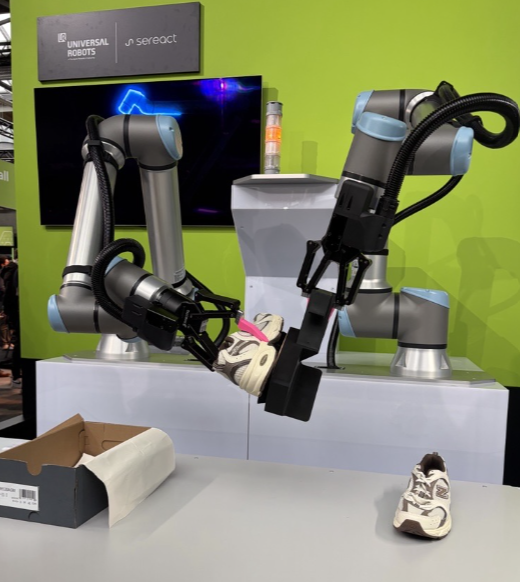
The companies are marking the partnership with a joint demo at this week’s NVIDIA GTC Berlin 2026. In the NVIDIA booth, Cortex, Sereact's Vision-Language-Action (VLA) model, runs on two Universal Robots UR12e-1300s to show a returns handling applications that is already implemented in live logistics centers.
The deployments are done in collaboration with CEVA Logistics for Zalando, a European technology platform for fashion and lifestyle, connecting 62 million active customers with more than 7,000 brands across 29 markets. At Zalando's fulfillment centers in Greven, Germany, and Świebodzin, Poland, the robots now autonomously process returned fashion items. This is the first phase of a broader initiative to scale returns automation across Europe.
“Returns are one of the hardest jobs in logistics. Returned products almost never arrive in a robot-friendly sequence. Items differ in shape, orientation and packaging, and the mix changes continuously. That is exactly what Cortex is built to handle on the Universal Robots platform,” said Dr. Gulde and adds: ”By rapidly reconditioning returned goods for resale, the solution also helps retailers comply with European Union regulations prohibiting the destruction or landfill disposal of returned merchandise.”
For images of the demo at NVIDIA GTC Berlin and the Sereact solutions featuring Universal Robots, see this image collection.
Powered by NVIDIA technologies
NVIDIA’s technologies are a key part of the Sereact and Universal Robots demo at GTC Berlin. Cortex is trained in NVIDIA Isaac Sim, an open simulation framework, using NVIDIA Cosmos open world models. It is post-trained with reinforcement learning using NVIDIA Isaac Lab frameworkand benchmarked on Teradyne Robotics hardware before any model is deployed. In deployment, Cortex runs on NVIDIA Jetson Thorat the cell where inference must happen at line speed, and on NVIDIA DGX Spark for site-level development, validation and model updates.
Teradyne Robotics also uses NVIDIA computing in its UR and MiR product ranges. Teradyne Robotics are contributing SimReady OpenUSD robot assets to SimReady Central Library on Hugging Face for both Universal Robots and MiR products, helping developers discover and reuse robot models in simulation with less asset preparation.