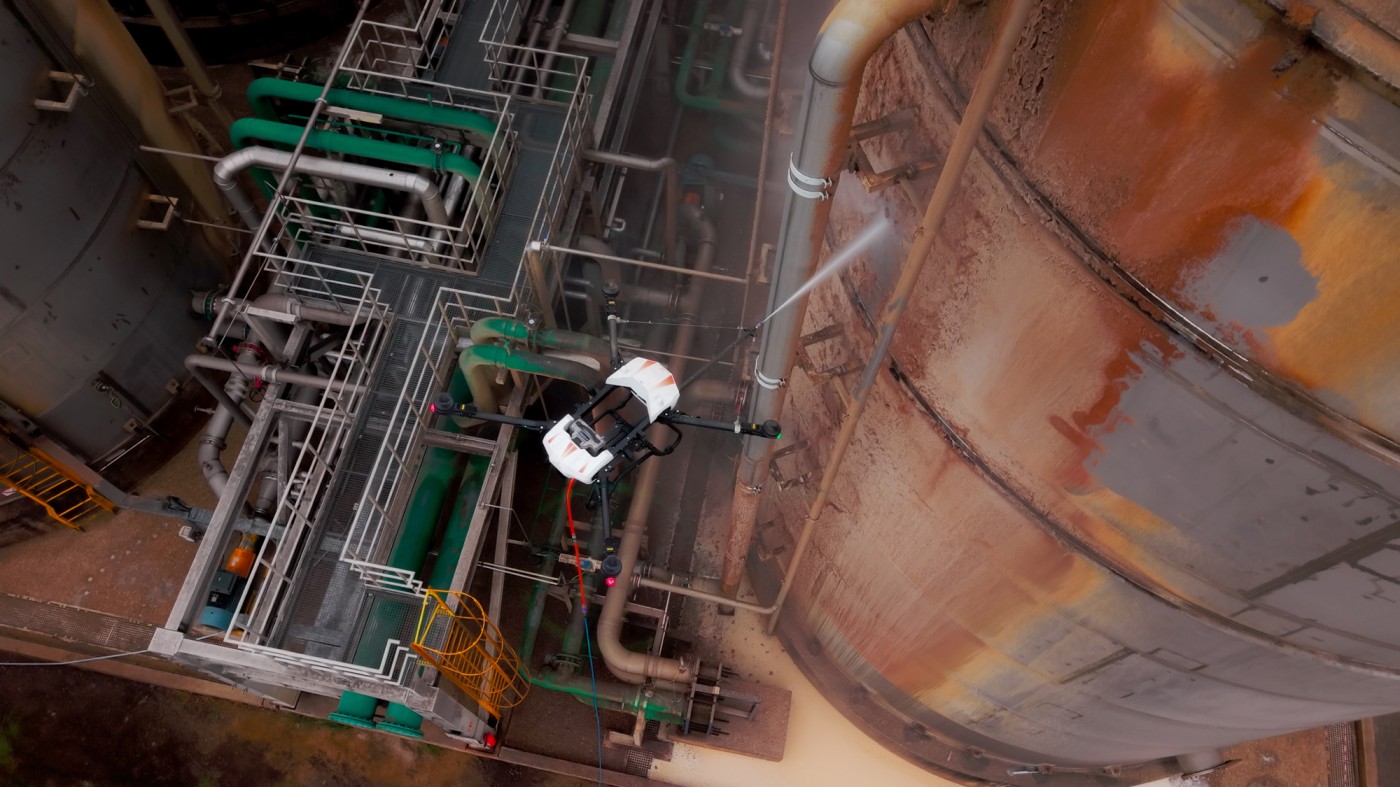
ABZ Innovation, a European developer and manufacturer of heavy-duty civilian drones for agricultural and industrial use, launched the C30, an industrial water jetting drone built for the hardest cleaning work at height. Paired with dedicated ground equipment, the C30 delivers 500 bar (7,250 psi) of pressure and up to 30 liters (7.9 gallons) of water per minute to surfaces as high as 120 meters (394 feet): bridges, steel frameworks, tanks, silos, wind turbine blades and industrial facades that are reached today with scaffolding, cranes or rope access teams.
Thirty years of buildup, removed in less than a day
Before launch, ABZ Innovation put the C30 to work at an active industrial site in Visonta, Hungary. On a 600 m² (6,460 ft²) facade carrying an estimated 30 years of bonded carbon, the drone finished the job in less than one working day, using water alone. A scaffolding contractor had quoted roughly a week of site time for the same surface. The system ran at a sustained 500 bar throughout, while its radar kept the cleaning distance constant; the pilot never had to correct it by hand. At the same site, the C30 cleaned the exteriors of mash tanks that had been coated layer by layer for seven to eight years by liquid overflowing from the top.
Pressure breaks it loose. Flow carries it away.
The C30 is built around a piece of physics that only a heavy-lift platform can fully use: pressure alone does not clean an industrial surface. High pressure cracks bonded deposits, coatings and rust off the substrate. At 30 liters per minute, the loosened material is flushed away immediately. In industrial cleaning, rinsing capacity often decides the speed more than pressure does, and together the two deliver up to four times the cleaning performance. On large facades and silo walls, radar-guided automated cleaning covers 4–10 m² (43–108 ft²) per minute, depending on the surface and weather.
At this level of pressure and flow, detergents are unnecessary in most jobs. Where oil, fuel or industrial grease is involved, the system runs hot water, typically at 70–80°C (158–176°F), which makes the residue lose viscosity and wash off. Most surfaces are cleaned by physical force and heat alone, without chemical run-off.