Apricity Robotics Raises $16.1M Series A to Advance Robotic Ultrasound Assistant
Ohio-based medical robotics company will use the funding to complete development of its Robotic Ultrasound Assistant, expand clinical evaluations and support regulatory submissions, aiming to reduce sonographer strain and improve cardiac imaging efficiency.
Image Courtesy: Public Domain
Apricity Robotics, which is developing a robotic system that holds and positions the ultrasound probe during cardiac exams, announced a $16.1 million Series A financing round led by JumpStart Ventures, with participation from private funds advised by The O.H.I.O. Fund, Orlando Health Ventures, JobsOhio Ventures, University Hospitals Ventures and others. Including previous seed funding and grants from the U.S. National Science Foundation, Apricity has raised $19.1 million to date. The funding will support completing development of the company’s Robotic Ultrasound Assistant (RUA), expand clinical evaluations with health system partners and support regulatory submissions.
“Apricity CEO Aaron Crookes and his team are building innovative medical robotic systems in Ohio, a state with the health systems that can use them, the engineering talent to advance them and the manufacturing capabilities to build and scale them,” said Peeyush Shrivastava, a principal with The O.H.I.O. Fund, a private investment firm focused on generating strong returns for investors while creating economic growth in Ohio. “Supporting companies with the potential to transform industries while creating long-term value is exactly the type The O.H.I.O. Fund was established to back.”
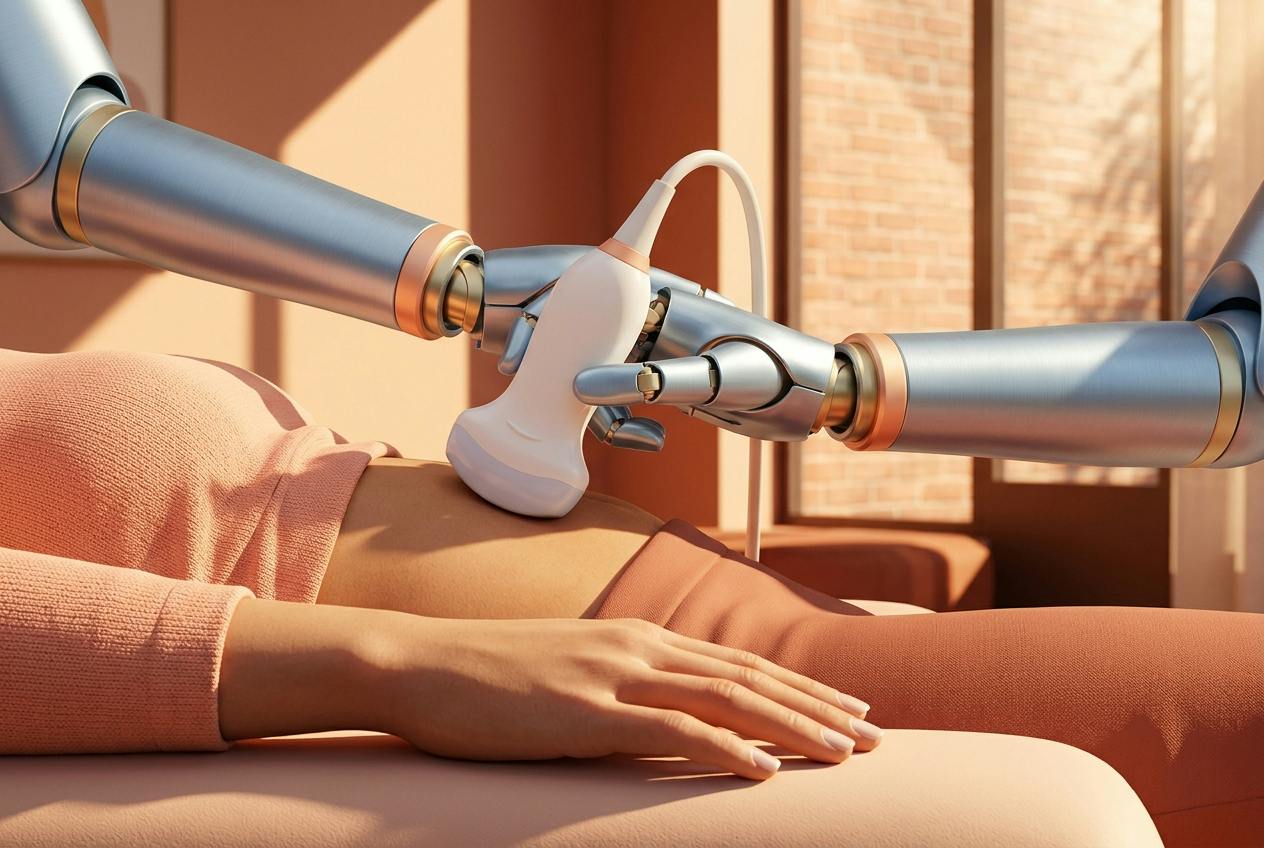
An ultrasound exam requires a sonographer to press a transducer against a patient’s body, often at full reach, for much of the exam. The RUA mounts to a health system’s existing ultrasound cart from any manufacturer and holds and manipulates the probe while the sonographer directs the scan. The sonographer makes the clinical decisions, while the robot takes on the physical work of holding position. Apricity designed the system around the sonographer first.
That’s because when repeated several times a day over a career, sonographic work takes a toll: a 2024 study estimated that 75.8% of sonographers have experienced work-related musculoskeletal disorders. At the same time, U.S. ultrasound exam volume grew 55% between 2011 and 2021, while the number of sonographers grew 44%. When experienced sonographers cut back their hours or leave the field, health systems lose capacity they can’t quickly replace.
The effects also reach beyond staffing for health systems. An unfilled sonographer position can leave an exam room idle and lengthen wait times, and differences in experience and technique from one sonographer to the next show up as variation in image quality and measurements, which can affect downstream interpretation. The RUA is designed to support more repeatable image acquisition, faster proficiency for new staff and more flexibility in how health systems staff and fulfill exams. The company is building technology to amplify sonographers, not replace them.
Apricity is working with health system partners including University Hospitals to evaluate the RUA and build the clinical evidence required to support FDA clearance and market adoption.
“Health systems face a growing challenge in meeting the demand for high-quality diagnostic ultrasound services while protecting and retaining the skilled sonographers who make that care possible,” said Andres Schuster, MD, System Medical Director of Echocardiography at University Hospitals in Cleveland. “Our study with Apricity will help us explore how robotics can support the sonographer workforce, with the goals of improving productivity and increasing throughput across our cardiac imaging services.”
The funding will support development of the RUA hardware and software platform, including ergonomic, image-quality and AI capabilities. It will also fund key hires and the commercial infrastructure needed to bring the RUA to market.
“We didn’t set out to build an ultrasound robot,” said Aaron Crookes, founder and CEO of Apricity Robotics. “But in conversation after conversation, our health system partners told us the same thing: their sonographers were wearing out, and every exam still required one in the room with the patient. They asked us to turn our robotic platform into an assistant for their sonographers, and that’s what we built. Ultrasound is still the most hands-on exam in imaging, and we believe robotics is going to change that.”