Driving the Future of Open-Platform Orthopedic Robotics Through Innovation, AI, and Surgeon Choice
31 July 2026 | Interaction | By Editor Robotics Business NEWS <editor@rbnpress.com>
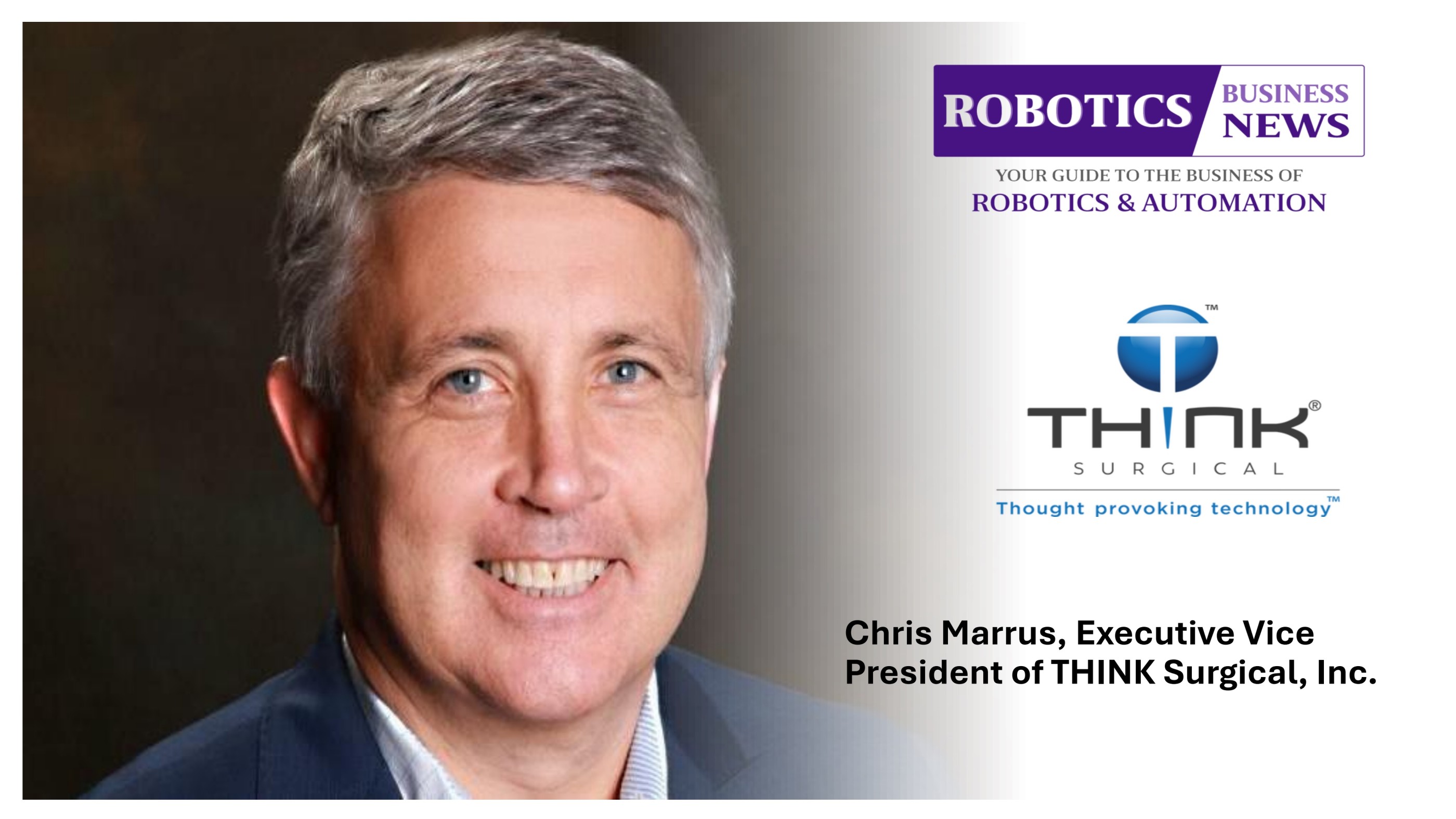
Chris Marrus, Executive Vice President of THINK Surgical, discusses growth funding, AI-powered robotics, open-platform innovation, and the future of orthopedic surgery.
As orthopedic surgery embraces robotics, artificial intelligence, and data-driven clinical workflows, healthcare providers are seeking technologies that improve precision while preserving surgeon choice and operational efficiency. In this exclusive conversation with Robotics Business News, Chris Marrus, Executive Vice President of THINK Surgical Inc., shares his insights on the company's open-platform robotics strategy, the expansion of the TMINI® Miniature Robotic System, the growing role of AI in orthopedic surgery, and how THINK Surgical is advancing surgeon-centric innovation to accelerate the adoption of robotic-assisted procedures worldwide.
THINK Surgical has secured up to $65 million in growth capital. How will this investment accelerate the commercialization and global adoption of the TMINI® Miniature Robotic System?
We are pleased to have the support of leading healthcare investors, like Symbiotic Capital, who recognize the momentum behind our commercial and regulatory strategies.
This funding will accelerate adoption of the TMINI® Miniature Robotic System by expanding our sales, marketing, medical education, and clinical support departments. It will also support continued innovation, including expanded clinical capabilities and broader implant compatibility.
Our goal remains simple: deliver a best-in-class robotic experience while making advanced orthopedic robotics more accessible to surgeons and healthcare providers.
Your open-platform approach supports implants from multiple manufacturers. How does this strategy differentiate THINK Surgical in the increasingly competitive orthopedic robotics market?
THINK Surgical's open-platform strategy is unique because it gives surgeons and healthcare providers the freedom to choose the implants that best meet their clinical and operational needs. Today, the open-platform TMINI System is compatible with 12 implant systems from 9 vendors, more than any orthopedic robotic platform available in the U.S. This flexibility benefits surgeons, multi-surgeon practices, and healthcare systems alike by reducing the need for multiple robotic platforms while preserving implant choice. It also helps hospitals improve operational efficiency and strengthen purchasing flexibility.
We plan to continue expanding implant compatibility until we achieve complete market coverage.
As robotic-assisted orthopedic surgery becomes more widely adopted, what technological advancements are you prioritizing to improve surgical precision, workflow efficiency, and patient outcomes?
Having supported more than 6,000 procedures, we've gained valuable insights that continue to shape product development.
We are hyper focused on advancing our technology to meet our two core value statements 1) Making robotics easy to use for surgeons and staff, and 2) empowering surgeons’ implant choices. We want to change the paradigm in orthopedic robotics by taking the complexity out of robotics. Surgeons shouldn’t have to compromise on complexity of workflow and implant choice to adopt robotics.
To do that we’re continuing to find ways to enhance our workflow and user experience, add additional compatible implant systems, and add features to our system that provide value to the surgeon, without overcomplicating the procedure.
In the not to distant future, we will start to look at adding other procedural indications.
The TMINI system is currently compatible with approximately 70% of the total knee implant market. What are your plans to further expand implant compatibility and strengthen partnerships with orthopedic device manufacturers?
Our implant strategy combines two successful channels: our open-platform business and our exclusive distribution partnership with Zimmer Biomet.
Together, these approaches currently provide compatibility with implant systems representing approximately 70% of the U.S. total knee market. Our next priority is expanding compatibility with additional strategic implant manufacturers, allowing healthcare providers to maintain implant choice while standardizing on a single robotic platform. This positions us to approach full market coverage. With our current proprietary method, we believe that is achievable and not too far away.
Many hospitals continue to evaluate the return on investment for surgical robotics. How is THINK Surgical helping healthcare providers justify adoption through clinical, operational, and economic benefits?
Healthcare providers have historically evaluated robotics through three lenses: clinical value, strategic value, and financial return. The TMINI System addresses all three.
Clinically, it delivers robotic precision. Strategically it allows facilities to offer competitive robotics programs. Economically the open-platform approach allows multiple surgeons to use a single robotic system.
A fourth area that health systems are now being challenged with is multiple closed platform systems and maintaining operational efficiencies. This is an area we are focused on at THINK Surgical. Having multiple robotic systems to meet clinician implant preference is an inefficient use of capital, storage space, and it increases complexity for staff. We believe we can standardize robotic technology at these sites, provide operational and financial efficiencies and deliver surgeon implant choice all in one system.
Together, these advantages create a compelling return on investment for healthcare providers.
Artificial intelligence is increasingly influencing surgical planning and intraoperative decision-making. How do you see AI shaping the next generation of orthopedic robotic systems over the coming years?
AI has the potential to transform surgical planning, workflow optimization, and decision support. However, success will depend on high-quality, unbiased clinical data.
THINK Surgical's open-platform model positions us uniquely to help generate those insights by combining imaging, planning, implant choice, and outcomes data across a broad range of clinical environments with a reproducible surgical execution across surgeons and facilities.
As AI continues to evolve, we believe robotic platforms will become increasingly intelligent, personalized, and data driven. Our goal is to be at the center of that evolution.
Scaling robotic surgery requires more than technology—it also depends on surgeon education and clinical adoption. What initiatives is THINK Surgical pursuing to expand training and support for orthopedic surgeons worldwide?
Education and adoption are critical to our growth strategy. We support surgeons through a comprehensive medical education program that includes surgeon-to-surgeon mentorship, virtual and in-person case observations, cadaveric training, workshops, and digital learning resources.
Our Clinical Launch Specialist team works closely with healthcare providers before, during, and after implementation to ensure successful program launches and a smooth learning curve. Together, these investments help surgeons and care teams adopt robotics with confidence.
We are focused on making sure our TMINI System programs are launched with the highest level of quality and user experience in mind.
Looking ahead, what are the key milestones investors, healthcare providers, and the robotics industry should expect from THINK Surgical over the next three to five years as you work toward profitability and broader market expansion?
Over the next three to five years, stakeholders should expect continued progress toward three strategic objectives: expanding implant compatibility, broadening clinical indications, and advancing global commercialization.
We believe the future of orthopedic robotics is open, flexible, and surgeon centric. With our commercial momentum, regulatory progress, and strong financial backing, THINK Surgical is well positioned to expand market access while progressing toward long-term profitability and sustainable growth.
About:
Chris Marrus, Executive Vice President, THINK Surgical, Inc.
Chris brings more than two decades of experience in the medtech and surgical robotics sector, having played instrumental roles in scaling high-growth companies. He previously served as Area Vice President at Intuitive Surgical, the market leader in robotic surgery, where he helped drive growth from a $1 billion to $10 billion valuation. He later joined Mako Surgical Corporation as Senior Vice President of Sales, contributing to its revenue growth to $100 million. After Mako Surgical Corporation was acquired by Stryker, he continued with the combined organization, serving for over six years as Vice President of Robotic Sales and Service. Most recently he served as Chief Commercial Officer at Synaptive Medical.