Foundry Robotics Aims to Transform U.S. Manufacturing with AI-Powered Autonomous Factories
12 November 2026 | Interaction | By Editor Robotics Business NEWS <editor@rbnpress.com>
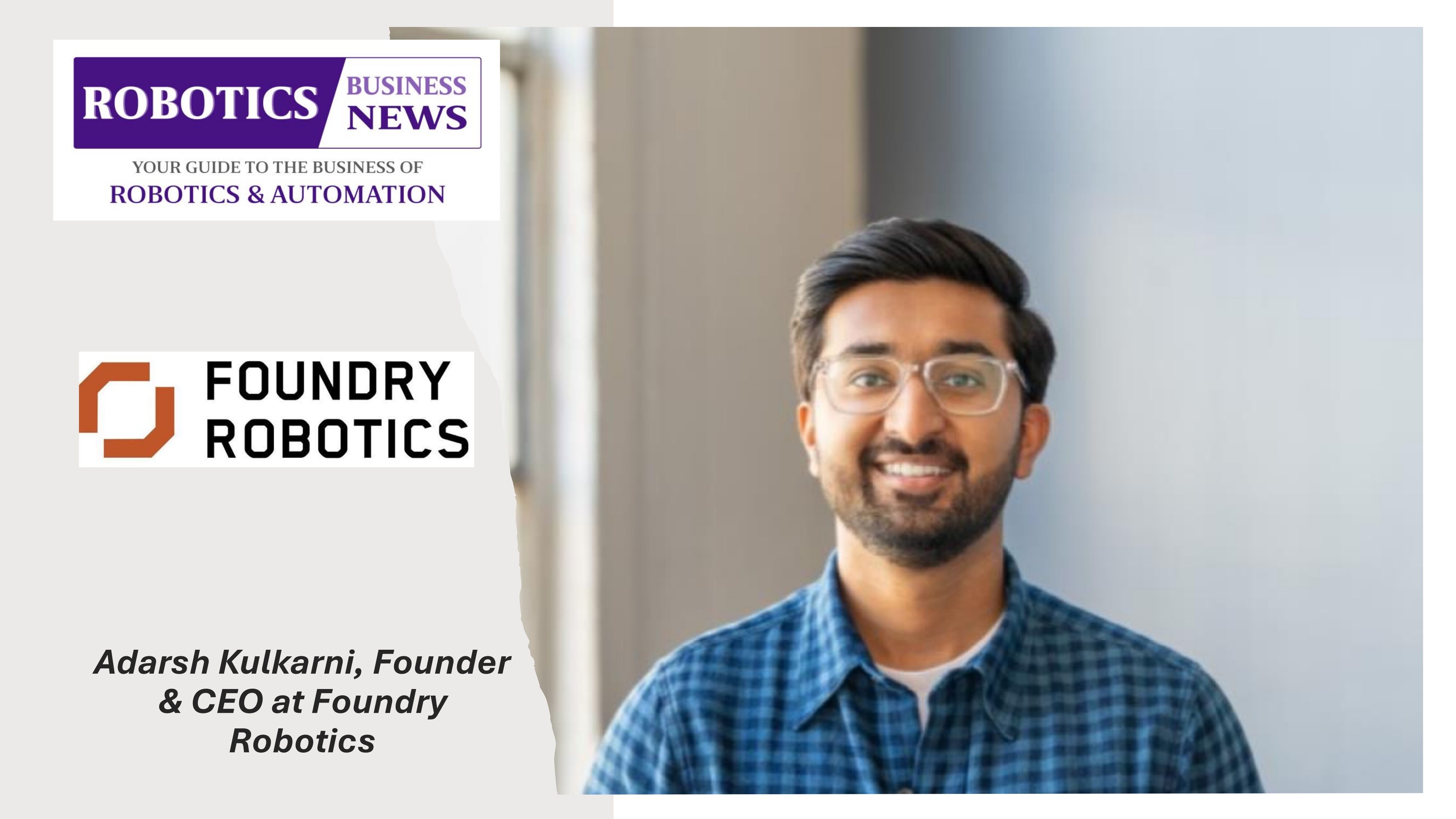
In conversation with Robotics Business News, Adarsh Kulkarni, Founder & CEO of Foundry Robotics, discusses its $100 million Series A funding, Physical AI-powered assembly, FoundryOS, and the future of flexible, autonomous manufacturing.
Foundry Robotics is transforming U.S. manufacturing with AI-powered autonomous factories designed for flexible, high-mix assembly. Backed by $100 million in Series A funding, the company aims to provide scalable domestic manufacturing capacity through its Manufacturing-as-a-Service model. In conversation with Robotics Business News, Adarsh Kulkarni, Founder & CEO of Foundry Robotics, discusses Physical AI, robotic assembly, FoundryOS, factory automation, and the technical challenges of autonomous production. He also shares his vision for accelerating hardware innovation, strengthening supply chains, and reshaping the future of global manufacturing.
What inspired Foundry Robotics to build an autonomous factory for assembly, and what gap in U.S. manufacturing is the company aiming to address?
Most factories in America are built to make one thing. When the product changes, retooling the line can take months and enormous investment. Even at Tesla, retooling for a new car costs hundreds of millions of dollars. Meanwhile, the companies designing the next great drone, satellite or battery are stuck, because manufacturing is so hard that it holds back design.
I’ve spent my career in robotics, from building robots for the Defense Department to leading robotics at Scale AI. My co-founder ran the Model Y program at Tesla. We saw two things happening at once: robots were finally starting to work, and the U.S. needed far more manufacturing capacity than exists today. If we have to build new factories anyway, we should build them from the ground up around AI and robotics. Foundry is built to close that gap. Through our Manufacturing-as-a-Service model, we give hardware companies domestic assembly capacity that can take on new products quickly, without building their own factory.
How will the $100 million Series A funding accelerate Foundry Robotics’ technology development, factory deployment, and commercial expansion?
The funding goes to three things. First, building out our new 130,000-square-foot factory in Emeryville so we can take on more customers and more products. Second, getting physical AI foundation models deployed into real-world manufacturing faster: fine-tuning them for assembly, collecting data from every production run, and building the tools our robots need. That includes our own end-of-arm tooling, like a torque-sensitive, manufacturing-grade fastening tool tied directly into FoundryOS. Third, growing the team across robotics research, engineering and factory operations, from robotics PhDs to experienced manufacturing experts.
On the commercial side, more capacity lets us say yes to more customers and new kinds of work. Customers come to us to fill gaps in their supply chain, and wire harnessing is one example.
What does an “autonomous factory for assembly” look like in practice, and which manufacturing processes are designed to operate with the highest levels of autonomy?
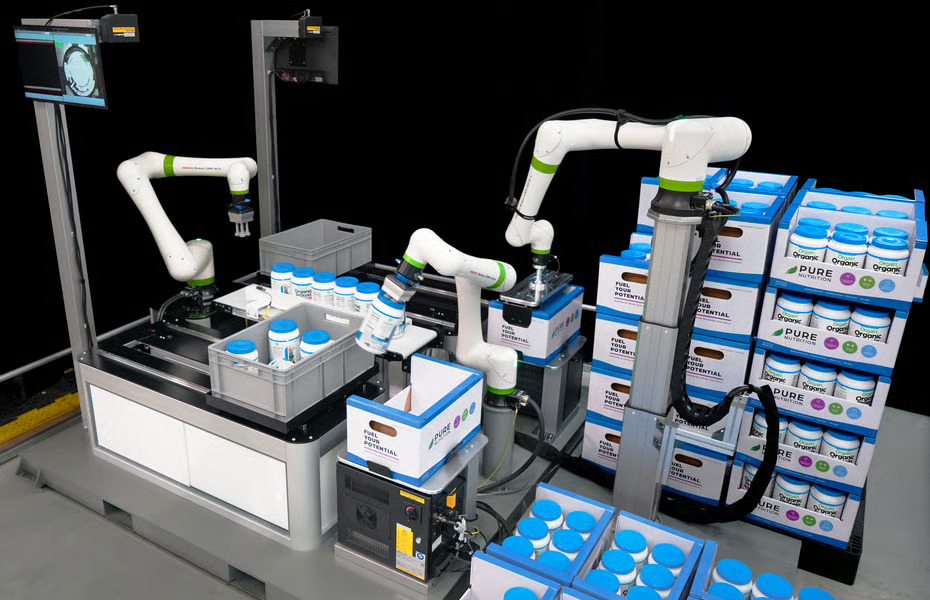
Walk into a Foundry facility and you’ll see a grid of robotic work cells. Some are building drones, some are building batteries, some are building self-driving car hardware, all under one roof. Each cell has two robot arms and the compute to run it, with GPUs under each cell and a small data center off to the side. Mobile robots move parts between the robotic cells and our technicians.
Autonomy is built around the core building blocks of assembly: fastening, pick-and-place, dispensing, cabling and putting components together. Those tasks repeat across nearly every product, so the robots get better at them with every production run. It isn’t all robotic. Human technicians handle the finest, most intricate work that robots can’t do yet, and our QA teams work alongside the system.
How are AI, robotics, computer vision, and intelligent software integrated to enable autonomous assembly operations?
It all runs as one system. We take best-in-class robotics foundation models and fine-tune them for manufacturing, training them on specific assembly tasks rather than specific products. They run on robotic cells with dedicated compute and on tooling we design in-house, like our fastening end effector.
FoundryOS ties it together. It’s our proprietary orchestration software that connects the robots, the factory floor and the cloud. It decides which job goes to which robot or technician, tracks whether parts and supplies are in, and handles data collection and model training. It’s also what customers see: a live dashboard showing what was built today, what’s delayed and why. Because everything runs through one system, the more products we build, the better we get at building all products.
What are the biggest technical challenges in creating a factory that can autonomously handle complex, variable, and high-mix assembly tasks?
There’s a big gap between a robotics demo and production. For robots to make a real dent in the economy, they need uptime around the clock, speed, reliability and scale. Reliability is where we’re focused first. The difference between 90% and 99.99% reliability is a thousand times fewer errors, and that matters when you’re building products for critical industries.
The second challenge is orchestration. Getting two robot arms to build something is one problem. Getting hundreds or thousands of robots and technicians to work together across sites is a much harder one, and nobody has really solved it. You’re constantly scheduling jobs across different robots and people while tracking parts and suppliers. Traditional manufacturers throw large teams of people at that. We’ve built FoundryOS to handle it.
How does Foundry Robotics plan to ensure that autonomous manufacturing systems remain flexible enough to adapt to new products and changing production requirements?
We specialize in the process and generalize in the product. Traditional automation programs machines to do one thing over and over, and manual lines train people on one specific task. Both are rigid. We don’t focus on any one product. We train our AI on the building blocks of manufacturing. A model that gets very good at fastening or cabling can do that for many different products.
That’s why we can build drones on Monday, batteries on Tuesday, and satellites on Thursday. Customers go from design to production in weeks, with no new line or retooling.
What role could autonomous factories play in strengthening U.S. manufacturing capacity and building more resilient domestic supply chains?
The U.S. simply needs more manufacturing capacity, and we can’t get there by retrofitting old factories alone. Foundry does critical work in defense, energy and telecom. Our customers are experts at designing hardware, but they can’t get it assembled fast enough domestically. We give them that capacity without asking them to build a factory of their own.
We also strengthen the supply chain around each product. Parts come to us, and we inspect them for quality, confirm counts and grade suppliers so customers know where the risks are. When we see gaps that are holding the industry back, we can move quickly to fill them. If we can build almost anything at scale here, it lowers the cost of critical goods and makes the infrastructure we all rely on more reliable.
Looking ahead, how does Foundry Robotics envision autonomous factories and Physical AI transforming the future of global manufacturing?
What AWS did for compute, we want to do for manufacturing. No software engineer starting a company today worries about scaling their own data center. In a few years, I want hardware founders to think about manufacturing the same way: you plug into Foundry, and scaling just works.
Robotics is finally reaching the point where it can do real work in factories, not just in demos. When production becomes that flexible, it changes what’s possible. Companies can bring new products to market faster, and the cost of high-value goods, from medical devices to energy and infrastructure, comes down. Our goal is to be the manufacturing layer any hardware company can plug into, so building in America is faster and cheaper than anywhere else.