Harpak-ULMA Advances Robotic Automation for Hygienic Food Packaging
30 October 2026 | Interaction | By Editor Robotics Business NEWS <editor@rbnpress.com>
Dan Feeney and Horia Saulean explain how robotic loading, vision technology and integrated controls improve packaging flexibility, hygiene and production efficiency.
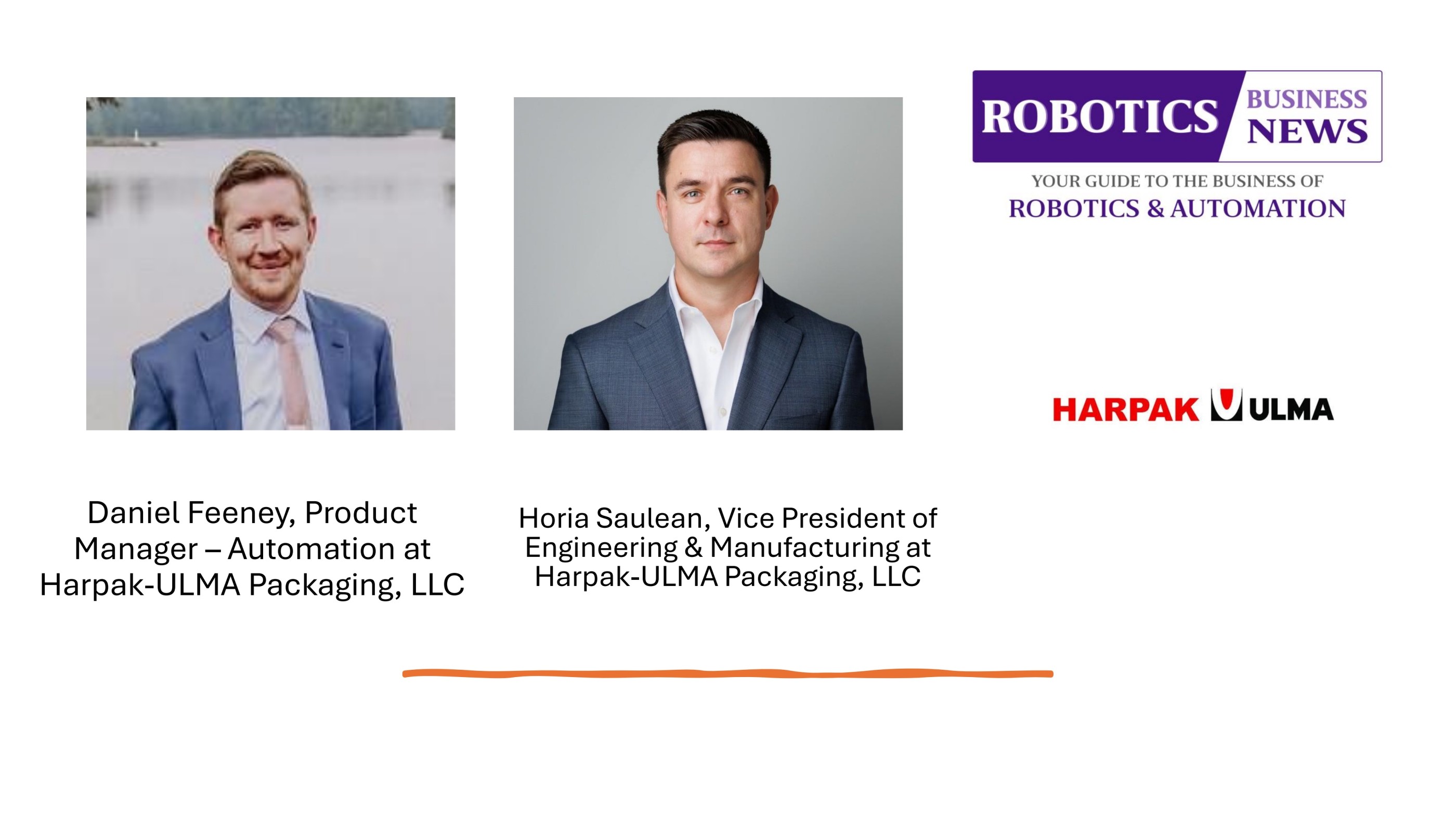
In an exclusive conversation with Robotics Business News, Daniel Feeney, Product Manager – Automation, and Horia Saulean, Vice President of Engineering & Manufacturing at Harpak-ULMA Packaging, LLC, discuss advances in robotic loading for food packaging.
They explain how hygienic design, 2D and 3D vision, Rockwell Automation controls and configurable engineering can help manufacturers improve productivity, simplify maintenance and adapt to changing packaging requirements.
What motivated Harpak-ULMA to develop a purpose-built hygienic robotic loading platform, and what key challenges in food packaging is it designed to solve?
Food manufacturers are under increasing pressure to maintain productivity despite persistent labor shortages, rising operating costs, greater product and packaging variety, and tighter production requirements. While robotic automation can address many of these challenges, implementing it has traditionally involved significant application-specific engineering, integration complexity, and ongoing maintenance considerations. For manufacturers operating multiple packaging formats or working within existing facilities, those challenges can make automation investments more difficult to justify.
Harpak-ULMA Packaging developed its robotic loading platform to address these barriers by making automation more repeatable, adaptable, and practical to deploy and support. Rather than approaching each robotic application as an entirely custom engineering project, we wanted to establish a common architecture that could be configured around the customer's products, packaging equipment, available floor space, and production requirements.
A central consideration was integrating robotics into the complete packaging process. A robot may perform its assigned task consistently, but its effectiveness ultimately depends on how well it interacts with upstream product handling, packaging machinery, and downstream operations. Integrating these elements is essential to maintaining consistent production and avoiding bottlenecks that can undermine the value of automation.
Food packaging also presents specific engineering challenges. Products can vary in size, shape, orientation, and handling characteristics, while demanding sanitation environments require equipment designed for accessibility, cleanability, and effective drainage. Our platform addresses these requirements through application-selected vision technology, product-specific end-of-arm tooling, and a purpose-built hygienic stainless-steel structure.
Equally important was developing a system that plant personnel could operate, troubleshoot, and maintain using familiar technologies. By incorporating Rockwell Automation-based controls and a parametrically configurable mechanical architecture, the platform is designed to simplify application engineering while supporting integration with existing packaging operations.
Our motivation was to help manufacturers move beyond isolated robotic installations toward a more practical, scalable approach to packaging automation. The objective is not simply to automate individual handling tasks, but to provide a flexible foundation that can support consistent production, changing operational requirements, and long-term investment value.
How does integrating robot motion directly into the Rockwell Automation PLC and Logix environment simplify deployment, programming, and maintenance for packaging plants?
Traditionally, integrating robotics into a packaging line can involve separate control systems, proprietary robot programming environments, and additional communication between the robot controller and surrounding equipment. While these approaches are well established, they can introduce complexity during system development, commissioning, and troubleshooting, particularly when plant personnel must work across different programming platforms.
Harpak-ULMA's standard robotic architecture takes a different approach by programming robot motion directly within the Rockwell Automation PLC using the Logix environment. This brings robotic motion and packaging equipment control into a common programming framework, allowing engineers to coordinate the robot, product infeed, and packaging machinery without relying on a separate proprietary robot programming environment for motion control.
For system development and deployment, this approach provides a more consistent foundation for engineering and integrating robotic loading applications. Rather than treating the robot as a separate automation system, developers can coordinate its operation with surrounding equipment using familiar Rockwell programming tools. For example, the PLC can synchronize the robot's picking position with products moving along a conveyor, coordinating both motions directly within the same control system without exchanging motion commands between separate controllers. This level of coordination is particularly valuable in high-speed packaging applications, where precise timing and product positioning are essential to maintaining consistent loading operations.
The maintenance advantages are equally important. Many North American manufacturing facilities already use Allen-Bradley controllers and Rockwell Automation software throughout their operations. Extending that environment to robotic loading allows plant engineering and maintenance personnel to apply existing programming knowledge and troubleshooting practices to a larger portion of the packaging line.
A common controls environment also provides opportunities for more consistent diagnostics and access to operating information, helping maintenance teams investigate problems involving robotic motion, product transfers, or interactions with adjacent packaging equipment.
The objective is to make robotics easier to integrate and support within the plant's existing automation infrastructure. By reducing dependence on unfamiliar programming environments and building on established Rockwell technologies, manufacturers can approach robotic loading with greater continuity between system development, commissioning, and day-to-day maintenance.
What specific engineering challenges arise when designing robotic systems for demanding washdown and food-hygiene environments?
One of the greatest engineering challenges in designing robotics for food packaging is ensuring that equipment can withstand demanding sanitation procedures without compromising its mechanical integrity, accessibility, or operational performance. In washdown environments, hygienic design must be considered from the beginning because the structure, component selection, and equipment layout all influence how effectively a system can be cleaned and inspected.
A primary consideration is eliminating areas where moisture, food particles, and other residues can accumulate. Conventional robotic cells may incorporate enclosed tubular framing, horizontal surfaces, or difficult-to-access structural features that complicate sanitation. Properly sealed tubular structures can be suitable, but concerns arise if moisture develops internally through condensation or enters through compromised seals.
Harpak-ULMA addressed these challenges by developing a purpose-built hygienic architecture using open, bent-plate stainless-steel construction rather than conventional tubular framing. The design emphasizes sloped, self-draining surfaces and accessible structural elements to reduce potential accumulation points and facilitate cleaning and inspection.
Component selection presents another challenge. Robotic systems depend on motors, drives, sensors, electrical connections, and other components that must remain reliable despite exposure to water and cleaning procedures. Our hygienic platform incorporates appropriately protected components, including IP69K-rated components for demanding washdown conditions, along with gasketed mounting interfaces designed to help protect connection points from moisture intrusion. Their placement, along with the routing of utilities and electrical connections, must also account for sanitation access and protection from environmental exposure.
Engineers must also consider how hygienic requirements interact with the robot's primary function. The cell must provide adequate access for cleaning and maintenance while accommodating robotic movement, product handling, guarding, and integration with surrounding packaging equipment. A hygienic design that unnecessarily restricts accessibility or complicates routine maintenance can introduce operational challenges of its own.
The engineering objective is to make cleanability an inherent characteristic of the robotic system rather than an accommodation added after the mechanical design is complete. By considering structural geometry, drainage, component protection, and accessibility together, manufacturers can deploy robotic automation better suited to the sanitation demands of modern food-packaging environments.
How do 2D and 3D vision technologies enable the platform to locate, inspect, pick, and load products at high speeds?
Vision technology plays a critical role in high-speed robotic loading because food products rarely arrive in perfectly uniform positions or orientations. Differences in product size, shape, spacing, and presentation can make consistent handling difficult, particularly when packaging equipment must operate at high production rates. By identifying product characteristics and communicating that information to the robotic system, vision enables more adaptable picking and loading operations.
Harpak-ULMA's platform supports both 2D and advanced 3D vision, with camera selection and inspection capabilities determined by the specific application and customer requirements. Two-dimensional color vision is particularly useful for identifying product location and orientation while performing visual inspections based on characteristics such as color, appearance, defects, labels, and the presence or absence of specific features.
Three-dimensional vision adds depth and dimensional information, making it especially valuable when products vary in height, shape, or physical presentation. For example, in a chicken breast loading application, 3D vision could evaluate product thickness, shape, and volume to identify portions that fall outside acceptable limits before loading. This information could also support volume-based mass estimation, although that capability would require product-specific calibration and validation to establish reliable results. Such inspection functions would be evaluated and engineered according to the requirements of each application.
In either configuration, the vision system identifies relevant product information and communicates it to the robotic controls. That information helps guide the robot toward the appropriate picking position and orientation, while product-specific end-of-arm tooling provides the handling method required for the application. Together, these technologies allow the system to locate, acquire, orient, and load products into downstream packaging equipment, including thermoformers, tray sealers, and flow wrappers.
At higher production rates, successful operation depends on more than the speed of the robot itself. Vision, product presentation, tooling, robotic motion, and packaging equipment must work together to maintain consistent product flow. By selecting the appropriate vision technology and integrating it into the broader packaging process, manufacturers can accommodate product variability while supporting reliable, high-speed loading.
How does the platform’s configurable, parametric architecture help manufacturers adapt robotic loading to different products, packaging formats, and production layouts?
The primary advantage of a parametric architecture is that manufacturers can obtain a robotic loading system engineered around their production requirements without treating every application as an entirely new design project. Instead of starting with a fixed robotic cell and asking the customer to accommodate it, Harpak-ULMA can configure the platform around the products being handled, the packaging equipment receiving them, and the physical constraints of the facility.
Parametric design allows key dimensions, including cell length, width, and height, to be adjusted during engineering and manufacturing while retaining a common underlying architecture. This is particularly valuable in existing production facilities, where available floor space, conveyor arrangements, equipment access, and line configurations can limit automation options. The objective is to accommodate those constraints while reducing the amount of application-specific engineering required.
Product and packaging requirements also influence how the system is configured. Loading fresh poultry into a thermoformer, for example, presents different handling considerations than transferring uniform snack products into a flow wrapper. The platform can accommodate these differences through application-specific end-of-arm tooling, appropriate vision technology, and robotic loading arrangements designed around the product and its destination.
The architecture is also designed to accommodate different levels of production demand. While the single-robot platform is available today, planned multi-robot configurations would allow manufacturers to expand loading capacity without duplicating every element of the system. These configurations are designed to share infrastructure, including the PLC, HMI, network, recipes, diagnostics, electrical enclosure, utilities, and common mechanical and conveying components. Additional robots would require their own motion hardware and end-of-arm tooling, with shared systems appropriately sized for the application and number of robots.
Importantly, parametric configuration does not mean the physical cell automatically changes dimensions or rearranges itself during production. These adjustments are made during system design and manufacture. Product changeovers and future modifications still depend on the equipment configuration, tooling, controls, and requirements of the specific application.
For manufacturers, the practical benefit is a more predictable engineering and deployment process. By combining configurable engineering with established mechanical and controls architecture, Harpak-ULMA can address different products, packaging formats, and facility layouts while reducing unnecessary customization and providing a foundation for future automation requirements.
What opportunities do you see for extending this robotic platform beyond food packaging into applications such as medical devices, cartoning, and case packing?
Although food packaging was a primary focus in developing the platform, the underlying engineering principles are applicable to a much broader range of automated handling and packaging operations. The opportunity lies in adapting the available single-robot platform to different products, processes, and production environments rather than developing an entirely separate automation solution for each industry. These applications would require project-specific engineering for product handling, feeding, vision inspection, and integration with the surrounding packaging equipment.
Medical-device packaging is one potential application. Manufacturers often need precise, repeatable product placement into thermoformed packages or other packaging formats, with careful consideration given to product handling, orientation, and inspection. The platform's configurable architecture, vision capabilities, and application-specific end-of-arm tooling provide a foundation for addressing these requirements, although the appropriate configuration would need to be engineered for each application. Any medical application would also need to be validated against its specific cleanliness, product-protection, and regulatory requirements.
Cartoning and case packing offer additional opportunities, particularly as manufacturers look to automate repetitive loading and downstream handling operations. The same principles used to locate, pick, orient, and place products into primary packaging can be adapted to transferring packaged goods into cartons or cases, provided the robotic configuration and tooling are appropriate for the application.
Importantly, the platform includes a general-purpose configuration alongside its hygienic design, allowing the underlying architecture to serve applications that do not require demanding food-production washdown capabilities.
Our longer-term objective is to extend the value of a repeatable automation platform across more of the packaging process. By retaining a consistent engineering and controls foundation while adapting the mechanical configuration, vision, and tooling to each application, we see opportunities to help manufacturers automate additional handling operations without approaching every project as a completely new system.
How important is a common controls architecture for helping manufacturers build, operate, troubleshoot, and scale robotic automation using existing plant engineering skills?
A common controls architecture is important because the long-term success of robotic automation depends on more than the equipment's technical capabilities. Manufacturers must also consider whether their engineering and maintenance teams can operate, troubleshoot, and support the system throughout its service life.
Many packaging facilities already have considerable experience with Allen-Bradley controllers and Rockwell Automation programming tools. By extending that familiar environment to robotic loading, manufacturers can build on existing plant expertise rather than introducing an entirely separate set of programming and maintenance requirements.
This becomes particularly valuable when production problems occur. A robotic loading cell does not operate independently of the equipment around it. Product presentation, conveyor operation, packaging machinery, and robotic motion all influence overall performance. Across multiple installations, a common controls foundation also helps engineering teams standardize diagnostics, training, and escalation procedures.
Supportability also extends beyond the plant itself. Rockwell Automation's established North American network of distributors, technical specialists, and available components provides additional resources when manufacturers need assistance. This is especially important for operations that may not have dedicated robotics specialists available on every shift.
As manufacturers expand automation, a consistent controls approach can also reduce the complexity associated with supporting multiple robotic installations. Engineering teams can apply familiar tools, programming practices, and maintenance knowledge across additional equipment rather than continually adapting to unrelated control environments.
A common architecture does not eliminate the need for robotics expertise or guarantee that every machine operates through a single controller. However, it can make that expertise easier to develop and apply within the plant's existing engineering organization.
The goal is to make robotic automation something manufacturers can confidently own and support over the long term, rather than technology that remains heavily dependent on outside specialists for routine operation and troubleshooting.
Looking ahead, how do you see robotics, vision, and integrated automation transforming high-speed packaging operations and enabling more flexible production?
The next major advancement in packaging automation will not simply come from making individual machines faster. It will come from enabling equipment to respond more intelligently to changing products, production conditions, and operational demands while maintaining consistent performance across the entire packaging line.
Manufacturers are increasingly managing shorter production runs, greater SKU variety, labor constraints, and more frequent changeovers. These pressures create a need for automation that can accommodate variability without requiring extensive manual intervention or repeated engineering changes.
Robotics and vision will play an important role in that evolution. As vision technologies become more capable, robotic systems will be better equipped to identify variations in product size, shape, orientation, and presentation. Combined with appropriate tooling and motion control, these capabilities can help manufacturers handle a broader range of products while maintaining the accuracy and consistency required for high-speed packaging.
We also see significant opportunities in connecting robotic systems more closely with the equipment around them. Rather than optimizing each machine independently, future packaging lines will increasingly use shared operating information to coordinate product flow, recognize developing bottlenecks, and respond more effectively to changing production conditions.
Another important development will be making automation more accessible to the people responsible for operating and maintaining it. Through Harpak-ULMA's broader work with Rockwell Automation, we are exploring how machine-level intelligence, contextual diagnostics, and digital work instructions could help operators navigate setup procedures, troubleshoot faults, and recover from interruptions more consistently. Over time, more advanced analytics could also help manufacturers identify potential problems before they result in extended downtime.
For Harpak-ULMA, the direction is toward packaging systems that combine mechanical flexibility with greater operational intelligence. Our robotic loading platform establishes a foundation through configurable engineering, vision-guided handling, and integrated controls. The longer-term opportunity is to build on that foundation with equipment that can better coordinate its operation, support plant personnel, and adapt to changing production requirements.
The future of high-speed packaging is not just greater throughput. It is the ability to maintain productive, reliable operations as manufacturing becomes more complex.