Lincoln Electric Brings Physical AI to Robotic Welding with XpertLINC, Transforming Industrial Automation
24 November 2026 | Interaction | By Editor Robotics Business NEWS <editor@rbnpress.com>
Jeff Knoll discusses how Lincoln Electric's XpertLINC platform uses Physical AI, intelligent sensing, and adaptive welding technology to simplify robotic automation, improve weld consistency, and advance manufacturing productivity.
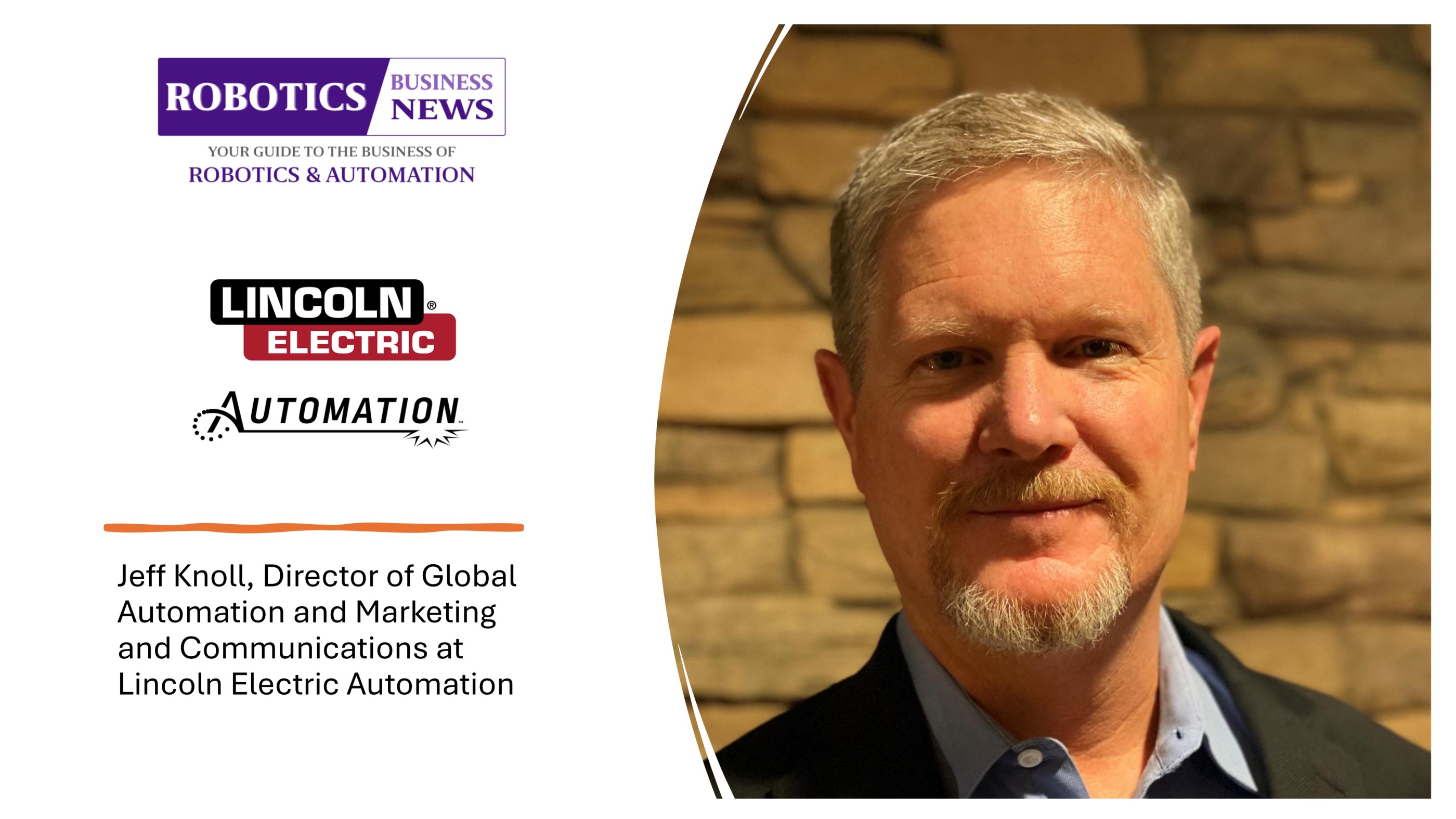
Robotic welding is evolving as Physical AI brings greater intelligence, adaptability, and flexibility to industrial automation. In an interview with Robotics Business News, Jeff Knoll, Director of Global Automation and Marketing and Communications at Lincoln Electric Automation, discusses the company's XpertLINC platform and its potential to transform robotic welding. Combining intelligent sensing, coordinated robot motion, welding-process control, and Lincoln Electric's welding expertise, XpertLINC enables robots to respond to real-world variations in joint geometry and part positioning. Knoll also explores simplified cobot operation, welding procedure validation, production efficiency, and the platform's expansion across automated welding and cutting applications.
What inspired Lincoln Electric to develop XpertLINC, and how does this Physical AI platform change the future of robotic welding and industrial automation?
The inspiration for XpertLINC™ came from a very practical manufacturing problem: traditional robotic welding is exceptionally repeatable, but the real world isn't. Parts move. Fit-up changes. Joint geometry varies. And the programmed path that worked perfectly for one part may not accurately represent the next one.
That creates a fundamental challenge. A conventional robot is very good at repeating what it has been programmed to do. A skilled welder does something different. A welder looks at the joint that is in front of them, understands the condition, and adjusts how the weld is made.
XpertLINC brings that kind of adaptability into robotic welding. It integrates sensing, coordinated robot motion, welding-process control and Lincoln Electric welding expertise into a Physical AI-enabled platform. The system evaluates actual joint conditions and develops the robot motion and welding parameters together, using sensor intelligence to coordinate how the robot and welding process respond and support repeatable execution.
That is the larger opportunity we see for Physical AI. Manufacturing automation should increasingly be able to respond to the physical world as it exists, rather than requiring the physical world to be made perfect for the automation.
For Lincoln Electric, there is another important distinction. We didn't approach this as a robotics company searching for a welding application. We started with the weld. Lincoln Electric brings more than a century of welding knowledge to the challenge and combines that expertise with automation controls, sensing and intelligent software.
That welding-first philosophy is at the heart of XpertLINC, helping bring more adaptable, repeatable robotic welding within reach.
XpertLINC enables operators to guide a cobot without traditional programming or CAD files. How does this approach simplify automation for manufacturers with limited robotics expertise?
For many shops, one of the biggest barriers to robotic welding isn't buying a robot. It is having the expertise, welding-process knowledge, and resources required to make that robot productive.
Traditional automation can require programming expertise, CAD resources, extensive setup and the ability to continually compensate when the physical part doesn't perfectly match what was programmed. Those requirements can be particularly difficult for manufacturers that don't have dedicated robotics engineers or programmers available.
XpertLINC changes the starting point. The physical part becomes the starting point for automation, not a robot program or CAD file.
The operator identifies the weld area and XpertLINC scans the actual joint. From that information, the platform evaluates thousands of potential weld strategies and develops coordinated robot motion and welding parameters within the customer’s authorized procedure requirements. As physical conditions change, XpertLINC can adapt the plan while remaining within the customer’s defined process constraints.
This approach addresses three persistent barriers to adoption: programming effort, welding-process knowledge and part-to-part variation.
That means we're shifting complexity away from the operator and into the system.
Our objective isn't to diminish welding expertise. Quite the opposite. We want manufacturers to use their skilled people where their knowledge creates the greatest value rather than requiring every person operating an automated welding cell to also become an expert robot programmer.
The simple way we think about it is to make robotic welding feel more like welding and less like programming.
How does the platform combine vision, sensor data, coordinated motion, and welding knowledge to identify joint geometry and generate optimized welding paths?
The XpertLINC workflow starts with the actual joint.
The system scans the part to capture its geometry and fit-up. It then interprets those physical conditions using Lincoln Electric welding knowledge and develops a coordinated welding strategy. That strategy includes both robot motion and the welding-process parameters rather than creating a robot trajectory in isolation. XpertLINC then commands motion and arc behavior together within the established process window.
We've described that workflow simply as Scan → Understand → Plan → Command.
The important distinction is that finding the joint isn't the same as understanding the weld. A sensing system can determine where something is located. Welding intelligence must go further by determining how robot movement and the welding process need to work together based on the actual joint conditions.
Our Physical AI work is intended to bridge that gap. The system isn't merely moving a robot to coordinates. It is using information from the physical weld joint to develop the motion and process required to make that weld.
That's what we mean when we say XpertLINC commands the motion and the arc as one.
How does XpertLINC adapt to variations in part fit-up, joint geometry, and material positioning while maintaining consistent weld quality?
This is one of the fundamental problems XpertLINC was designed to address.
Traditional automation works very well when the physical part closely matches the conditions for which the system was originally programmed. In fabrication, however, the actual joint can vary because of fit-up, part positioning and geometric differences.
Instead of assuming that every part is identical, XpertLINC scans the actual joint and uses that information to establish the welding strategy. For supported applications, the system deterministically adjusts robot motion and welding parameters to respond to those measured conditions while operating within established procedure boundaries. In multipass applications, it can rescan as weld geometry changes between layers rather than assuming the original geometry remains unchanged throughout the entire weld.
There is also an important quality control element. Before welding begins, XpertLINC can compare measured joint conditions with the requirements of an available welding procedure and identify a condition that falls outside the supported range for correction or authorized review.
Adaptation doesn't mean allowing the robot to make unrestricted changes. Adaptability occurs inside defined welding-process boundaries.
How does the platform use customer-defined Weld Procedure Specifications (WPS) to ensure that adaptive welding remains within approved process parameters?
This is a particularly important part of the XpertLINC story because adaptability cannot come at the expense of welding-process control.
XpertLINC can automatically evaluate scanned weld-joint conditions against the selected Welding Procedure Specification, develop a coordinated welding solution within established limits, and identify conditions that require review before welding begins. That capability is what we've described as Autonomous WPS Validation™.
There is an important responsibility distinction, however.
Lincoln Electric provides WPS programming intended for general fabrication applications, and customers can create and use approved customer-specific WPSs and joint-specific welding strategies when required. In both scenarios, the manufacturer remains responsible for determining and validating whether the selected welding procedure is appropriate for its specific application and meets applicable codes, standards, specifications, quality requirements and regulatory obligations. XpertLINC does not replace that engineering or qualification authority.
Once those process boundaries are established, XpertLINC can use its control of robot motion and the welding process to make adjustments while remaining aligned with those requirements.
In practical terms, we are trying to give manufacturers adaptability with guardrails.
What safety, reliability, and data-security measures have been built into XpertLINC for deployment in industrial production environments?
Industrial AI must meet a very different standard than a consumer AI application. In manufacturing, intelligence ultimately results in physical action.
For that reason, safety, reliability and data segregation were designed into the XpertLINC architecture rather than treated simply as software features added afterward. Our launch materials specifically identify those three areas as integral elements of the industrial AI platform.
Another important architectural principle is where welding decisions are made. XpertLINC information is being processed at the welding cell so the platform can interpret physical conditions and support timely execution without depending on cloud connectivity for welding decisions.
At the welding-process level, XpertLINC operates within defined procedure requirements rather than giving an AI system unrestricted authority over welding parameters. Conditions outside supported procedure limits can be identified for correction or authorized review before welding proceeds.
What benefits can manufacturers expect in terms of productivity, reduced rework, operator training, and automation adoption, particularly in low-volume and high-mix production?
No two joints are exactly alike, but traditional robotic welding depends on keeping actual conditions close to what was programmed. In low-volume, high-mix production, the effort required to manage that variation can be especially difficult to justify.
If every new part requires significant programming, teaching and setup, manufacturers have to spread that engineering effort over relatively few pieces. Part-to-part variation and rework can make the automation equation even more difficult.
XpertLINC is designed to change that equation by simplifying the path from a physical part to robotic weld execution. The platform does not require traditional robot programming techniques or CAD models. It develops a coordinated welding solution within the customer’s defined requirements and identifies conditions that require correction or authorized review.
We see four primary value areas: better parts with fewer problems, faster operator adoption, increased productivity and confidence in the welding process.
There can also be a workforce benefit. By absorbing more of the automation complexity into the platform, XpertLINC makes robotic welding more accessible to shops without dedicated robot programmers or extensive automation resources. The system is intended to help operators become productive faster and allow skilled welding personnel to focus their knowledge on the applications and problems where that expertise adds the greatest value.
XpertLINC is initially launching on Cooper welding cobots. What are Lincoln Electric’s plans to expand the platform across its wider robotic welding and automated cutting portfolio?
Cooper® welding cobots are the first implementation of XpertLINC, not the limit of the platform.
We intentionally developed XpertLINC as a platform architecture, with Cooper® welding cobots providing an accessible first deployment. From the beginning, the strategy has been to establish a foundation that can extend to additional Lincoln Electric automated products and applications over time.
Following the initial Cooper welding cobot introduction, XpertLINC is intended to expand across Lincoln Electric's broader portfolio of automated cutting and welding solutions.
What is more important than naming the next product is the architecture behind that expansion. XpertLINC brings together sensing, intelligent interpretation of physical conditions, coordinated motion and process control. Its architecture separates these core capabilities from the application-specific layer, allowing new welding and cutting applications to build on a common foundation rather than recreating the underlying controls, intelligence, and system functionality each time. That creates the opportunity to apply the same philosophy to other areas where automation has to understand and react to physical variation.
We see Cooper as the first expression of XpertLINC, not the final destination.
As additional applications are validated, we'll expand deliberately where this combination of Physical AI, process knowledge and automation can solve meaningful manufacturing problems.