Bridges Fund Management Backs AI-Powered Robotics for Sustainable Manufacturing
26 October 2026 | Interaction | By Editor Robotics Business NEWS <editor@rbnpress.com>
Christophe Defert explains how AI-powered 3D vision enhances industrial robotics, boosts manufacturing efficiency, reduces waste, and supports sustainable automation.
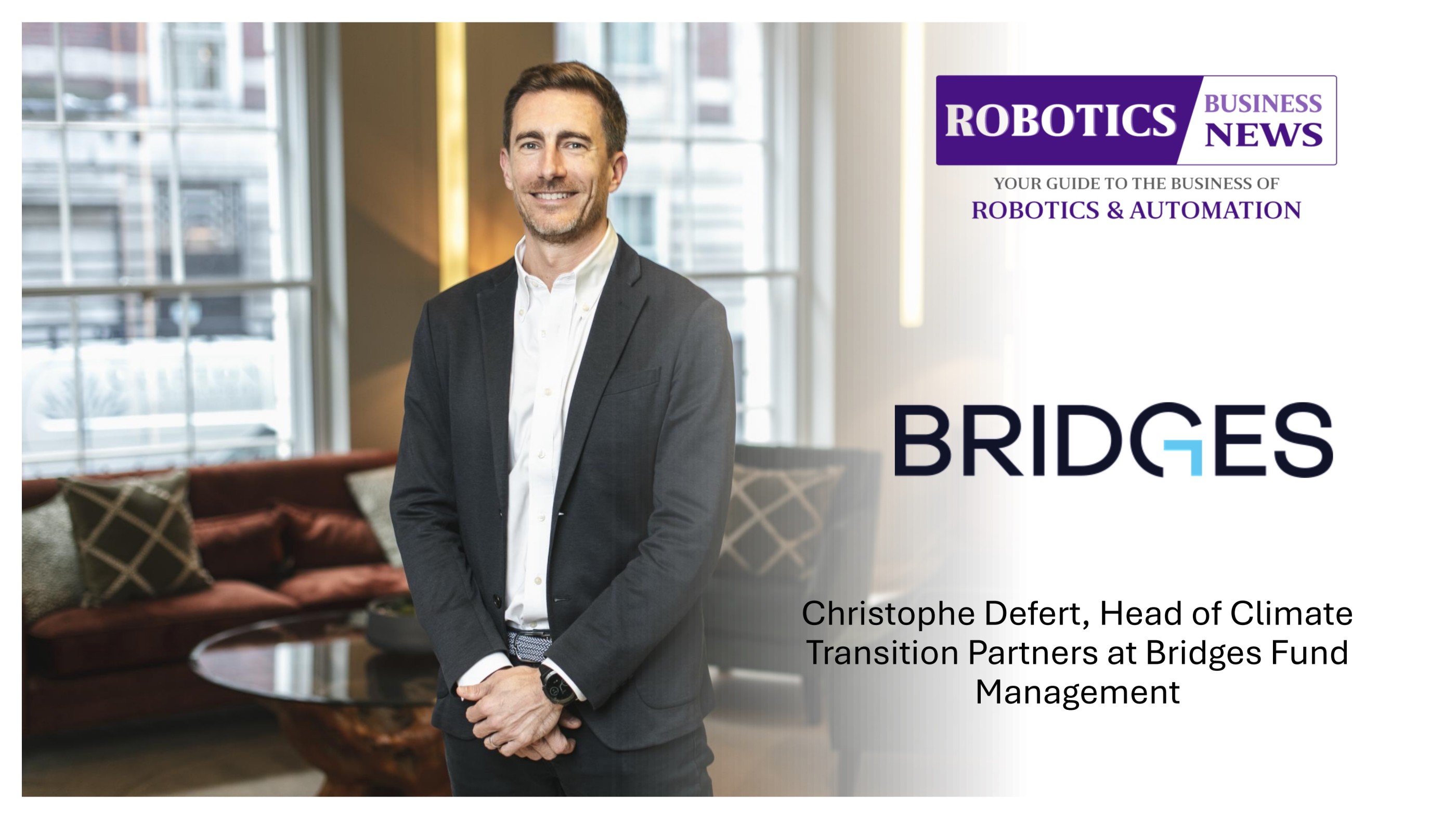
In an exclusive conversation with Robotics Business News, Christophe Defert, Head of Climate Transition Partners at Bridges Fund Management, discusses the investment potential of AI-powered robotics and Inbolt’s 3D vision technology.
He explains how intelligent vision can improve robot performance, reduce production downtime and material waste, and help manufacturers scale sustainable automation across automotive, electronics and data centre industries.
What attracted Bridges Fund Management to Inbolt, and what potential did you see in its AI-powered 3D vision technology for industrial robotics?
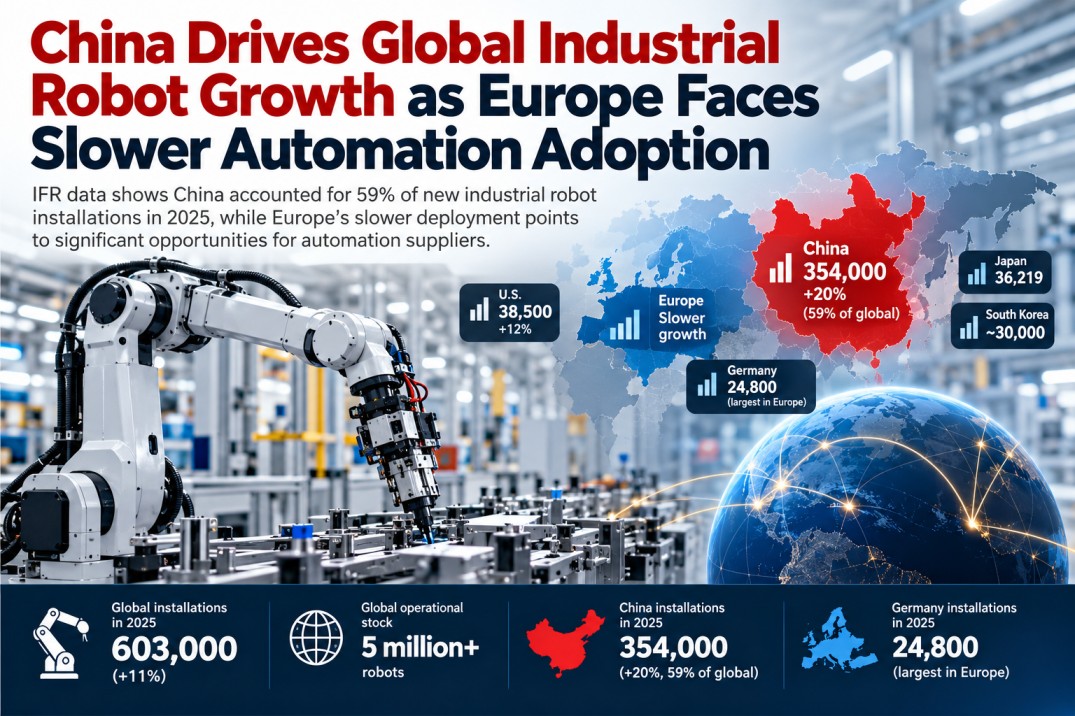
Three things stood out. The first was the scale of the problem. There are nearly five million industrial robots in factories worldwide, and the vast majority are effectively blind. They execute pre-programmed movements with great precision, but only if every part arrives exactly where it is expected. When a component shifts by a few millimetres, through line movement, vibration, heat or tooling wear, the robot stalls, throws an error or produces a defective part. Manufacturers have traditionally worked around this by building expensive precision fixtures around each robot; but that locks factory layouts in place and makes lines slow and costly to change.
The second was the elegance of Inbolt's solution. Rather than asking manufacturers to rip out their existing automation, Inbolt adds a perception and intelligence layer to the robots they already own. A robot-mounted 3D camera and an edge controller running Inbolt's proprietary AI model locate each part in real time and continuously correct the robot's trajectory, even on a moving line. Crucially, a new part can be set up in minutes from its CAD file, with no data collection or labelling, and the system works across all the major robot brands. That combination of real-time control, speed of deployment and hardware-agnosticism is very hard to replicate.
The third was real-world evidence. Plenty of companies can produce an impressive lab demo; far fewer can show sustained performance in live production. Inbolt is already running on more than 200 robots across Europe, North America and Asia, for some of the most demanding manufacturers in the world.
For us, Inbolt is a textbook example of what we call the 'intelligence era' of climate technology: AI-native software that makes existing industrial hardware work far more efficiently, with commercial and environmental benefits that grow together.
How does Inbolt's technology align with Bridges' focus on investing in businesses that can deliver both commercial growth and positive environmental or social impact?
Bridges invests exclusively in scalable commercial solutions to the world’s biggest challenges. So we’re looking for companies where commercial success and positive impact are structurally linked – that is, that every additional sale drives incremental impact. That’s clearly the case for Inbolt. Within our Climate Transition Partners strategy, we’re particularly focused on three themes where we think AI and technology can help to scale these commercial solutions in a way that will accelerate the climate transition: Sustainable Manufacturing, Clean Energy & Transport and Adaptation & Resilience. Inbolt sits squarely within that first theme.
Manufacturing and industrial processes account for around a fifth of global carbon emissions and consume roughly half of the world's energy[1]. Much of that is lost to inefficiency. A robot that stalls or misplaces a part still draws power, holds up the line and creates rework or scrap, which means wasted materials and the energy embedded in them.
Manufacturers buy Inbolt because it improves uptime, quality and productivity. But the same mechanism that delivers that upside also results in less waste, less rework and less wasted energy. So the more robots Inbolt guides, the greater the environmental benefit. There is a second dimension too: by making production lines more flexible and less costly to run, Inbolt can help to bring down the cost of manufacturing – notably for electric vehicles, which is the value case for several of its automotive customers.
We hold ourselves to measuring this impact, not just asserting it. Our funds are aligned with Article 8 of the EU's Sustainable Finance Disclosure Regulation, and we will track Inbolt's impact through clear indicators, including the number of robots deployed and the tonnes of waste and associated emissions avoided through lower scrap rates. That discipline matters to our investors on both sides of the Atlantic, and it is increasingly valued by manufacturers themselves.
What does Inbolt's work with manufacturers such as Stellantis and Toyota demonstrate about the real-world potential of AI-enabled robotic perception?
Above all, it shows that AI-enabled perception is ready for production, not just for the innovation lab. That distinction matters enormously. Automotive is the most heavily automated sector in manufacturing but also one of the most conservative. Carmakers run high-speed, high-volume lines where a few minutes of downtime is extremely costly, so they hold new technology to a very high bar for reliability. Many robotics start-ups win pilots with automotive innovation teams; far fewer make the leap into everyday production. Inbolt has already made that leap in Europe, North America and Japan.
The Stellantis relationship illustrates how this works in practice. It began in 2023 with a single robotic station and has since expanded across multiple plants across several countries, with the same applications, such as bolt fastening, replicated from one line to the next. The New York Times recently reported that Inbolt's deployment helped a Stellantis assembly plant in Detroit become one of the company's top performers. Machines running Inbolt's system are reported to deliver up to 95% less downtime and 30% faster cycle times.
Toyota is equally significant, both because of its reputation for manufacturing excellence and because it extends Inbolt's footprint into Asia.
Together, these deployments demonstrate three things: that real-time perception delivers measurable gains in uptime and quality; that it can be deployed quickly by customers' own engineers without specialist vision expertise; and that once proven on one station, it scales rapidly across a plant and then a whole network of sister plants. That 'land-and-expand' dynamic is what turns a promising technology into a commercially scalable business.
How important is the ability to upgrade existing industrial robots with intelligent vision, rather than replacing entire automation systems, from an investment perspective?
It is central to the investment case, and it reflects a principle that runs through our whole strategy. After more than two decades of investment in climate and industrial hardware, the world now has a vast installed base of capable equipment. The biggest opportunity today is not to replace that hardware, but to make it work far better. That is the essence of what we call the ‘intelligence era’.
Industrial robots are a case in point. There are around five million in operation globally, representing an enormous sunk investment, yet the vast majority have no form of vision-based intelligence. Manufacturers are understandably reluctant to write off working equipment, or to bet their production lines on unproven new generalist robots. A solution that upgrades the robots they already own removes that barrier.
From an investor's perspective, this has several important consequences. First, the addressable market exists today, rather than depending on the timing of the next major capex cycle. Second, the economics for customers are compelling: integration and commissioning often account for a large share of the cost of a new robotic deployment, whereas Inbolt can be installed in hours and configured in minutes, without touching the wider production cell. That means a short payback period and a faster, easier sales process. Third, it supports a capital-efficient, software-led business model with recurring licence revenue, rather than a hardware business with heavy inventory and one-off sales.
There is also a sustainability dividend. Extending the useful life and productivity of existing equipment avoids the materials and embodied carbon involved in manufacturing replacement hardware. And because Inbolt also works on new robots, it is well placed as robot makers increasingly look to offer intelligent vision as a standard option. Universal Robots is a case in point: Inbolt's 3D vision now runs natively on UR's new Gen 7 cobot platform and is available through the UR+ marketplace.
What role do you believe AI-powered vision and Physical AI will play in improving manufacturing productivity, flexibility, and resource efficiency?
We think it will be one of the most important levers available to manufacturers over the next decade, on all three counts.
On productivity, the prize is reducing unplanned downtime. A 2025 ABB survey of 3,600 industrial leaders found that downtime can cost up to $500,000 an hour, with 44% reporting equipment-related stoppages at least monthly. Robots that can see and adapt in real time stall far less often and need much less human supervision, freeing skilled workers for higher-value tasks. That matters on both sides of the Atlantic, where manufacturers face persistent labour shortages and growing pressure to reshore production competitively.
On flexibility, factories increasingly need to build several product variants on the same line, as carmakers do with electric and combustion models. Traditional automation relies on fixed tooling and hard-coded movements, so every change is slow and expensive. Vision-guided robots can be retrained for a new part in minutes from a digital design file, making lines far easier to reconfigure.
On resource efficiency, fewer errors mean less scrap, less rework and less wasted energy. This will become more important over time: as vehicle fleets electrify and emissions from driving fall, the manufacturing phase becomes a much larger share of a vehicle's lifetime footprint.
We would add one note of realism. There is a lot of excitement around humanoids and general-purpose robot 'brains', and those technologies may well find a role in time. But production lines run high-volume, repetitive, tightly controlled processes that demand sub-millimetre precision and predictable, auditable behaviour. The near-term value lies in purpose-built intelligence that makes today's robots more capable and reliable. That is where Physical AI is already delivering returns, and where we expect the fastest adoption.
As Inbolt expands beyond automotive into areas such as electronics and data centres, what characteristics make these markets attractive for intelligent robotics?
Automotive was the right place to start: it is the densest, most demanding robotics market, and success there carries real credibility. But the problem Inbolt solves is not unique to cars. Wherever robots handle, assemble, fasten or dispense parts that are not perfectly fixed in place, the same blind spot exists, and those tasks make up the majority of the world's installed robots.
Electronics is attractive for several reasons. It is already one of the largest buyers of industrial robots globally. Production is high-mix and high-precision, with small, valuable components and short product cycles, so lines need to be reconfigured frequently. That plays directly to Inbolt's ability to set up a new part in minutes from a CAD file, without collecting training data. And because components are expensive, every defect avoided has a meaningful financial and material benefit.
Data centre hardware shares many of those characteristics, with an added sense of urgency. The global build-out of AI infrastructure is driving enormous demand for servers and racks, and manufacturers are under pressure to scale output quickly, often in new facilities in the US and Europe where skilled labour is scarce.
What were the key factors Bridges Fund Management evaluated when assessing Inbolt's technology, market opportunity, leadership team, and ability to scale internationally?
On technology, our central question was whether Inbolt's advantage would prove durable. We spoke to robot manufacturers, systems integrators, former executives at machine-vision incumbents and end customers. The consistent message was that closing the loop between perception and motion, feeding real-time corrections directly into a robot's control system on a moving line, is genuinely difficult, and not something incumbents currently offer. Inbolt's patent portfolio, which spans Europe, the US and Asia, plus the growing body of production data it accumulates with every deployment, both reinforce that lead.
On market opportunity, we looked beyond a top-down market size to the concrete accounts Inbolt can win and expand. With around five million industrial robots worldwide and only a small fraction equipped with vision intelligence, the headroom is substantial. Just as important is that land-and-expand idea: one station becomes a plant, and one plant becomes a network.
On leadership, we were impressed by the complementary strengths of the three co-founders, who met on the joint École Polytechnique and HEC Paris deep-tech programme. Rudy brings applied mathematics, Louis robotics and computer vision, and Albane finance and industrial strategy. Reference calls with customers and investors were consistently positive about their pragmatism and customer focus. They have also attracted senior industry advisors and senior hires ahead of their stage.
On international scale, this is a genuinely transatlantic business. The US is already a significant market for Inbolt – it has opened an office in Detroit with two co-founders relocating there – while it has a growing presence in Japan, too. It is also building partnerships with distributors and robot manufacturers that can multiply its reach.
Finally, as with every investment we make, we assessed the impact case rigorously, confirming that Inbolt's environmental benefits are real, measurable and grow with the business.
Looking ahead, what role can investors such as Bridges Fund Management play in helping robotics and Physical AI companies move from successful deployments to broader industrial adoption?
The hardest transition for any industrial technology company is not proving the product works; it is turning a handful of successful deployments into a repeatable, scalable business. Industrial customers are rightly cautious, sales cycles are tied to budget and capex calendars, and scaling requires building deployment and support capabilities across multiple countries at once.
Specialist investors can make a real difference here.
First, by providing patient, well-informed capital. Physical AI is attracting enormous investment, much of it chasing ambitious long-term visions. We think there is a strong case for backing companies solving concrete problems on today's factory floors, and for giving them the runway to convert pilots into plant-wide and network-wide rollouts without being forced into short-term decisions.
Second, by being genuinely hands-on. We deliberately make only a small number of investments each year, typically two to five, so that we can work closely with management teams.
Third, by opening doors. Our team operates across the US, UK and Europe, and our network spans manufacturers, industrial partners and co-investors on both sides of the Atlantic. That is particularly valuable for a European company building a major US presence.
Finally, by helping companies measure and articulate their impact. Clear evidence of reduced waste, energy use and emissions is not just a requirement for our investors. It’s increasingly part of the commercial case, as manufacturers face mounting pressure to decarbonise their operations and supply chains. The companies that can demonstrate both productivity and sustainability gains will be the ones that achieve broad industrial adoption.