e-con Systems Advances Robotics Vision with Next-Generation 3D Depth Cameras
05 November 2026 | Interaction | By Editor Robotics Business NEWS <editor@rbnpress.com>
Maharajan Veerabahu explains how embedded vision, 3D depth sensing and Edge AI are enabling smarter, more capable robots.
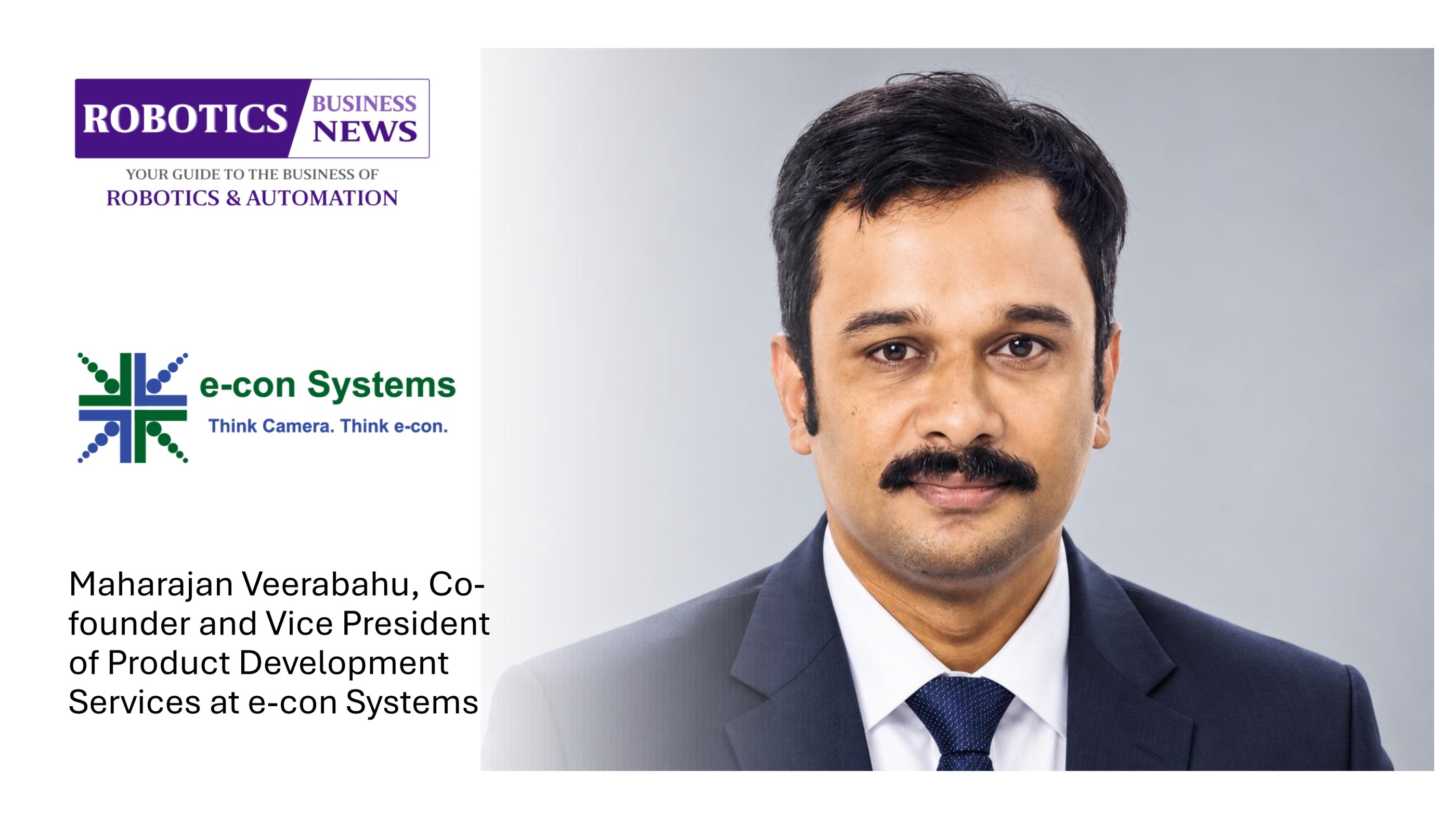
In an exclusive conversation with Robotics Business News, Maharajan Veerabahu, Co-founder and Vice President of Product Development Services at e-con Systems, discusses how advanced embedded vision, 3D depth cameras and Edge AI are shaping the future of robotics and Physical AI. Drawing on his experience in product design and embedded software development, he explains how e-con Systems is helping robots perceive, navigate and interact with real-world environments through solutions such as NetraVis.
With more than two decades of experience building e-con Systems into a profitable global technology company with over 350 employees, Veerabahu shares insights into the engineering challenges behind reliable robotic vision, including depth accuracy, multi-camera synchronization, AI processing and performance in demanding environments. He also explores emerging vision requirements across humanoids, AMRs, autonomous systems and industrial automation, and the growing role of integrated vision technologies in enabling intelligent machines.
What inspired e-con Systems to develop NetraVis, and what key robotics perception challenges does the new 3D depth camera address?
As robots move into warehouses, factories, and spaces shared with people, they must reliably estimate distances, recognize nearby obstacles, understand object geometry, and respond to changes around them. 2D cameras help identify objects and visual features, but depth information is needed for docking, obstacle avoidance, and manipulation.
The challenge is maintaining consistent depth around reflective surfaces, low-texture areas, changing illumination, and moving objects.
At e-con Systems, we’ve spent years addressing depth perception challenges for robotics customers. Now, we’re taking that expertise into active stereo with NetraVis, our 1MP active stereo 3D depth camera launched at VISION 2026. NetraVis is designed for indoor robotics and automation applications that require accurate, consistent depth information for real-time perception.
NetraVis combines two 1MP monochrome global-shutter sensors with IR-projected active stereo and e-con Systems’ proprietary depth-processing algorithm. The processing pipeline is designed to deliver accurate depth across reflective and non-reflective surfaces, with excellent frame-to-frame consistency. Its depth deviation is as low as ≤0.5% at 1 meter, with a sensing range of up to 6 meters. Enhanced texture reconstruction also helps generate dense point clouds containing more spatial detail.
Another important design decision is to perform depth computation inside the camera using an onboard ASIC. Instead of requiring the host to perform the initial stereo-depth computation, NetraVis sends a computed depth stream to the Linux host. This reduces the initial processing burden and simplifies the perception pipeline.
NetraVis also combines depth sensing with a global-shutter RGB sensor, a 6-axis IMU, and an onboard NPU for AI workloads such as object detection and segmentation. With USB 3.0 Type-C connectivity and support for C++, Python, OpenCV, and ROS 2, it is designed to fit into existing robotics development workflows.
How can high-accuracy 3D vision improve perception, navigation, and decision-making in humanoid robots and AMRs?
High-accuracy 3D vision gives robots spatial information that conventional 2D images alone cannot provide. An RGB image can help a robot identify an object, but depth information helps determine how far away it is, how it is positioned, and how much clearance is available around it. Combining these capabilities gives the robot a more useful representation of its environment.
For autonomous mobile robots (AMRs), this information is valuable throughout the material-handling workflow. During navigation, depth data helps identify obstacles and estimate their distance. When approaching a pallet, the robot needs more detailed information about the pallet’s position, fork pockets, alignment, and surrounding obstructions. These details influence whether the robot can complete a docking or lifting operation or needs to correct its approach.
Humanoid robots face a broader set of perception requirements because their cameras may be distributed across the head, torso, hands, and wrists. Head-mounted stereo vision can support 3D perception, localization, mapping, and navigation. Torso-level depth sensing helps detect nearby obstacles and supports safe interaction with people and objects. Compact global-shutter cameras in the palms and wrists provide close-up views for object tracking, grasp verification, and manipulation.
Humanoids also need multi-camera aggregation and frame-level synchronization to combine different camera views into a coherent perception stream. Inputs from LiDAR and IMUs can contribute to sensor fusion and help robots interpret their surroundings and movement.
The vision system must also accommodate the robot’s physical movements. Custom GMSL cable assemblies designed to withstand up to 10 million torsion and bending cycles help maintain camera connectivity through continuously moving joints while maintaining high signal integrity. Edge AI compute supports on-device inference, helping connect camera inputs with the robot’s broader perception and decision-making pipeline.
At e-con Systems, we bring these capabilities together across the vision stack—from cameras and depth sensing to connectivity, synchronization, and compute. By working with a single vision engineering partner, robotics developers can simplify integration and build a cohesive perception infrastructure that supports navigation, obstacle avoidance, object handling, and other robotic tasks.
What are the biggest challenges in delivering reliable vision for robots operating in dynamic and unstructured environments?
Reliable robotic vision depends on usable data as lighting, object positions, environmental conditions, and robot movement change. The challenge is maintaining dependable perception under varied operating conditions rather than a single controlled scene.
Changing environments and lighting are major considerations. Robots may move between bright and dim areas, encounter glare from reflective surfaces, or operate around objects with different textures and finishes. Low-texture regions can make stereo correspondence difficult, while reflective materials can complicate depth estimation. A camera that performs well in one scene may produce less consistent results when the environment changes.
Motion, vibration, and calibration drift introduce another layer of complexity. AMRs navigate around people, forklifts, pallets, and other robots. Humanoids move their bodies and limbs while interacting with nearby objects. Multi-camera systems require precise lens-to-sensor alignment; even a small change in camera orientation or stereo baseline can introduce depth errors and blur object boundaries. Thermal expansion, vibration, and mechanical shock can cause calibration to drift over time.
In humanoid robots, repeated joint articulation can also affect the alignment of limb-mounted cameras, making consistent multi-view perception more challenging.
Environmental reliability is equally important. Cameras deployed outdoors or in cold-storage and industrial environments may face temperature fluctuations, condensation, frost, vibration, and electromagnetic interference. These factors can degrade image quality or disrupt connectivity. Ruggedization, thermal management, appropriate interfaces, and reliable cabling must therefore be considered alongside optical performance.
A further challenge is system-level integration. High-quality images alone do not guarantee good perception. Camera drivers, calibration, frame timing, data formats, compute, and sensor placement all influence the results produced by downstream algorithms. When multiple cameras are involved, their data must be coordinated so that the robot can combine views meaningfully. Processing delays can also affect how quickly the robot responds to changing conditions.
At e-con Systems, we address these challenges through an integrated vision approach that can include global-shutter imaging, stereo or time-of-flight depth sensing, multi-camera synchronization, and robust connectivity. We also use engineering validation, including alignment and environmental testing, to assess camera-system performance under demanding conditions. Ultimately, reliable vision is achieved when image capture, depth estimation, connectivity, processing, and application software work together.
How is Edge AI changing the role of cameras in robotics, autonomous mobility, and intelligent transportation systems?
Edge AI is changing the camera from a device that primarily captures and transmits images into a more active part of the perception system. By running AI inference close to the image sensor, cameras and embedded vision platforms can extract useful information from incoming data before it reaches a central host or remote computing system. This can reduce latency, limit unnecessary data transfers, and reduce the processing burden on the main computer.
In robotics, this is particularly useful because perception must support actions in real time. An AMR may need to identify a person entering its path, recognize a pallet, detect an obstruction near its forks, or correct its approach during docking.
Processing selected vision tasks at the edge can help provide these results without requiring every raw image stream to be processed centrally. When combined with depth sensing and other sensor inputs, edge inference can contribute to a more responsive perception pipeline.
Integrated platforms can also simplify camera connectivity, software deployment, and system maintenance. e-con Systems' Darsi Pro, for example, brings camera connectivity, edge compute, and sensor interfaces together in a rugged AI vision box for mobility and robotics applications.
In traffic enforcement, an edge-based ANPR camera can recognize a number plate without waiting for a remote server. Local processing also reduces bandwidth demands and helps systems operate during network interruptions. The cloud remains useful for centralized analytics, fleet-wide searches, reporting, and remote device management. Hybrid architectures combine local decisions with centralized intelligence.
NetraVis illustrates this at the camera level. Its onboard 3.2 TOPS NPU handles AI workloads such as real-time object detection and segmentation, while its ASIC computes depth, reducing host-side processing for those functions.
How does e-con Systems ensure reliable camera performance in challenging environments such as cold storage, extreme temperatures, condensation, and outdoor conditions?
Automotive camera systems face operating temperatures from −40°C to +85°C. We apply the same engineering thinking to cold-storage robots and outdoor mobility platforms, where condensation or frost can obscure the lens even while a camera continues streaming.
Heated optics addresses two closely connected requirements. The first is intelligent heater control. We have developed a solution with a built-in microcontroller that can manage lens heating autonomously or through commands from the host. This makes it possible to regulate heating according to operating conditions and manage power consumption. The second requirement is maintaining clear imaging through rapid temperature transitions, including preventing condensation and clearing frost or ice from the lens.
For instance, a robot moving out of a refrigerated area into a warmer warehouse can encounter lens fogging. Heating must respond to the changing conditions to keep images usable without manual intervention.
Our heated optics solution is designed to clear frost and ice at temperatures down to −40°C. The heating element typically consumes 2 W, rising to a maximum of 4 W while enabled. For battery-powered robots, running the heater when required helps manage power demand.
For outdoor use, we examine how enclosures handle rain and dust, how HDR imaging performs between sunlight and shade, and how prolonged vibration affects the camera. Enclosure ratings, mounting stability, connector retention, and cable integrity all matter. In automated storage systems, electrical interference also deserves attention because an intermittent feed can interrupt material handling.
We have documented camera designs operating from −40°C to +85°C and environmental testing for humidity, shock, and vibration. For a customer deployment, we examine the complete setup, including its enclosure and operating cycle, before choosing validation steps.
How important will the integration of cameras, 3D perception, AI processing, and software be for the next generation of autonomous robots?
Integration will be increasingly important because a robot has to do something useful with what its cameras capture. Take a mobile robot approaching a pallet. It needs an image, certainly, but it must also judge the distance, locate obstacles, and understand how its movement changes the scene. If those inputs reach the control software at different times, the robot can make a poor decision with otherwise good sensor data.
Each sensing technology addresses something different. RGB imaging helps with recognition and visual context. A 3D sensor measures distance and describes the geometry of the surroundings. An IMU provides data on movement, while LiDAR may provide a wider view. Installing these sensors is only the starting point. Their measurements must be calibrated and synchronized, and the processing platform needs to receive the data quickly enough to act on it under changing conditions in the field.
This is where the edge AI becomes interesting. We want to reduce unnecessary transfers of raw data when some processing can happen close to the sensors. NetraVis demonstrates this direction. It utilizes active stereo sensing with an onboard processor to generate depth information, alongside RGB imaging and a six-axis IMU. An integrated NPU handles AI inference. As a result, the host receives useful perception outputs without having to perform every operation on the raw camera streams.
The hardware is only one aspect of the issue. Robotics teams need to be able to access those outputs using the development tools they are used to. By making use of Python and C++ resources, OpenCV demonstrations, and ROS 2 integration, they can link camera data to navigation or manipulation software. The process of registering depth with color enables distance measurement to be associated with the corresponding position in the color image, enabling the robot to relate a recognized object to its position in space.
The ultimate goal is to give the robot coherent information in time to make its next movement safely, without forcing teams to rework the sensing architecture late in development.
What emerging customer requirements are you seeing in humanoids, AMRs, ASRS, autonomous vehicles, and other robotics applications?
A change we see in robotics is that camera discussions are becoming closely connected to the task the robot must finish. A team developing a humanoid asks different questions from someone designing a warehouse shuttle. Even within warehouse automation, the requirements for a moving robot differ from those of a fixed picking station. So we spend time understanding the task and the operating conditions before discussing camera architecture. In some projects, that means a millimeter-level depth target; elsewhere, the immediate concern is latency.
Humanoid development places considerable emphasis on real-time perception from several viewpoints. Small form factor is a major requirement because cameras must be accommodated within the head, torso, palms, and wrists, where mounting space and weight are limited. These positions also demand different imaging capabilities, from wider views for navigation to close-range imaging for grasp verification and object manipulation.
As humanoids move and interact with objects, camera streams need consistent timing. Bandwidth and computation delays become major concerns with advanced AI models. Camera feeds must also be synchronized with IMU and LiDAR inputs to account for the robot's movement during sensor fusion.
AMR requirements tend to be grounded in navigation and handling. A robot may need to identify a low obstacle, line up with a pallet, or assess clearance around a rack. Thin edges and reflective materials make depth sensing harder. During robotic picking, a small measurement error can change the point where a gripper engages with an object.
Throughout an AMR's operating cycle, camera and depth data contribute to mapping, route planning, obstacle detection, pallet identification, fork-pocket alignment, and payload verification. This helps the robot slow down, correct its position, or change routes when needed.
Customers also ask about depth quality at their working distance, filtering questionable measurements, and using depth data while the machine moves.
We have direct experience of these demands from a Physical AI robotics engagement. The customer needed synchronized RGB-D vision from as many as eight cameras for manipulation work. CPU load was a concern, along with data-transfer speed and the ability to adjust depth processing. The resulting system achieved a validated depth deviation of ±5 mm over the tested range of 0.5 to 4 meters. This project showcased how closely hardware design and software performance are linked in a production robotics environment.
ASRS customers prioritize continuity: missing visual confirmation can delay a tote transfer or storage step. That makes vibration, stable connections, and camera-fault visibility relevant to throughput. Autonomous vehicles and delivery robots face additional challenges from sunlight, LED lighting, rain, dust, and temperature changes. Customers may require rugged enclosures and lens-cleaning mechanisms to remove surface contamination, while heated optics can help prevent condensation and clear frost or ice during temperature transitions.
Looking ahead, what is e-con Systems' vision for the future of 3D vision, AI-powered imaging, robotics, and Physical AI?
As vision systems take on more demanding roles in robots and vehicles, image quality alone is not enough. Customers need imaging, optics, AI edge processing and system integration to work together reliably in the field. We are bringing these capabilities together across 3D perception, heated optics and intelligent traffic applications, and discussing how they can be adapted to specific deployment needs.
Consider what denser 3D measurements can mean in a warehouse. A narrow rack edge might occupy very few pixels in a low-resolution depth image. For a picking robot, a small height difference between stacked boxes can determine where a grip should happen. We have been working on higher-resolution depth imaging and methods that identify questionable measurements, including confidence scoring and multipath filtering. These can be valuable when a robot encounters reflective surfaces or objects made from very different materials.
Bringing imaging and computation closer together is also part of our direction. We have expanded our work into unified edge vision platforms because robotics teams have asked for camera connectivity and AI processing within a common system. It can reduce separate driver work and hardware coordination throughout development. It also changes the discussion after deployment.
Remote health checks, configuration management, and software updates become relevant when customers operate fleets of robots as opposed to isolated prototypes.
The software side deserves equal attention. A reliable depth image must become usable information for a planner. In a published robotic demonstration, we combined depth data and LiDAR information to create a height-aware obstacle map for ROS 2 navigation. We adjusted image cropping and data-publishing settings to manage the load on embedded processing.
Physical AI connects these developments through manipulation tasks. We have worked with a robotics customer that needed synchronized RGB-D data from multiple cameras, tighter depth measurements, and a software pipeline capable of handling the incoming streams.
We expect demand for synchronized 3D perception, local AI processing, and dependable software interfaces to grow once autonomous systems take on increasingly complex physical work. Our aim is to make those capabilities work together in real-world settings in which customers deploy robots.