From Demo-Ready to Deployment-Ready: Why Outdoor Autonomy Is the Next Frontier in Robotics
22 December 2025 | Interaction | By editor@rbnpress.com
Hong Kong Centre for Logistics Robotics Director Professor Yunhui Liu and ATEC 2025 winning team leader Chengrui Zhu of Zhejiang University discuss real-world autonomy, outdoor robotics challenges, and what it takes to make robots truly deployment-ready.
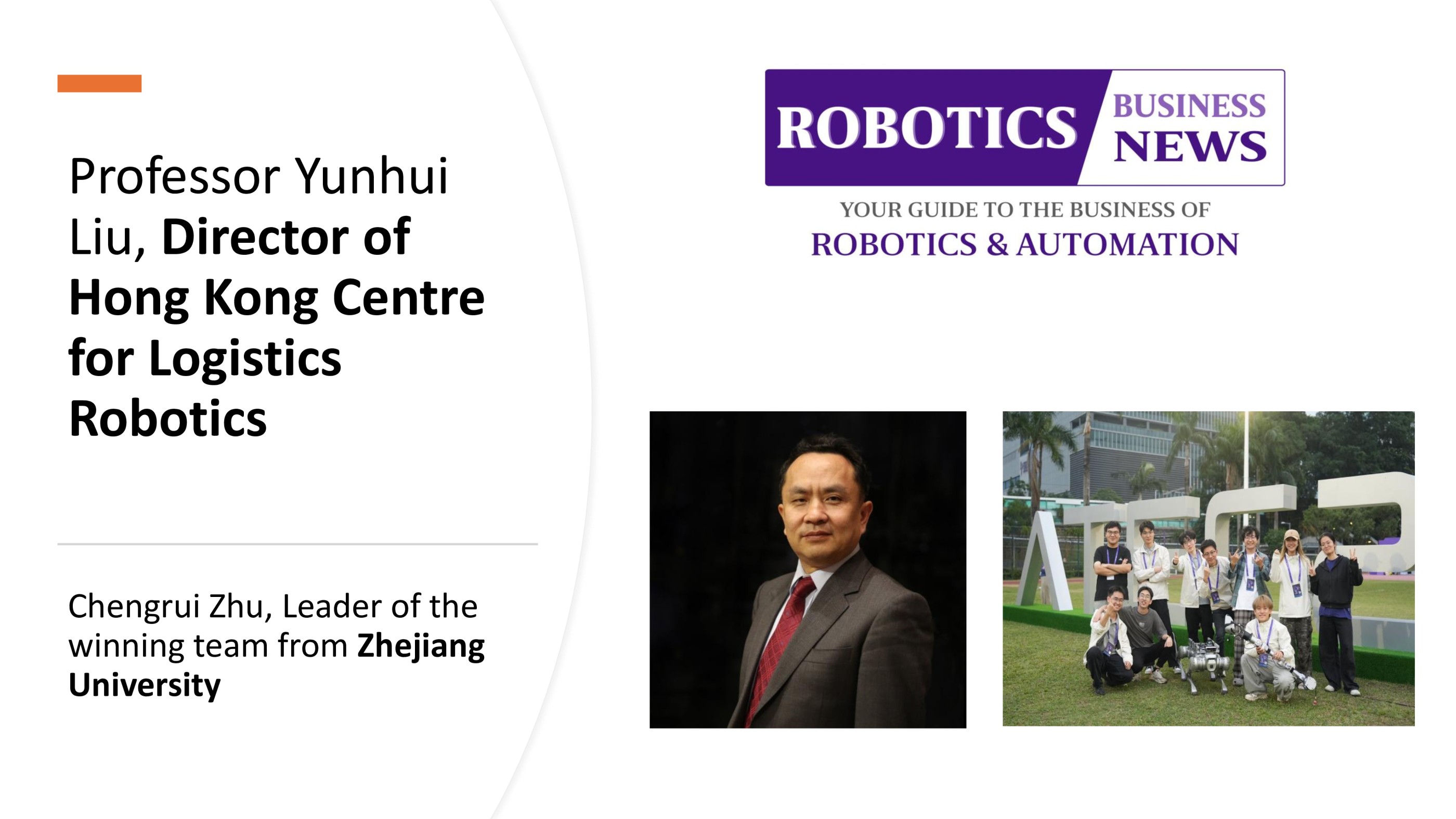
As robotics moves beyond controlled labs and polished demos into unpredictable real-world environments, autonomy, resilience, and system integration have become defining challenges. In this joint interview with Robotics Business News, Professor Yunhui Liu, Director of the Hong Kong Centre for Logistics Robotics, and Chengrui Zhu, leader of the ATEC 2025 winning team from Zhejiang University, share insights from designing and competing in a fully outdoor robotics challenge. Together, they explore the technical gaps between simulation and reality, the future of autonomous locomotion and manipulation, and the lessons learned from pushing robots to operate reliably in natural,unstructured terrain—offering practical insights into what it takes to move outdoor robotics from experimental prototypes to deployment-ready systems.
Q1. What core problem in modern robotics were you aiming to address by designing a competition entirely outdoors with unpredictable natural terrain?
Professor Yunhui Liu:- The core challenge we aimed to tackle with an entirely outdoor competition is the gap between controlled-environment robotics and real-world deployment, encouraging breakthroughs in the kind of autonomy and resilience that modern robotics still lacks.
In controlled simulation or lab environments, variations can be managed, allowing robots to complete tasks in a predictable setting. However, for robots to function effectively in the real world, they must adapt to unpredictable environments. By designing the competition entirely outdoors, we are exposing robots to various challenges, including unpredictable terrain, changing weather, inconsistent lighting, and the dynamic complexity of natural environments. This environment enables us to identify the practical challenges that robots encounter in the field, providing insights that are often lacking in lab-based testing.
By placing the ATEC 2025 competition fully outdoors, we aim to push teams to develop robots that are:
- More robust and adaptable to real-world conditions
- Capable of reliable perception, manipulation, and navigation on irregular natural terrain
- Able to handle uncertainties, which are critical for future applications
Q2: You often speak about moving robotics from “demo-ready” to “deployment-ready.” Based on this year’s results, what gaps still exist before robots can operate reliably in the real world?
Professor Yunhui Liu:- When discussing the transition of robotics from “demo-ready” to “deployment-ready we are focused on closing the gap between controlled success and real-world reliability. This year’s competition revealed several gaps that still need to be addressed:
- Robust perception in unstructured environments
Robots still struggle with variable lighting, reflections, and complex natural geometry. Many teams performed well in ideal conditions but saw performance drop when the environment changed unexpectedly.
- Real-time decision-making under uncertainty
Robots can follow a plan, but adapting to the changes/uncertainties due to terrain, obstacles, or sensor noises remains a major challenge.
- Hardware durability and power efficiency
Extended outdoor operation exposed weaknesses in mechanical robustness, thermal management, and battery endurance. Long-duration reliability is still far from turnkey.
- Integration and system resilience
A robot is only as reliable as its weakest subsystem. We saw that when perception, control, and communication aren’t tightly integrated, failures cascade quickly in the field.
- Minimal human intervention
True deployment-ready robots must operate without frequent resets, manual tuning, or remote corrections. This year showed progress, but autonomy still relies too heavily on human oversight.
In short, the results demonstrated that robots can excel in demonstrations, but achieving dependable performance in unpredictable, real-world conditions requires significant advances in robustness, adaptability, and fully integrated autonomy.
Q3: How did the “no remote control” rule shape the technical direction and difficulty of this year’s competition compared with previous robotics challenges?
Professor Yunhui Liu:- Although we didn’t implement a strict “no remote control” rule, this year’s competition strongly encouraged autonomous operation. Robots were tasked with recognizing, analyzing, and executing, which introduced challenges that significantly impacted both the technical direction and complexity of the event.
This emphasis on autonomous operation aligns the competition with our long-term vision for robotics. Previously, limited teleoperation provided teams with a safety net, allowing human intervention when robots faltered. By reducing this dependence, teams were challenged to meet the true demands of autonomy, where robots must perceive, decide, and act independently. Our goal is to develop deployment-ready robots, not just “demo-ready” ones. Achieving true autonomy is the future we seek, and promoting autonomous operation is a crucial step toward that advancement.
Q4: Of the three core capabilities—locomotion, manipulation, and environmental modification—which do you believe will advance the fastest in the next five years, and why?
Professor Yunhui Liu:- Locomotion will advance the fastest, and manipulation remains challenging.
Locomotion is where we see rapid progress in reinforcement learning and low-cost robotic hardware. Recent advances in foundation models, vision-language systems, and reinforcement learning are accelerating location capability of legged robots in terrains or uncertain environment. In this years’ competition, there are teams which completed the autonomous locomotion in the natural outdoor wild environment, though the team built the map beforehand. I look forward to advancement of locomotion in long-horizon tasks in natural environment without using prior maps.
Q5. What was the single biggest technical challenge your team faced in achieving fully autonomous decision-making under real-world outdoor uncertainty?
Chengrui Zhu:- We encountered numerous challenges in uncertain outdoor environments, such as perception inaccuracy (particularly from depth cameras), recognition and segmentation inaccuracy, and infeasible grasp poses, etc. We believe that since each subsystem inevitably experiences issues, the robot's decision-making must be sufficiently intelligent. The robot must accurately confirm the success of each sub-task, identify its current state, and adjust its subsequent actions accordingly. When a subtask fails, it could retry the subtask to make the complete task done.
Q6. Many algorithms work perfectly in simulation but fail outdoors. How did your team ensure your system remained stable and reliable in unpredictable terrain?
Chengrui Zhu:- To ensure algorithms work in the real world, they cannot be evaluated solely through simulation. Taking the quadrupedal locomotion controllers as an example, we meticulously model and randomize various scenarios that may occur in reality, such as terrain friction, sensor noise, and system latency. After training in simulation, robots must undergo extensive testing across diverse real-world terrains to guarantee their reliability and robustness in actual environments. Typically, testing in real-world scenarios reveals numerous issues that simulations cannot uncover, prompting us to make targeted adjustments to the training environment. Ultimately, this iterative feedback loop gradually enhances the robot's adaptability in actual conditions.
Q7. Which of the four tasks—Orienteering, Swaying Bridge Crossing, Plant Watering, or Waste Sorting—most tested your system’s limits, and how did you overcome that challenge?
Chengrui Zhu:- We believe the plant watering task to be the most challenging among the four. This task demands the highest point-to-point navigation accuracy and grasping precision, along with the most complex task scheduling. It poses significant challenges to the entire hardware and software system. We adopted a comprehensive suite of reliable hardware platforms, including an industrial-grade quadrupedal robot, manipulator arm with gripper, and high-performance computing platforms. We also designed corresponding locomotion control, navigation, and teleoperation algorithms, enabling upper-level commands to effectively control the underlying hardware. The seamless integration of the entire system allowed us to accomplish this challenging plant watering task.
Q8. What do you believe set your team apart from the other international competitors and ultimately helped you win the ATEC2025 Challenge?
Chengrui Zhu:- First, all members of our team are from Zhejiang University's Advanced Perception on Robotics and Intelligent Learning (APRIL) Lab. We have extensive knowledge in robotics while also holding deep insights within our respective research fields. Furthermore, we are close friends in our daily lives, enabling us to collaborate wholeheartedly in our work. We also bring dedication and passion to the competition, allowing us to fully immerse ourselves in tackling technical challenges. The collective efforts of our entire team led to our victory in the ATEC2025 Challenge.