Inside the Future of Autonomous Delivery: Coco Robotics and Airgain Power Next-Gen Connected Robots
17 April 2026 | Interaction | By Editor Robotics Business NEWS <editor@rbnpress.com>
Rob Zehner and Brian Makarowski discuss how dual-modem connectivity, IoT integration, and resilient wireless systems are shaping scalable, real-time urban delivery robotics
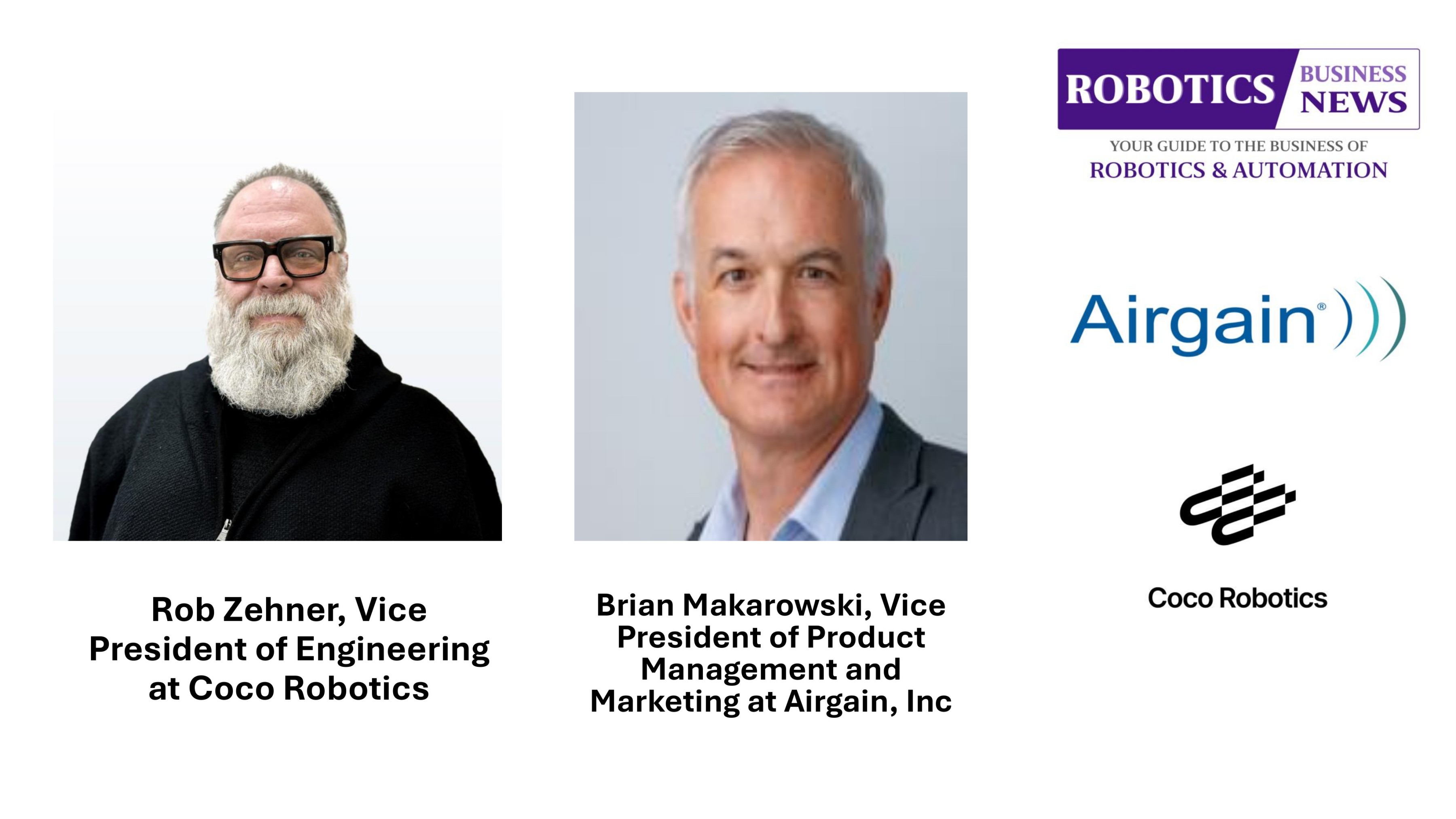
As autonomous delivery rapidly evolves, connectivity has become the backbone of reliable, scalable operations in dense urban environments. In this exclusive conversation with Robotics Business News, Rob Zehner, Vice President of Engineering at Coco Robotics, and Brian Makarowski, Vice President of Product Management and Marketing at Airgain, Inc., share how their collaboration is enabling next-generation delivery robots through robust cellular infrastructure, dual-modem redundancy, and real-time data orchestration—laying the foundation for smarter, more resilient last-mile logistics and connected city ecosystems.
What strategic factors led to the collaboration between Airgain and Coco Robotics for next-generation autonomous delivery platforms?
Airgain offers modems that are pre-certified by government agencies and wireless carriers around the world, streamlining Coco’s time to market and removing the need for complex, expensive compliance testing..
How do Airgain’s NimbeLink cellular modems enhance connectivity and reliability for Coco Robotics’ autonomous delivery robots operating in urban environments?
Coco’s delivery robots integrate two Airgain modems per unit, ensuring redundancy and continuous communication with navigation engines, cloud orchestration systems, and critical operational data paths. This dual‑modem architecture supports uninterrupted connectivity in complex RF environments such as dense neighborhoods, commercial districts, campuses, and mixed‑use urban areas. As Coco expands deployment pilots and launches in new geographies later this year, Airgain’s modems will provide the cellular foundation that keeps each robot connected, aware, and responsive.
Coco’s robots integrate dual cellular modems for redundancy and continuous communication—how critical is this architecture for ensuring safe and reliable autonomous operations?
Coco uses Airgain’s cellular modems to maintain real-time connectivity with every robot in our fleet, allowing us to supervise every meter we travel. We rely on a dual-modem network, operating over two different cellular carriers, to ensure that we always have a reliable connection.
As autonomous delivery expands in cities, what role does real-time connectivity play in enabling navigation, teleoperations, and fleet management for robotics platforms?
Reliable wireless performance is critical for autonomous navigation, remote operations, telemetrics, and real‑time fleet management.
How will this design win support Airgain’s broader strategy of expanding its IoT connectivity solutions into robotics and automation markets?
As Coco expands its autonomous delivery network, the program represents a multi-million-dollar opportunity for Airgain over the life of the rollout.
Coco Robotics has already completed more than 500,000 zero-emission deliveries—how will next-generation platforms help scale operations to new cities and markets?
Coco’s next-generation Coco 2 delivery robot is a ground-up design incorporating everything we’ve learned from our first half-million deliveries. It’s faster, smarter, and designed to operate in the toughest conditions, from below-zero blizzards to monsoon rains to desert heat.
What technical challenges arise when deploying autonomous delivery robots in dense urban environments, and how does reliable wireless communication help address them?
Cities are extremely complex environments for both robots and wireless communication. It’s important that we always stay connected to our robots so we can monitor them as they move around the city, overcoming challenges like multipath, network congestion and cellular dead zones.
Looking ahead, how do you see connected robotics and autonomous delivery shaping the future of last-mile logistics and smart city infrastructure?
Coco’s mission is to create a more sustainable, reliable, and affordable last-mile logistics solution in cities. As connected robotics and autonomous delivery systems mature, reliable, always-on connectivity becomes the backbone of that ecosystem, enabling real-time navigation, teleoperations, fleet coordination, and continuous data exchange between robots and cloud systems. This model scales through connected infrastructure, where each robot operates as part of a coordinated, data-driven network that can adapt dynamically to dense urban environments.
Coco’s approach is designed to complement human couriers by handling dense micro-routes and freeing drivers to focus on longer, more lucrative trips, while connected systems ensure those handoffs are seamless, efficient, and optimized at the network level. Over time, this type of integrated, connected robotics layer will become a core component of smart city infrastructure, supporting more responsive, efficient, and sustainable urban logistics.