BiomX and Motomea on the Future of Electric Propulsion Testing for Drones and Autonomous Systems
28 August 2026 | Interaction | By Editor Robotics Business NEWS <editor@rbnpress.com>
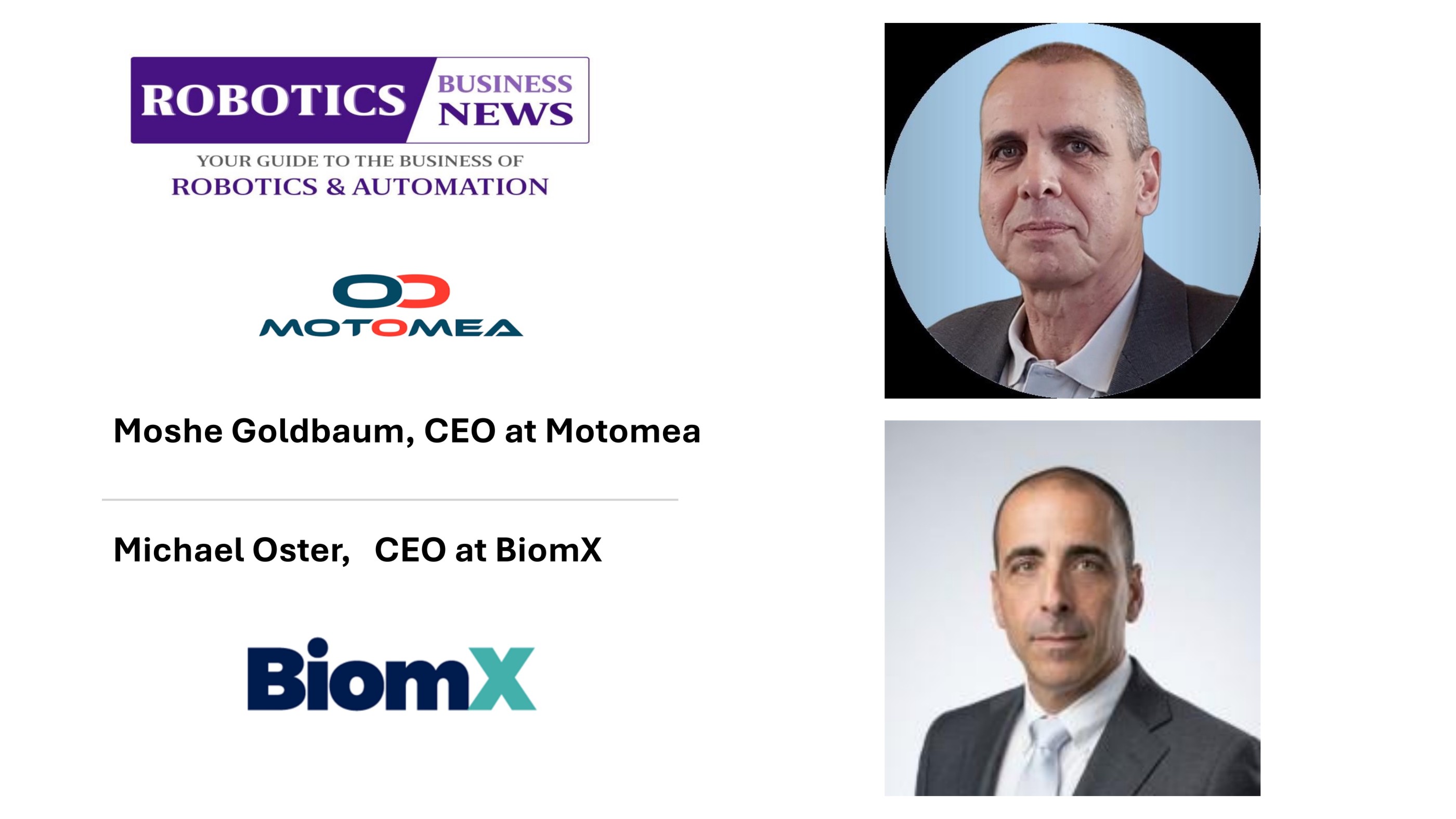
BiomX CEO Michael Oster and Motomea CEO Moshe Goldbaum discuss their strategic collaboration, advanced motor testing technology, UAV propulsion, and the future of autonomous defense systems.
In this exclusive Robotics Business News interview, BiomX CEO Michael Oster and Motomea CEO Moshe Goldbaum discuss their strategic collaboration and the growing importance of advanced electric propulsion testing for drones, robotics and autonomous systems. The executives explain how Motomea’s patented motor-testing technologies, including its Inertial Dynamometer System (IDS) and RDS platform, can improve propulsion validation, reliability and mission readiness, while complementing BiomX’s detection, AI-powered analysis and response capabilities. They also share their perspectives on UAV markets, defense applications, robotics, electric propulsion and the opportunities ahead for integrated autonomous systems.
From BiomX CEO Michael Oster:
What strategic opportunity did BiomX see in Motomea’s electric motor testing and validation technology, particularly for drones and autonomous systems?
We see Motomea as an opportunity to add highly specialized engineering expertise in an area that’s increasingly important to unmanned and autonomous aerial systems. What attracted us was the combination of a strong engineering company, more than 25 years of experience, and a technology that we believe is genuinely differentiated. Electric propulsion has a direct impact on the efficacy of these systems, so the ability to rigorously test and validate those systems is critical.
What makes Motomea particularly interesting to us is its combination of long-standing motor-testing expertise, its dynamometer technology, and exposure to UAS-related applications. That gives us the opportunity to better understand and validate technologies that sit much closer to the response side of the autonomous-systems ecosystem, and fits with our Detection, Analysis and Response strategy.
From a BiomX perspective, the strategic fit is also about seeing how those capabilities can work alongside the technologies already within our portfolio. We have detection capabilities through our DFSL subsidiary, and AI-powered analysis, validation, and coordination through our Zorronet subsidiary. Motomea adds propulsion, testing and engineering expertise that could complement those capabilities in a meaningful way. It also gives us greater exposure to the broader UAV market, which we see is becoming increasingly important across defense and homeland security industries.
We see this investment as an opportunity to build a closer technical understanding of the systems that ultimately have to act on the intelligence our other technologies generate, while giving us the ability to validate the technology, evaluate the commercial opportunity, and develop a clearer view of how the pieces can fit together across the portfolio.
How will the exclusive drone testing distribution license help BiomX and Motomea address the growing demand for reliable electric propulsion systems in defense and commercial UAV markets?
The exclusive drone-related license gives BiomX and Motomea a framework to bring Motomea’s testing and validation expertise more directly into the UAV market.The license also gives us a way to better understand where the strongest customer demand exists, develop those opportunities into a more formalized pipeline, and see how Motomea’s technology performs against real requirements in the UAV market.
We’re looking at whether the technology can solve a meaningful problem for customers, whether those opportunities can translate into repeatable business, and how that capability can fit alongside the broader technologies within BiomX.
As we build greater visibility into customer demand and commercial execution, we will have a much clearer understanding of the scale of the opportunity and the role Motomea can play within the broader unmanned-systems ecosystem.
How do you see the combination of Motomea’s propulsion expertise with BiomX’s broader detection, analysis, and response capabilities strengthening autonomous and defense systems?
What makes the combination compelling is that autonomous and defense systems depend on multiple layers working together. You need to detect what’s happening, understand it quickly and accurately, and then rely on the response system to perform consistently when it matters.
BiomX is building around that framework. DFSL contributes detection capabilities, Zorronet adds AI-powered analysis, validation and coordination, and Motomea brings specialized propulsion, testing and engineering expertise that’s highly relevant to unmanned aerial systems.
That’s important because the value of autonomous systems comes from how reliably each component works together across the full chain, from identifying a threat to understanding it and enabling an effective response.
For us, the next step is about proving that fit. If we can demonstrate that Motomea’s capabilities integrate well with the rest of the portfolio, technically and commercially, it strengthens the broader architecture we are building around autonomous and defense systems.
The agreement also provides BiomX with an option to acquire a controlling interest in Motomea. What milestones or market opportunities will be important in evaluating the next stage of the relationship?
The option gives us the flexibility to deepen the relationship as we build greater confidence in both the technology and the commercial opportunity. We’re encouraged by what we see in the company, the technology, and the broader market opportunity. The next stage is really about turning that potential into something more tangible.
One important area is the drone-related technology itself. We want to continue validating the technology, better understand its capabilities, and make sure we have a clear picture of how it can support the broader opportunity we see in unmanned systems.
We’re also looking closely at the commercial pipeline. As those opportunities become more formalized and we gain greater visibility into customer demand, it’ll give us a stronger basis for evaluating how far the relationship can go.
Just as importantly, we want to evaluate how Motomea can work alongside the other companies within BiomX. The opportunity is to see whether its capabilities can complement our existing detection and AI-powered analysis technologies in a way that’s technically feasible and commercially meaningful.
So for us, the next stage is about building confidence through execution: validating the technology, seeing Motomea develop its commercial pipeline, demonstrating the fit across the portfolio, and making sure the company is ready to support a deeper relationship with BiomX.
From Motomea CEO Moshe Goldbaum:
How do you see the combination of Motomea’s propulsion expertise with BiomX’s broader detection, analysis, and response capabilities strengthening autonomous and defense systems?
The combination brings together two critical layers of autonomous and defense systems: the intelligence that allows a platform to detect, analyze and respond to its environment, and the electric propulsion technology that enables it to execute that response reliably.
BiomX is building capabilities across threat detection and AI-powered analysis as part of its detection, analysis and response strategy, while Motomea contributes more than 25 years of expertise in electric motor testing and validation. For UAVs and other autonomous platforms, propulsion is mission-critical. Motor performance directly affects endurance, payload capability, maneuverability, stability and overall system reliability.
Motomea’s patented IDS technology and its RDS platform enable engineers to characterize electric propulsion systems in depth, measuring parameters such as torque, speed, efficiency, friction, torque ripple, back EMF and other dynamic characteristics, as well as evaluating motors under simulated operating conditions. This can help identify performance deviations and potential weaknesses before a propulsion system is integrated into an aircraft or deployed in the field.
We therefore see a very natural complement between the companies. BiomX is developing technologies around the ability of autonomous systems to perceive and respond, while Motomea provides the testing and validation capability needed to help ensure that the propulsion system can reliably deliver the required physical performance.
For defense and autonomous applications, where reliability is not simply a performance metric but can be a mission requirement, bringing these capabilities closer together can support a more integrated approach to system development, validation and readiness.
How will the exclusive drone testing distribution license help BiomX and Motomea address the growing demand for reliable electric propulsion systems in defense and commercial UAV markets?
The exclusive license creates a focused commercial framework for taking Motomea’s electric motor testing technology deeper into the rapidly developing UAV market, while giving BiomX access to a specialized capability that complements its broader strategy in autonomous and defense technologies.
As UAV applications expand across defense, security and commercial markets, electric propulsion systems are being asked to deliver greater endurance, higher payloads, increased efficiency and consistent performance under increasingly demanding operating conditions. That makes rigorous motor testing and validation an essential part of both development and production.
Motomea’s IDS is particularly relevant because it can rapidly characterize motor performance without a conventional external mechanical load, making it suitable for the high-speed, lightweight electric motors commonly used in UAV applications. Its RDS technology complements this by enabling controlled load testing and simulation of demanding operating conditions. Together, these technologies can support R&D, design validation, quality assurance, end-of-line testing and final acceptance before motors are integrated into UAV platforms.
The license allows BiomX to develop and distribute drone testing solutions based on this technology while leveraging Motomea’s engineering know-how and established motor-testing capabilities. For Motomea, it provides a dedicated route to expand the application of its technology within defense and commercial UAV markets. For BiomX, it adds propulsion testing and validation to a portfolio already focused on detection, analysis and autonomous response.
Ultimately, the opportunity is to help UAV manufacturers and system integrators move from simply asking whether a motor operates to understanding precisely how it will perform across its operating envelope. That deeper level of validation can contribute to more reliable propulsion, faster development cycles, stronger production quality control and greater confidence before deployment.
How does Motomea’s load-free inertial dynamometer technology improve the testing and validation of electric motors compared with conventional approaches?
Motomea’s patented Inertial Dynamometer System, or IDS, changes the conventional testing model by eliminating the need for an external mechanical load. Instead, it captures the motor’s real dynamic and static behavior during acceleration and deceleration, enabling engineers to measure full performance from stall to no-load in seconds.
This significantly reduces setup time, alignment requirements and the need for multiple dynamometer configurations for different motor sizes. At the same time, it provides a much deeper diagnostic picture, including torque, speed, current, voltage, efficiency, friction, torque ripple, cogging, power quality and frequency-spectrum behavior.
The result is a faster and more flexible validation process that can be applied from R&D and prototyping through quality assurance and end-of-line testing. For manufacturers working with rapidly evolving motor designs, that speed and depth of insight can help shorten development cycles while improving confidence in motor performance before integration.
Electric propulsion directly affects drone flight time, payload, stability, and reliability. How can more advanced motor testing improve overall UAV performance and mission readiness?
In a UAV, the propulsion system has a direct influence on how efficiently electrical energy is converted into usable thrust. Small inefficiencies, torque irregularities, thermal issues or electrical anomalies can affect endurance, stability, payload capability and reliability.
Advanced motor testing gives engineers a much clearer understanding of how a propulsion motor behaves across its operating envelope rather than evaluating it only at a few nominal points. Motomea’s IDS can identify dynamic characteristics such as torque ripple, friction, cogging and electrical behavior, while the RDS can reproduce controlled load conditions, high-speed operation and thermal stress representative of real operating environments.
This allows developers to identify weak points earlier, optimize motor and control-system performance, compare designs more accurately and validate consistency before deployment. In defense and autonomous applications, where a propulsion failure can compromise an entire mission, this level of testing becomes an important part of mission readiness.
What role will real-world testing of torque, efficiency, temperature, vibration, and electrical performance play in reducing propulsion failures before motors are integrated into drones?
The key advantage of combining these measurements is that motor failures rarely appear in only one parameter. An emerging problem may first appear as an electrical imbalance, torque irregularity, friction increase, vibration signature or efficiency loss before it becomes a visible thermal or mechanical failure.
By correlating torque, efficiency, temperature, vibration, current, voltage and other electrical parameters under realistic operating conditions, engineers can detect anomalies much earlier and understand their likely root causes.
Motomea’s testing approach is designed to provide this broader diagnostic picture. Its IDS captures dynamic motor behavior during acceleration and deceleration, while its monitoring technologies can correlate electrical, mechanical and thermal information. The RDS complements this by allowing motors to be subjected to controlled load profiles and demanding operating conditions.
For UAV manufacturers, this means defective, inconsistent or marginal propulsion units can be identified before they are installed in an aircraft. That improves quality control and reduces the risk of discovering propulsion weaknesses only after system integration or during field operation.
How do you see the combination of Motomea’s propulsion expertise with BiomX’s broader detection, analysis, and response capabilities strengthening autonomous and defense systems?
The combination brings together two very different but complementary parts of an autonomous system.
BiomX is developing capabilities in threat detection and AI-powered analysis as part of its detection, analysis and response strategy, while Motomea brings deep expertise in electric motor testing, propulsion validation and performance diagnostics.
In an autonomous or defense platform, intelligence and mobility ultimately depend on one another. A system may be able to detect and analyze a threat, but it still needs a reliable propulsion system to physically execute the required response. That makes propulsion performance a fundamental part of system readiness.
By combining BiomX’s capabilities in sensing and analysis with Motomea’s ability to validate the motors that power UAVs and other autonomous platforms, we see an opportunity to support a more complete approach to reliability and operational readiness. The objective is not only to make autonomous systems smarter, but also to ensure that the underlying electromechanical systems can perform consistently when they are required most.
Looking ahead, which applications do you believe will drive the greatest demand for advanced electric motor testing across drones, robotics, autonomous systems, and next-generation aircraft?
We expect demand to be strongest wherever electric motors are becoming more compact, more powerful and more mission-critical.
UAVs are an obvious example, particularly defense, surveillance, logistics and other applications where endurance, payload and reliability are critical. Robotics and autonomous systems will also require increasingly sophisticated testing as motors become integral to precision movement, actuation and continuous-duty operation.
Electric and hybrid-electric aviation is another major area. As propulsion systems move toward higher speeds, greater power density and more demanding thermal and electrical environments, the need for accurate performance validation becomes much more significant.
Across all of these sectors, the common trend is that the motor is no longer viewed as an isolated component. It is part of an integrated propulsion or motion-control system that includes power electronics, batteries, software and control systems. That is why we believe the future of motor testing will increasingly focus on dynamic behavior, real-world simulation, high-speed diagnostics and system-level validation rather than simple pass-or-fail measurements.