ForSight Robotics Advances Robotic Eye Surgery With JASPER’s Next Clinical Milestones
17 August 2026 | Interaction | By Editor Robotics Business NEWS <editor@rbnpress.com>
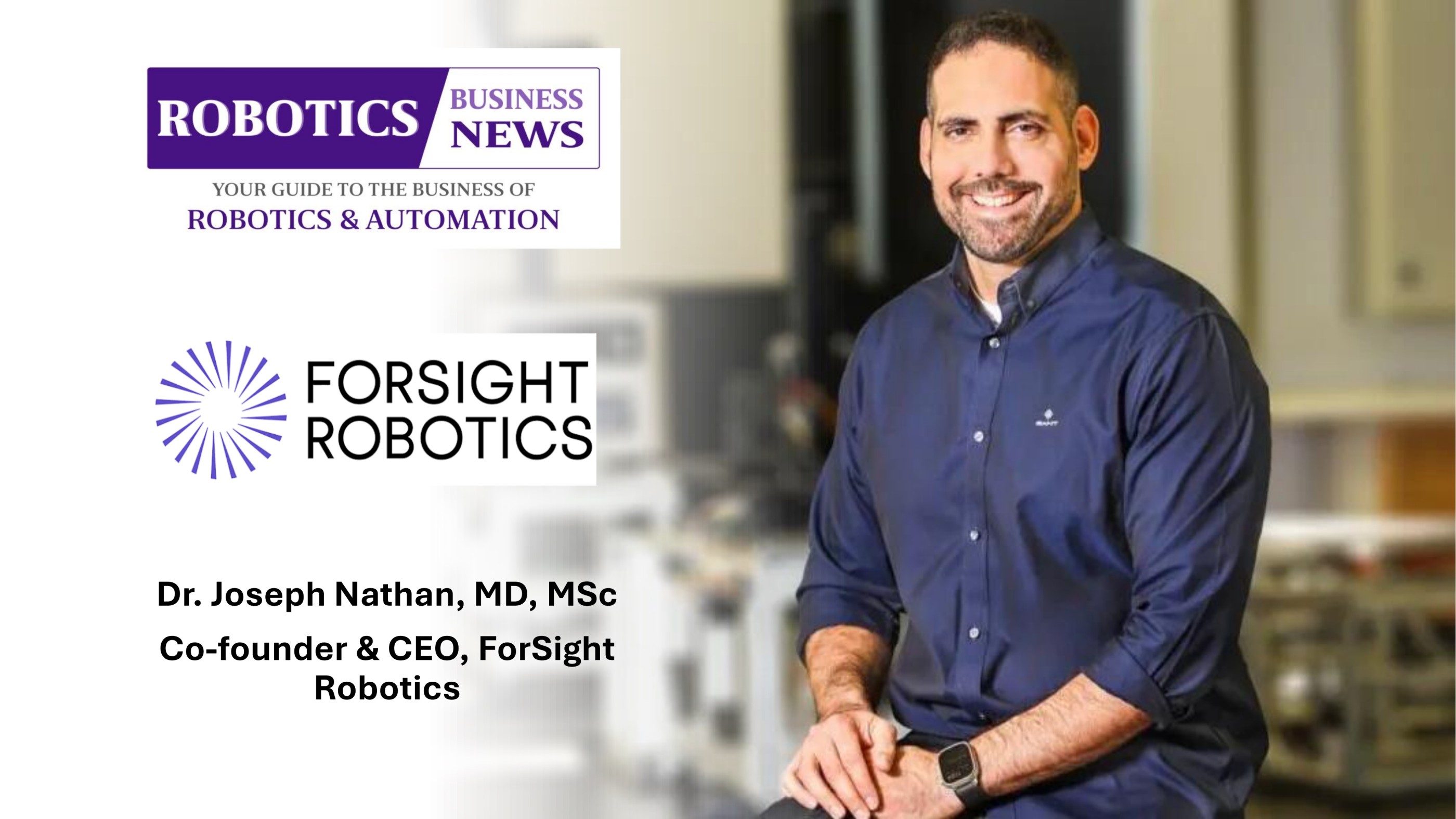
Dr. Joseph Nathan discusses 26 successful robotic cataract surgeries, clinical integration, AI-enabled precision, and the future of ophthalmic robotics.
In this conversation with Robotics Business News, Dr. Joseph Nathan, MD, MSc, Co-founder & CEO of ForSight Robotics, discusses the company’s progress with JASPER following 26 fully robotic-assisted cataract surgeries with a 100% completion rate. He shares key clinical and engineering lessons, the importance of seamless workflow integration, AI-enabled surgical precision, upcoming clinical and regulatory milestones, and ForSight Robotics’ vision for transforming ophthalmic surgery at global scale.
ForSight Robotics has now completed 26 fully robotic-assisted cataract surgeries with a 100% completion rate. What were the most significant clinical and engineering lessons learned between the first procedure and this latest milestone?
The first-in-human procedure we performed earlier this year answered a fundamental question: can a complete cataract surgery be performed robotically in a real patient? The next 25 procedures began answering a much more important question: can it be done it consistently, within the existing workflow of everyday cataract surgery?
For us, a major lesson has been that clinical integration matters almost as much as robotic performance. Across all 26 procedures, we completed the surgery robotically without converting to manual surgery. Patients received the same anesthesia used in routine cataract care, either topical anesthesia (numbing eye drops) or mild sedation, and went home the same day. When we think about our end users, the surgeons, clinics, ASCs (ambulatory surgery centers), and hospitals that will ultimately utilize the JASPER platform, the technology has to fit naturally into the way they already deliver care. A robotic system cannot scale simply because it performs well technically; it also has to work within the clinical and operational realities of everyday surgery. That has been an important validation for us in this study.
JASPER was designed from the ground up as a holistic platform, one that could respond naturally to the surgeon, account for movement of the eye, provide excellent visualization and operate precisely and reliably throughout an entire procedure.
From an engineering perspective, operating on an additional 14 patients reinforced how important this complete system is.
The progression from one patient to 26 has therefore been less about proving a single technical capability and more about demonstrating repeatable performance in a real clinical environment. That transition is one that every surgical technology has to make if it is ultimately going to reach patients at scale.
A key highlight of the study is that the robotic platform integrated seamlessly into standard cataract surgery workflows. How important is this compatibility for accelerating adoption among ophthalmic surgeons and healthcare providers?
As I mentioned above, this seamless integration is absolutely essential. Cataract surgery is performed more than 30 million times every year. At that scale, you cannot introduce a technology that requires hospitals, surgeons and patients to redesign the entire care pathway around it.
Cataract surgery already follows a well-established clinical flow, and providers have optimized highly efficient outpatient systems to support that model of care. Patients expect a relatively short procedure, one that allows them to return home the same day. Our responsibility is to bring the advantages of robotics into that environment without creating unnecessary complexity.
I believe this will be one of the major determinants of whether surgical robotics succeeds in ophthalmology. An impressive robot in a laboratory is one thing. A platform that surgeons can realistically imagine becoming part of their operating day is something very different. If we want robotics to become broadly adopted, the technology has to adapt to clinical practice, not the other way around.
JASPER combines telemanipulation, real-time eye tracking, motion scaling, tremor elimination, and computer vision. Which of these technologies has had the greatest impact on improving surgical precision and patient outcomes?
I would be reluctant to isolate one technology. As I said, JASPER was designed in a holistic way from the ground up, and in many ways, the enhanced precision it was designed to provide comes from the way these capabilities work together.
Motion scaling and tremor elimination can translate the surgeon's movements into extremely controlled movements inside the eye. Three-dimensional visualization and computer vision give the surgeon a much richer understanding of the surgical field. Real-time eye tracking is particularly important because the eye is not a static object, especially when a patient is receiving the standard anesthesia used in cataract surgery rather than general anesthesia.
The important point is that the surgeon remains in control. The technology is there to extend what the surgeon can see and how precisely the surgeon can act. We should also be careful about separating engineering performance from clinical outcomes. This is still early clinical experience, and we are continuing to build the evidence required to understand the clinical benefits scientifically. What we can say today is that through all 26 procedures, the platform demonstrated the stability and control required to perform the complete procedure safely and successfully within routine clinical practice.
Cataract surgery is one of the most frequently performed procedures worldwide. What challenges do you foresee in scaling robotic cataract surgery across different healthcare systems, from advanced hospitals to emerging markets?
In advanced healthcare systems, adoption will depend on clinical evidence, regulatory approval, training, economics and integration with existing operating rooms. Hospitals and surgical centers will want to know that the technology improves the way they deliver care, but they will also want to know that the business model makes sense. That means demonstrating not only clinical value, but also that the platform can fit into high-throughput surgical workflows. Over time, the strongest case for adoption will be one where robotics can help providers expand capacity, standardize quality and make scarce surgical expertise more scalable.
In emerging markets, the opportunity may be even greater because the shortage of expert surgeons is often more severe. But the surrounding challenges can also be greater. A robotic platform still needs trained clinical teams, reliable infrastructure, service and support, and a healthcare system capable of identifying patients and getting them into surgery.
Our long-term vision has always been global. Hundreds of millions of people need cataract surgery, while only a fraction receive it each year. Robotics can help change that equation.
You have described JASPER as the foundation for the next generation of intelligent surgery. How do you envision AI enhancing robotic ophthalmic procedures while ensuring surgeons remain in full control of clinical decision-making?
Today, JASPER is surgeon-controlled throughout the procedure, and that is an important starting point for how we think about AI.
The first role of intelligence in surgery is to give the surgeon better information and better physical capabilities. For example, computer vision can help the surgeon understand what is happening in the surgical field. Already, the platform integrates advanced computer vision and AI-driven image guidance to enhance intraoperative visualization. By providing surgeons with visual insight into ocular anatomy and instrument positioning, the platform is designed to support greater precision, informed decision-making, and the controlled execution of delicate surgical steps.
The JASPER™ platform also incorporates AI-enabled capabilities designed to shorten surgeon learning curves, helping surgeons reach elite performance faster and enabling continuous skill development. Through advanced AI-enhanced simulations, surgeons can practice procedures virtually, receive objective, data-driven feedback, and refine their techniques in a controlled environment.
The JASPER™ platform also captures comprehensive procedural data that can be used to assess performance. These powerful data-collection and feedback loops can support continuous learning and help promote greater consistency in surgical performance.
With successful first-in-human results now established, what are the next milestones for ForSight Robotics in terms of expanded clinical studies, regulatory approvals, and commercialization?
Twenty-six procedures are an important milestone, but they are still an early chapter in the clinical development of JASPER.
The next phase is about building a broader body of clinical evidence. That means expanding our clinical experience, continuing to evaluate the platform across patients and surgical conditions, and generating the data required for regulatory submissions.
At the same time, we will continue refining the system based on what we learn in the operating room. One of the advantages of reaching this stage is that development is no longer based only on simulation or preclinical models. We are now learning from actual clinical use.
Regulatory approval is the gateway to commercialization, and we intend to approach that process carefully and scientifically. JASPER remains an investigational platform under design and development and is not yet approved for commercial use.
The destination, however, is very clear. We want to bring robotic ophthalmic surgery into routine clinical practice and ultimately make this technology available across major healthcare markets. These first 26 patients give us additional confidence that the platform can fit naturally into the care model we eventually hope to serve at much greater scale.
How has the feedback from surgeons participating in the clinical study influenced the evolution of the JASPER platform, and what additional capabilities are planned for future software or hardware updates?
Surgeons have been part of the development process from the beginning, and we have brought together an incredible Clinical Advisory Board that includes the world’s top eye surgeons to help inform every stage of the development process. You can build extraordinary engineering in isolation, but if the surgeon does not feel that the system belongs in the operating room, you have missed something fundamental.
The most important feedback from clinical use is often very practical. How naturally does the surgeon interact with the system? Is the visualization giving the right information at the right moment? Does the technology support the existing procedure rather than interrupt it? Our recent clinical experience has been particularly important because it confirmed that JASPER can complement the routine cataract workflow.
That feedback continues to shape both software and hardware development.
Over time, we see the platform incorporating richer data and feedback loops, deeper integration with other technologies in the operating room, and offering additional tools available to the surgeon. We also designed the robotic architecture with ophthalmology beyond cataract surgery in mind. While cataract surgery is our first indication, JASPER can reach any point within the human eye, allowing surgeons to navigate complex angles and ensuring access to both anterior and posterior segments, setting the stage for glaucoma and retinal surgical treatment. We are also working on developing increasingly automated surgical steps to further support surgeons in providing highly precise and consistent high-quality treatment.
Looking ahead five to ten years, how do you see robotic platforms transforming ophthalmology, and what role do you expect ForSight Robotics to play in shaping the future standard of eye surgery?
I believe we are at the beginning of a fundamental change in how eye surgery is performed.
For decades, advances in ophthalmology have given surgeons better microscopes, more advanced lenses, higher-quality imaging systems, and technologies such as lasers. Robotics creates something fundamentally different: a digital and physical platform through which the entire surgical procedure can eventually be understood, measured, standardized, and continuously improved.
Five to ten years from now, we believe JASPER can become the physical platform through which artificial intelligence enters the operating room. It will continue to help surgeons perform extraordinarily delicate maneuvers with greater precision, stability, and control, while progressively enabling carefully validated elements of surgical execution. Over time, the operating room can evolve from a place where technology simply assists the surgeon into an intelligent environment that learns from every procedure and helps make the very best surgical capabilities more reproducible.
That evolution matters because ophthalmology faces a mathematical problem. The number of patients needing care is growing much faster than the number of expert surgeons available to treat them. Already, there is an enormous gap between the number of people who need sight-restoring cataract surgery and the number of highly skilled providers available to perform it. Longer life expectancy and a rapidly aging global population will only widen that gap. We cannot solve this challenge simply by asking surgeons to work harder or operate longer hours.
Our mission at ForSight is to change that equation.
Cataract surgery is the starting point because it is the world’s most commonly performed surgical procedure, but JASPER was conceived as the foundation for ophthalmic surgery much more broadly. Our ambition is to build the platform on which the next generation of eye surgery is performed: one that combines the judgment and expertise of the surgeon with the precision of robotics, the intelligence of AI, and the ability to capture and learn from surgical data at a scale that has never before been possible.
Ultimately, we want to help transform world-class eye surgery from a scarce skill concentrated in the hands of a limited number of experts into a capability that can be delivered far more consistently and at far greater scale. When we succeed, robotics will not simply make existing surgery better. It could fundamentally reshape who has access to high-quality surgical care, how quickly new surgical capabilities can spread, and what becomes possible inside the operating room.
That is the future we are building toward: a world in which geography, surgeon shortages, and variability in expertise are no longer the primary determinants of whether someone can receive the sight-saving care they need. We believe ForSight can help define that new standard for ophthalmic surgery.