China’s Robotics Rise: Insights from Jonathan Lu of Intralink on the Industry’s New Center of Gravity
21 April 2026 | Expert Insight
With unmatched supply chain integration, rapid iteration cycles, and massive real-world deployment, China is redefining the future of robotics—forcing global players to rethink where innovation truly happens.
The global robotics industry is entering a decisive phase. Scale, speed of innovation, and real-world deployment are now the factors that determine who is leading – and China is rapidly becoming the sector’s centre of gravity.
Much in the way Silicon Valley defined the internet and AI revolutions, China is now where robotics are being developed, tested, and improved not only at an unprecedented scale, but at lightning iteration speed. And, for international robotics companies, the question is no longer whether China matters, but whether they can afford not to engage with the world’s fastest-moving robotics ecosystem.
Scale changes everything
In robotics, scale accelerates innovation.
It’s striking that China has developed the most complete robotics supply chain in the world. From sensors, motors, and precision gears to batteries, control systems, and electronics, almost every key hardware component required to build advanced robots can now be sourced within the country. And close collaboration between global and Chinese companies has become a highly effective way to reduce production costs, shorten development cycles, and speed time-to-market for new robotic systems.
Another advantage lies in China’s dense industrial clusters. Cities like Shenzhen and Shanghai have developed ecosystems where robotics companies, suppliers, integrators, and engineers operate side by side. This means prototypes can be built, tested in real industrial environments, and refined in a fraction of the time that would be required elsewhere. Sometimes this can all be done in a matter of weeks.
For example, from our recent conversations with top Chinese robot makers Unitree, UBTech, and Galbot, we learned that manufacturing leaders such as CATL and Toyota (China) are already deploying their humanoids on their production lines and updating the algorithms on a weekly basis.
Robotics developers also greatly value the kind of large-scale deployment environments that China’s industrial clusters provide. Factories, warehouses, and logistics hubs across the country are constantly adopting new automation technologies, and the result is a vast flow of real-world operational data that improves robotics performance and accelerates AI learning.
Put simply, if international robotics pioneers want to move faster, they need to operate in China, where innovation and testing are happening at scale and speed.
The world’s largest robotics user
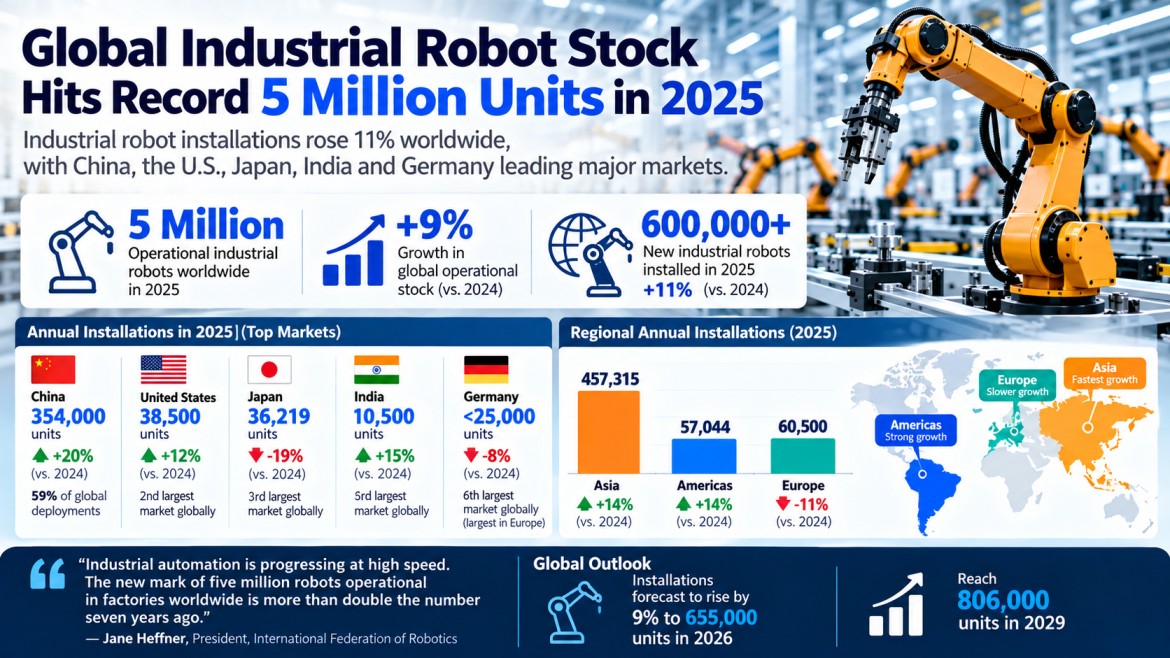
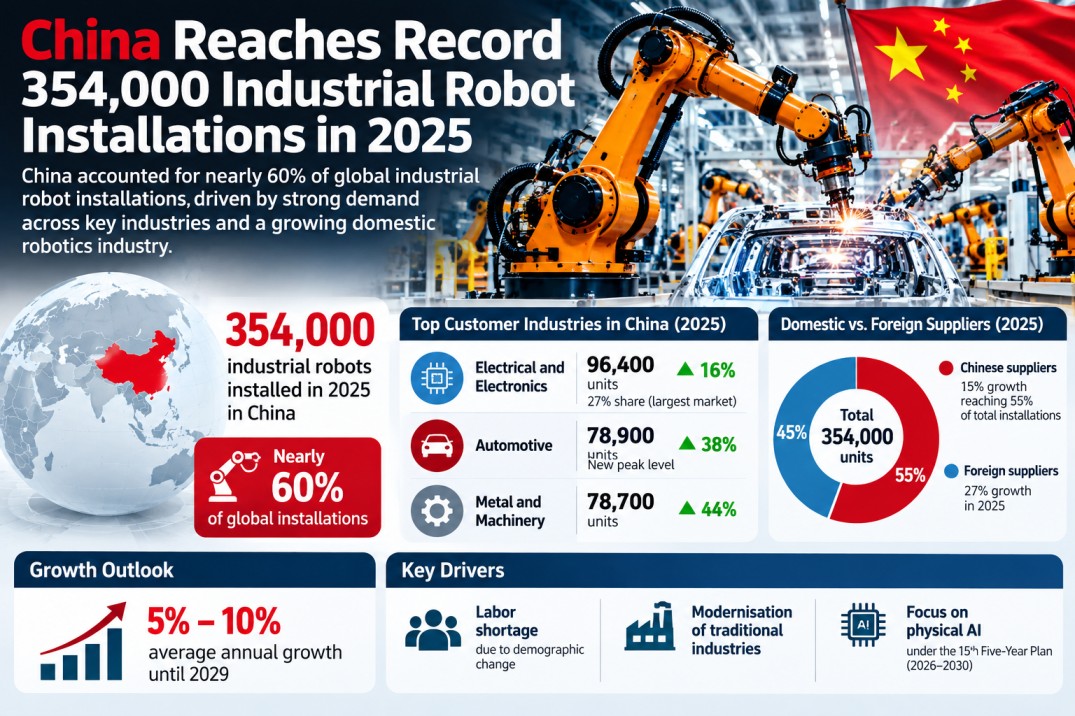
But China isn’t only a robotics manufacturing powerhouse: it now operates more than two million industrial robots, making it the world’s largest robotics user.
This massive demand for automation is being driven by several fast-growing industrial sectors – including electric vehicles, batteries, smart logistics, and advanced manufacturing – and led by the likes of BYD and CATL.
The explosion of e-commerce in China has also pushed logistics automation requirements to new levels, with robotics managing vast warehouse networks and fulfilment centres.
While 2025 official numbers are yet to be confirmed, we know Chinese factories installed nearly 300,000 industrial robots in 2024 alone, meaning more were installed in China than in the whole of the rest of the world.
Importantly, Chinese factories have been buying more than 100,000 of these robots annually from international suppliers, making China one of the largest export markets for global robotics companies.
Partnership opportunities
Aside from China as a huge robotics end-user market, while the country’s robotics companies are exceptionally strong in hardware engineering, actuation technologies, and large-scale manufacturing, there are great opportunities for international companies to forge partnerships with them and bring valuable capabilities to complement these strengths.
Several leading Chinese humanoid and robotics companies have recently told us their primary focus is on advancing the hardware. But with visions of continuing to lead the world in robotics, they’re keen to collaborate with international players in areas such as advanced AI software, system integration, and high-level autonomy.
They see companies from Europe and North America as offering valuable expertise in safety engineering, regulatory compliance, and international certification standards – capabilities which will become increasingly important as Chinese robotics companies target global markets.
There is also a clear need for precision engineering and industrial design, where international companies have long experience delivering high-end systems for demanding applications. And, most importantly, global firms have the local knowledge and expertise in sectors which increasingly require tailored systems rather than generic platforms.
The key then is not to compete directly with China’s strengths, but to build complementary partnerships. Combining China’s scale, unrivalled manufacturing ecosystem, and hardware prowess with international expertise in software, design, and specialized applications is the basis for powerful collaborative models.
Beyond the risk of missing out
The global robotics race is increasingly defined by where the latest technologies are being developed and deployed at scale. And, with its strengths in hardware, its integrated supply chains, and its vast industrial demand, China has arguably become the world’s most important arena for robotics innovation and deployment.
The question is no longer whether China matters in robotics. It’s whether ambitious international companies can afford to build their future anywhere else.