Two Students Who Built India’s First Humanoid Robot Later Built a Global Warehouse Robotics Company
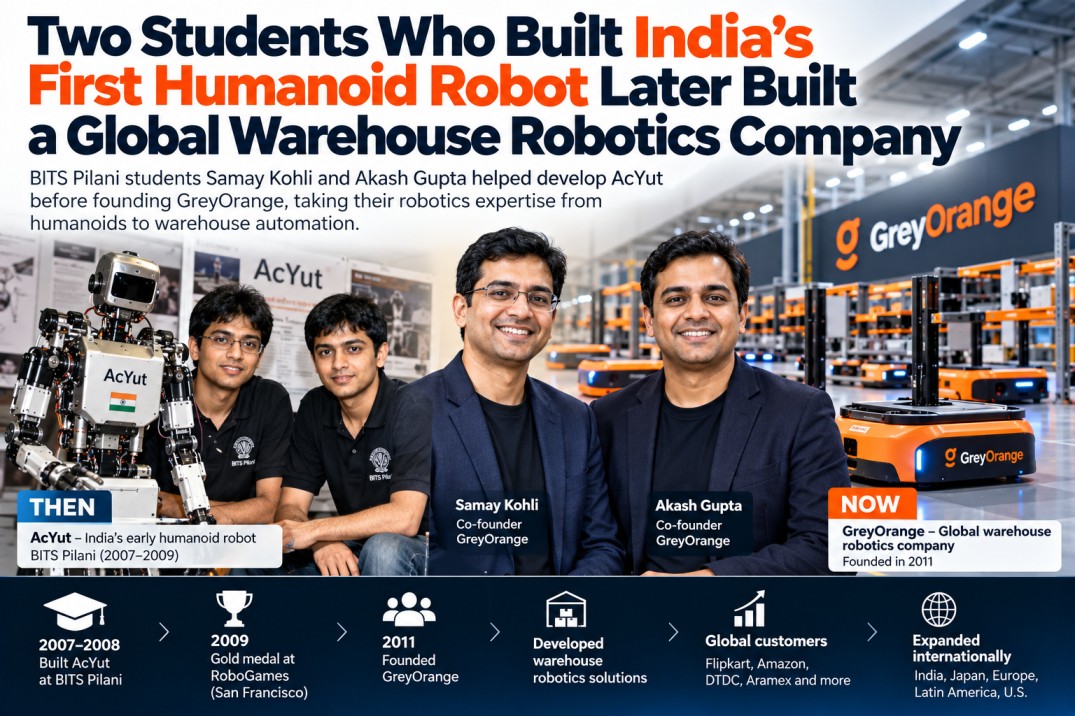
BITS Pilani students Samay Kohli and Akash Gupta helped develop AcYut before founding GreyOrange, taking their robotics expertise from humanoids to warehouse automation.
In 2007–2008, Samay Kohli and Akash Gupta, then students at BITS Pilani, were part of the team behind AcYut, one of India’s first indigenously developed humanoid robots. The project became an early example of Indian student-led humanoid robotics and gave the two engineers practical experience in hardware, controls, software and autonomous robotics.
Their journey would eventually move beyond humanoid competitions and into commercial robotics.
From AcYut to GreyOrange
Kohli and Gupta continued developing AcYut and represented India in international robotics competitions. The team achieved a gold medal at the 2009 RoboGames in San Francisco, demonstrating the capabilities of Indian robotics engineering on an international stage.
In 2011, the two founders launched GreyOrange, initially focusing on robotics education before shifting toward commercial robotics applications. They identified warehouse operations as an area where robotics could address growing demand from India's rapidly expanding e-commerce industry.
From Humanoids to Warehouse Robots
The transition illustrates an important path in robotics entrepreneurship: technology developed for complex research and competition can become the foundation for solving specific industrial problems.
GreyOrange developed robotic systems for warehouse automation, including autonomous systems for moving inventory and automated sorting. Its early customers included companies such as Flipkart, Amazon, DTDC and Aramex.
Rather than attempting to commercialize a humanoid robot directly, the founders applied their robotics expertise to a narrower problem where automation could provide measurable operational benefits.
Building a Robotics Business
GreyOrange subsequently expanded internationally and developed robotics and AI-based systems for fulfillment and warehouse operations. Fortune India reported that the company's systems were deployed across customer sites in India, Japan, Europe, Latin America and the U.S.
The company has also attracted significant investment. In 2018, GreyOrange announced a $140 million Series C round, while later funding brought its disclosed financing substantially higher.
Some recent industry sources cite a $1.2 billion valuation, but this should be treated as a historical private-market valuation rather than a current valuation unless confirmed by a newer financing or transaction.
A Lesson for India's Robotics Ecosystem
The AcYut-to-GreyOrange journey highlights how university robotics projects can become a starting point for commercial innovation.
Kohli and Gupta moved from building humanoid robots for competitions to addressing logistics and fulfillment challenges with specialized robotic systems. Their experience also demonstrates the importance of identifying a practical industrial application for advanced robotics technology.
Today, the robotics industry is again seeing growing interest in humanoids, embodied AI and Physical AI. The story of AcYut and its student builders offers an earlier example of how robotics research, engineering talent and entrepreneurship can connect to create commercially focused automation companies.
For India's emerging robotics ecosystem, the journey provides a notable link between the country's early humanoid robotics experiments and its expanding warehouse automation industry.