Boston Dynamics Opens Robotics Metaplant Application Center to Train Atlas Humanoids for Automotive Manufacturing
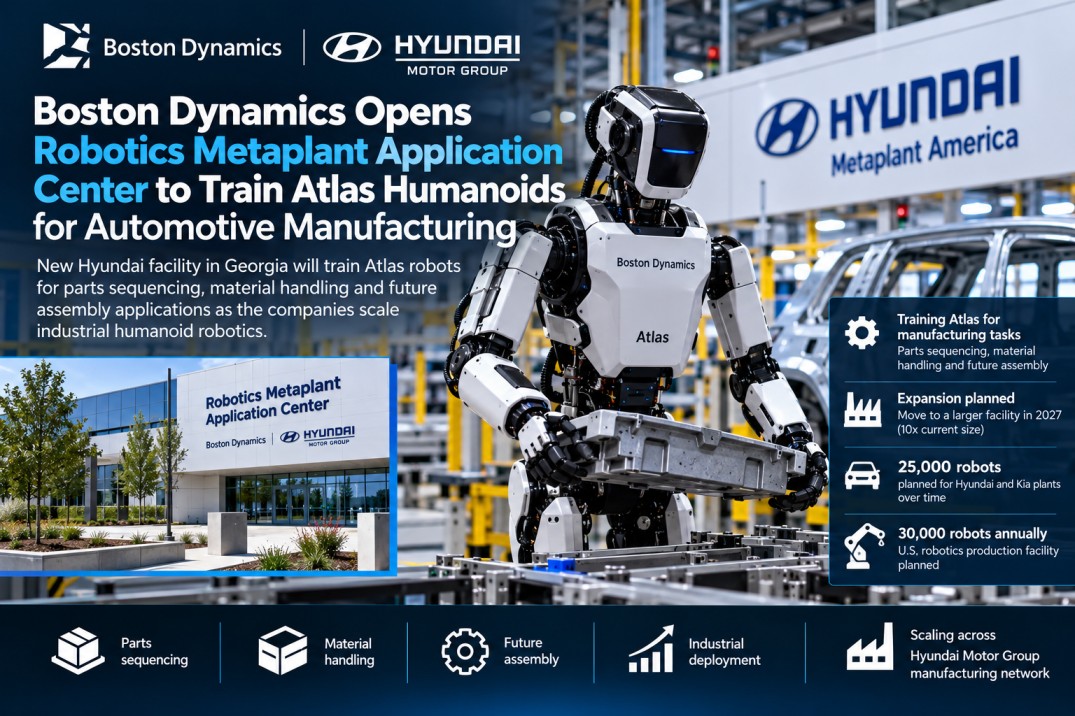
New Hyundai facility in Georgia will train Atlas robots for parts sequencing, material handling and future assembly applications as the companies scale industrial humanoid robotics.
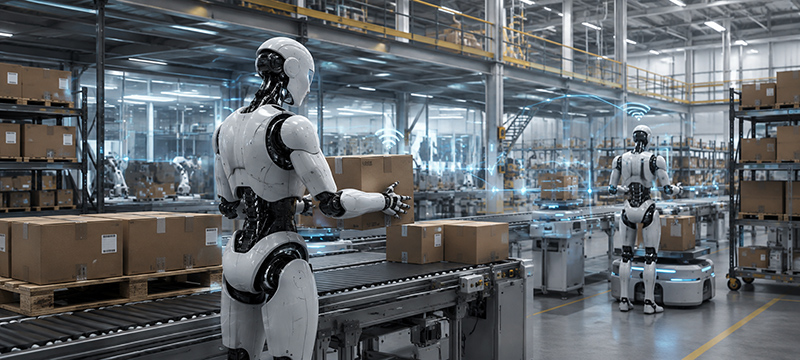
The facility represents a step toward deploying humanoid robots in real-world industrial environments. Atlas is being trained on manufacturing tasks including preparing and sequencing automotive parts before they are delivered to assembly operations. The companies plan to expand the robot’s responsibilities over time to include component assembly, repetitive operations and heavy-load handling.
Atlas Moves From Development to Factory Training
The RMAC provides a controlled environment where Atlas can learn and validate tasks using real manufacturing conditions. Boston Dynamics said the center will support the collection of operational data needed to improve Atlas before broader deployment across Hyundai Motor Group’s manufacturing network.
The first phase of the center is already operational. Boston Dynamics and Hyundai plan to move RMAC operations into a substantially larger facility at HMGMA in 2027, expanding the site to approximately ten times its current size.
Hyundai Motor Group previously outlined a phased roadmap for Atlas deployment. Parts-sequencing applications are planned from 2028, followed by component assembly applications from 2030, subject to safety and quality validation.
Hyundai Plans Large-Scale Atlas Deployment
Hyundai Motor Group plans to expand Atlas deployment across its global manufacturing network, with 25,000 robots planned for Hyundai Motor and Kia plants over the coming years. The Group also plans a U.S. robotics production facility capable of manufacturing 30,000 robots annually.
This manufacturing strategy is designed to connect Boston Dynamics’ robotics technology with Hyundai Motor Group’s automotive manufacturing infrastructure and supply chain capabilities.
The relationship also builds on Hyundai Motor Group’s majority ownership of Boston Dynamics and its broader strategy to develop an end-to-end robotics ecosystem spanning robotics hardware, AI, manufacturing, software and deployment.
Physical AI Enters Automotive Manufacturing
The Atlas program reflects the growing focus on Physical AI, where artificial intelligence is integrated with robots capable of sensing, reasoning and acting in physical environments.
Boston Dynamics' production Atlas is designed for industrial applications, with 56 degrees of freedom, a 2.3-meter reach and a maximum instantaneous lifting capacity of 50 kg. The robot supports autonomous, teleoperated and tablet-based control modes and includes human detection and fenceless safety capabilities.
The company has also designed Atlas for integration with manufacturing systems, including barcode and RFID workflows, allowing the humanoid to operate within existing industrial environments.
From Training Data to Scalable Deployment
A major focus of the RMAC is creating a continuous development cycle in which robots perform tasks, generate operational data and use that information to improve future performance.
Hyundai Motor Group describes RMAC as a training ground for its robotics strategy, with real-world manufacturing data supporting the development and validation of Atlas before wider commercialization.
The approach could allow Hyundai and Boston Dynamics to progressively introduce humanoid robots into increasingly complex manufacturing operations rather than attempting to automate entire processes at once.
Expanding the Industrial Humanoid Ecosystem
The Atlas program is part of a wider robotics strategy involving Hyundai Motor, Kia, Hyundai Mobis, Hyundai Glovis and other Group companies. The ecosystem is intended to combine manufacturing expertise, robotics components, software and AI capabilities to support larger-scale deployment.
Boston Dynamics is also exploring Atlas applications beyond automotive manufacturing. The company said it is discussing future use cases with customers across manufacturing, aerospace, semiconductors, logistics, food and beverage, and life sciences.
The opening of RMAC therefore marks more than a new robotics facility. It provides a real-world environment for testing how humanoid robots can transition from advanced prototypes into repeatable industrial workflows.
As Atlas moves through training, validation and deployment, the collaboration between Boston Dynamics and Hyundai Motor Group offers a closely watched example of how humanoid robotics, Physical AI and automotive manufacturing are converging to create new models of industrial automation.