SoftBank Group Corp. has agreed to acquire the Robotics and AI Institute (RAI), the Cambridge, Massachusetts-based research organization founded by Boston Dynamics founder Marc Raibert, according to multiple sources. Financial terms have not been disclosed, and the transaction is currently under review by the Committee on Foreign Investment in the United States (CFIUS).
RAI was established in 2022 following Hyundai Motor Group’s acquisition of Boston Dynamics. Hyundai provided more than $400 million in initial funding for the institute, which focuses on robotics research spanning control, perception, manipulation, navigation and artificial intelligence.
Marc Raibert’s Robotics Legacy
Raibert founded Boston Dynamics and later established RAI to pursue research into future generations of intelligent machines. RAI’s research includes dexterous manipulation and learning-based control designed to help robots operate more effectively in physical environments.
The institute has also contributed research connected to Boston Dynamics’ Atlas humanoid robot, including work on whole-body learning and dynamic robotic movement.
The potential SoftBank acquisition therefore brings the company back into the orbit of a robotics research organization created by the same founder whose earlier company it owned from 2017 to 2021. Hyundai later became the controlling owner of Boston Dynamics.
SoftBank Expands Its Robotics Strategy
The RAI transaction comes alongside SoftBank’s planned acquisition of ABB’s robotics business for approximately $5.4 billion. ABB brings decades of industrial robotics expertise, a large installed base and global manufacturing customers, while RAI contributes research capabilities in AI and advanced robotics.
SoftBank has also been increasingly active in Physical AI. In 2026, the company said it was pursuing initiatives that combine AI, robotics, computing and communications infrastructure to enable robots to make decisions and act in physical environments.
Physical AI and Robotics Research
RAI's research focus aligns closely with the industry's movement toward Physical AI, where AI systems perceive their surroundings and control machines to perform physical tasks.
The institute works on areas such as:
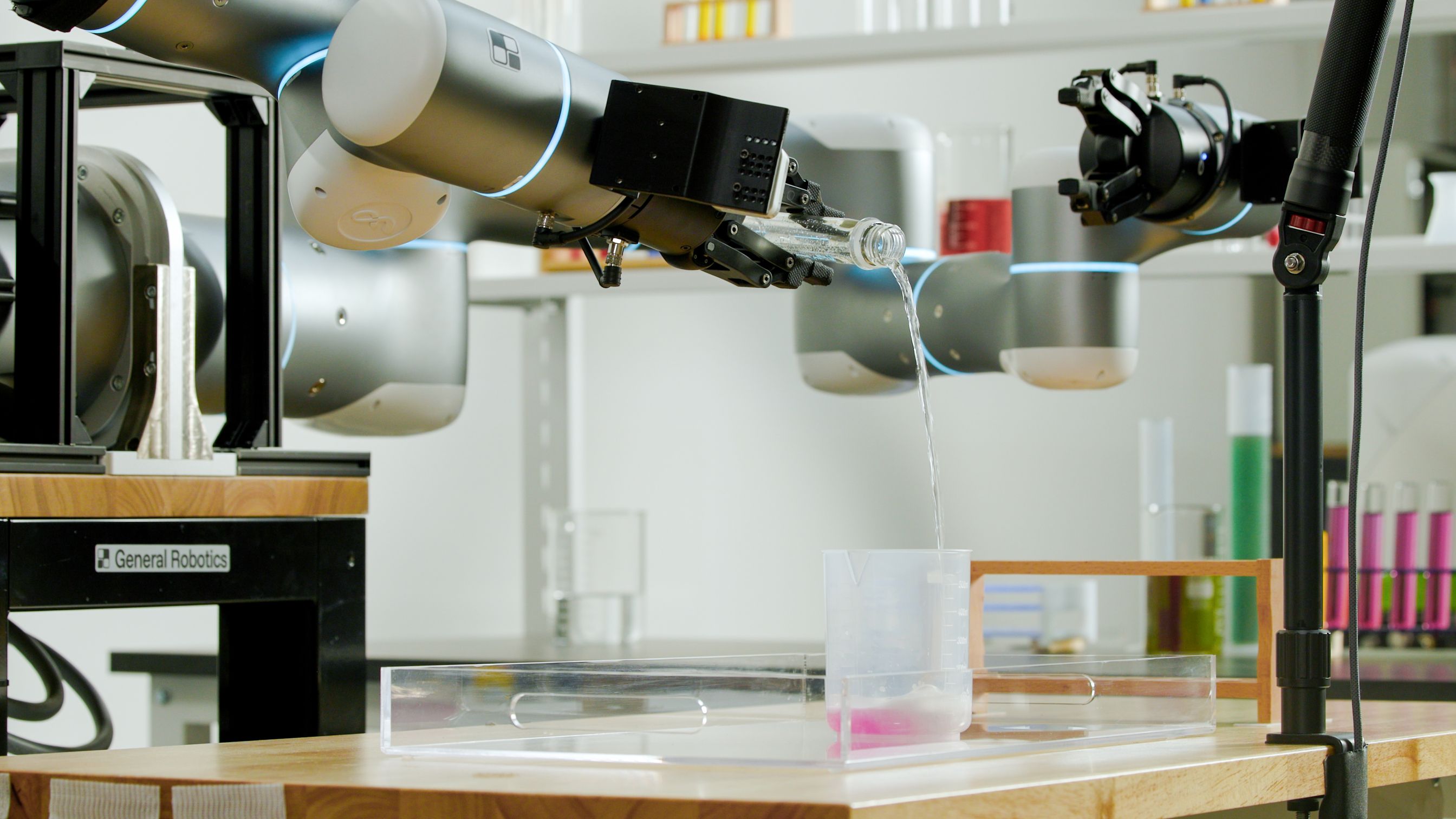
- Dexterous robotic manipulation
- Learning-based robot control
- Physical interaction models
- Navigation in challenging environments
- Robot perception and intelligence
These capabilities are relevant to applications ranging from humanoid robots and industrial automation to logistics and advanced manufacturing.
SoftBank's broader strategy also includes connecting robotics with external computing infrastructure. The company has demonstrated systems that dynamically offload AI processing from robots to edge computing environments while maintaining low-latency, reliable connectivity.
CFIUS Review Adds Uncertainty
The reported acquisition is subject to CFIUS review because RAI is a U.S.-based research organization and SoftBank is a Japanese company. Public reporting has not disclosed the stage of the review or any potential conditions attached to the transaction.
RAI told The Robot Report that it had no announcement to make regarding the transaction when contacted, while SoftBank had not commented at the time of the report.
A Broader Robotics Ecosystem
If completed, the acquisition would place RAI alongside SoftBank's expanding robotics interests, including its planned ABB robotics acquisition and other AI and robotics investments.
The combination of robotics research, industrial automation, AI and Physical AI infrastructure illustrates how the robotics industry is increasingly bringing together fundamental research and commercial deployment.
For the broader robotics ecosystem, the deal could become significant not simply because of RAI's research capabilities, but because it would connect Marc Raibert's research legacy with SoftBank's expanding investment in industrial robotics and AI.