GITAI Completes S3 Robotic Satellite Flight Model for Future On-Orbit Servicing Missions
The space robotics company has finalized its S3 mission flight model, designed to demonstrate autonomous satellite servicing, robotic operations, and modular spacecraft technologies for future commercial and defense applications.
Image Courtesy: Public Domain
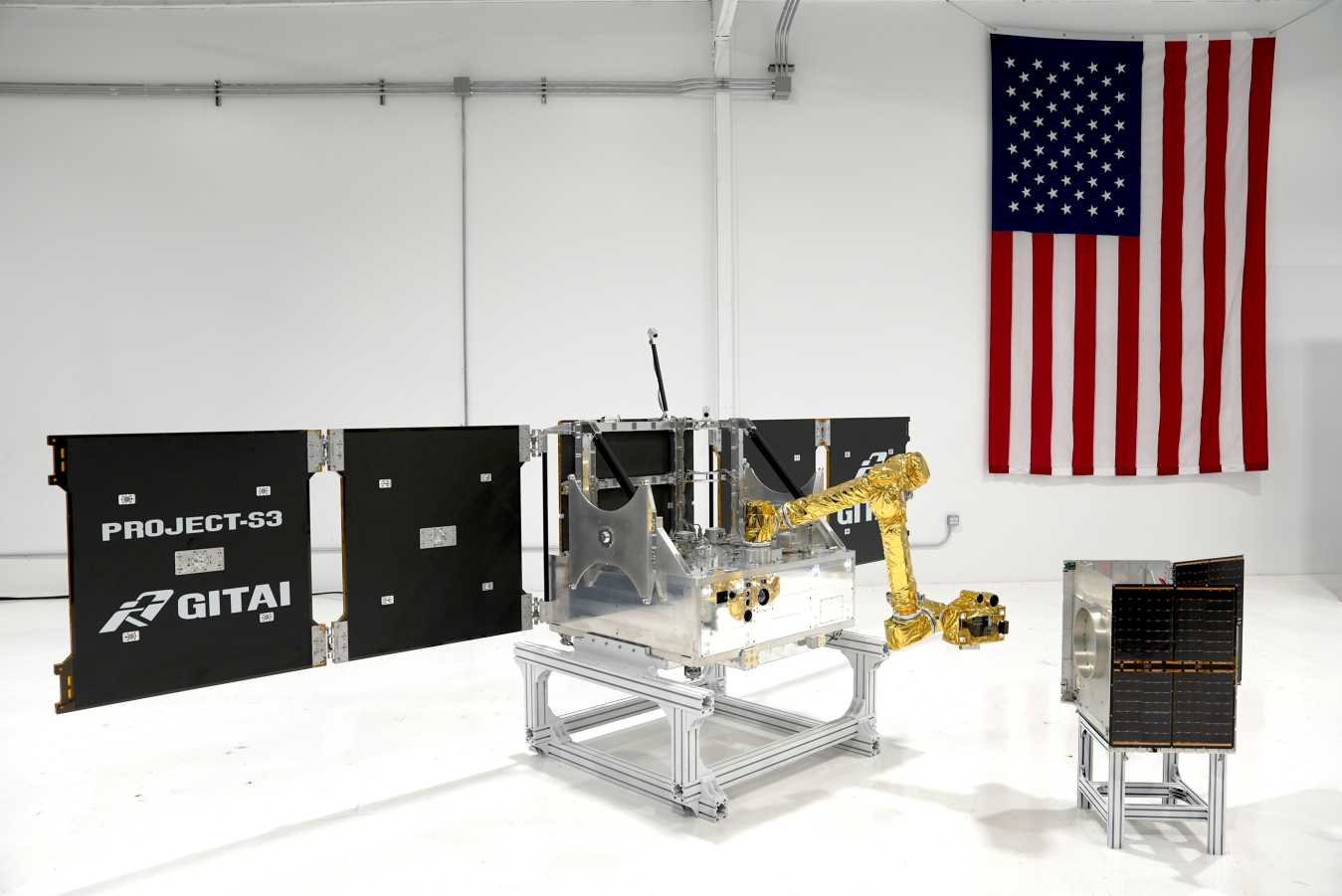
GITAI USA Inc. ("GITAI"), a U.S.-headquartered space robotics and satellite platform company, announced the completion of the flight model of its S3 robotic satellite mission, a technology demonstration mission designed to validate advanced on-orbit servicing technologies and demonstrate the company's modular spacecraft architecture supporting future defense-focused low Earth orbit (LEO) constellation services.
As governments and commercial operators increasingly seek resilient, scalable, and cost-effective space infrastructure, on-orbit servicing is expected to play an increasingly important role in supporting national security, civil, and commercial space missions.
The S3 mission is designed to demonstrate key capabilities required to support this emerging market. The S3 mission consists of a robotic servicing satellite equipped with an advanced robotic arm and autonomous rendezvous and docking technologies, together with a target satellite designed for on-orbit servicing demonstrations.
Demonstrating Technologies for Future On-Orbit Servicing Missions
The S3 mission is designed to demonstrate key technologies required for future on-orbit servicing missions. On-orbit servicing represents one of the core service offerings within GITAI's Defense-Focused LEO Constellation strategy, alongside missile defense, communications, and observation services.
The mission is designed to demonstrate:
* Autonomous rendezvous and proximity operations (RPO)
* Autonomous docking with non-cooperative satellites
* Robotic servicing operations
* Controlled de-orbit operations
Leveraging GITAI's robotic arm technology and proprietary vision-based software, the servicing satellite is capable of autonomously identifying a target spacecraft's separation ring and performing autonomous docking operations without requiring modifications to the client spacecraft, such as pre-installation of dedicated GITAI interfaces.
For commercial applications, the servicing satellite can provide life-extension services through a piggyback configuration, enabling client spacecraft to continue operations beyond their original mission lifetime.
For government and defense applications, the system can support satellite relocation, disposal, and controlled de-orbit operations.
Fully In-House Developed Spacecraft and Robotics
The S3 servicing satellite, including both the satellite platform and robotic arm system, was developed entirely in-house by GITAI.
By vertically integrating spacecraft, avionics, software, robotics, manufacturing, and testing, GITAI is able to rapidly develop and deploy advanced space systems while maintaining cost efficiency, schedule control, and design flexibility.
The mission also demonstrates GITAI's ability to develop sophisticated space systems with minimal reliance on external suppliers, enabling faster deployment cycles and greater scalability for future constellation programs.
Common Satellite Platform for Multiple Mission Types
Although the S3 mission focuses on on-orbit servicing, the spacecraft bus developed for S3 serves as a common modular platform that can also support missile defense, communications, and observation missions through the integration of different mission modules.
This common-platform approach enables GITAI to leverage a shared spacecraft architecture across multiple national security and commercial missions, significantly reducing development costs, manufacturing complexity, and deployment timelines.
The same spacecraft architecture is also being leveraged across GITAI's future Defense-Focused LEO Constellation programs and is intended to serve as a foundational platform for future missile defense, communications, observation, and on-orbit servicing deployments.
By leveraging a common spacecraft platform across multiple mission types, GITAI aims to reduce development costs, shorten deployment timelines, and accelerate the deployment of future defense-focused constellation services.
Flight Model Completion and Launch Readiness
The S3 flight model has completed manufacturing, assembly, and integration activities, with the exception of final installation of solar panels that have already been completed separately, and is substantially in a launch-ready configuration.
GITAI had previously secured a launch opportunity on SpaceX's Transporter-18 rideshare mission and originally planned to launch the S3 mission in October 2026.
Launch Schedule Updated to Prioritize U.S. Space Force Program
Following GITAI's selection as a Prime Contractor for the U.S. Space Force Space-Based Interceptor (SBI) program, the company has elected to prioritize execution of SBI program milestones and related customer deliverables.
Unlike many traditional defense programs that rely on extensive subcontractor networks, GITAI is executing the SBI program without relying on major subcontractors and develops and manufactures key elements of the system internally, including spacecraft, avionics, software, robotics, solid rocket motors, and mission systems.
GITAI believes that this vertically integrated approach represents the most effective path to achieving the cost, schedule, scalability, and performance objectives expected by government customers.
This approach enables rapid iteration, tighter system integration, reduced supply-chain dependency, and accelerated deployment timelines.
The same vertically integrated development model that enabled completion of the S3 flight model is now being applied to the SBI program.
As a result, GITAI has chosen to prioritize execution of its U.S. Space Force prime contract over its internally funded S3 demonstration mission, and the S3 mission launch has been deferred to a date after 2028.
The completion of the S3 flight model significantly reduces future mission risk while preserving the mission as a strategic technology demonstration platform supporting GITAI's long-term on-orbit servicing roadmap.