Faraday Future Showcases Physical AI Vision at Harvard World Speakers Series
Co-CEO Chris Chen highlights data-driven Physical AI infrastructure and unveils FF AI-Robotics’ “Three-in-One” strategy at a global innovation forum.
Image Courtesy: Public Domain
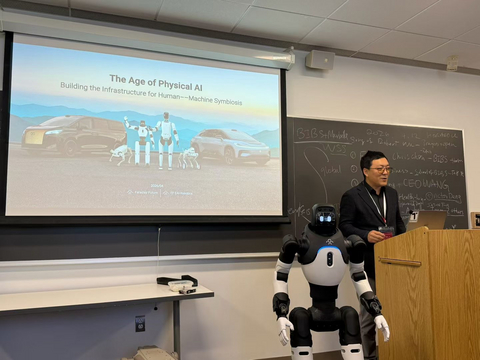
Faraday Future Intelligent Electric Inc. (NASDAQ: FFAI) (“Faraday Future”, “FF” or the “Company”), a California-based global Embodied AI (EAI) ecosystem company, announced that Chris Chen, Co-CEO of FF AI-Robotics, was invited to speak at the World Speakers Series, held on April 12 at the Science Center at Harvard University. The World Speakers Series was hosted by the Boston International Business School (BIBS) as a parallel forum to the Harvard China Forum, attracting significant attention from academic leaders, industry executives, and global innovators.
At the forum, Chris delivered a keynote presentation on the evolution of Physical AI infrastructure, emphasizing that data — not just algorithms — will be the defining foundation of the next generation of AI systems. Chris shared FF AI-Robotics’ latest progress in its “Three-in-One” strategy, which integrates large-scale robotics deployment, a robotics data factory, and the EAI Brain, along with an open-source, open-platform developer ecosystem.
Unlike traditional AI, Physical AI requires continuous real-world data acquisition, closed-loop learning, and scalable data infrastructure, positioning robotics not only as products, but as data-generating assets. FF AI-Robotics is building a full-stack, closed-loop ecosystem connecting devices, data, and intelligence, enabling real-time data capture, model training, and deployment across diverse real-world scenarios.
During the event, FF AI-Robotics also conducted live demonstrations of its humanoid robot, FF Master, and quadruped robot, FX Aegis. These demonstrations showcased not only hardware capabilities, but also the Company’s ability to collect high-value embodied data and accelerate the evolution of its EAI Brain.
“The Harvard University Science Center has long been a global hub for defining the future direction of science and technology,” said Chris Chen. “Today, Physical AI is no longer just about robots — it is about building a new data infrastructure for the physical world. As the first U.S. company to deliver both humanoid and bionic robots, we believe our role is to bridge deployment, data, and intelligence at scale.”
This event signals the emergence of Physical AI as an infrastructure-level industry, where data factories, developer ecosystems, and real-world deployment will define long-term competitive advantage. It further strengthens Faraday Future’s strategic positioning in embodied AI and reinforces its vision of enabling human–machine symbiotic productivity through data-driven intelligence.