Galbot’s Humanoid Robot G1 Stuns 2026 Spring Festival Gala with Real-Time Autonomous Intelligence
Powered by AstraBrain, the world’s first end-to-end embodied AI model, Galbot G1 demonstrated human-like dexterity—from rolling walnuts to folding clothes—marking a major leap toward general-purpose humanoid robotics.
Image Courtesy: Public Domain
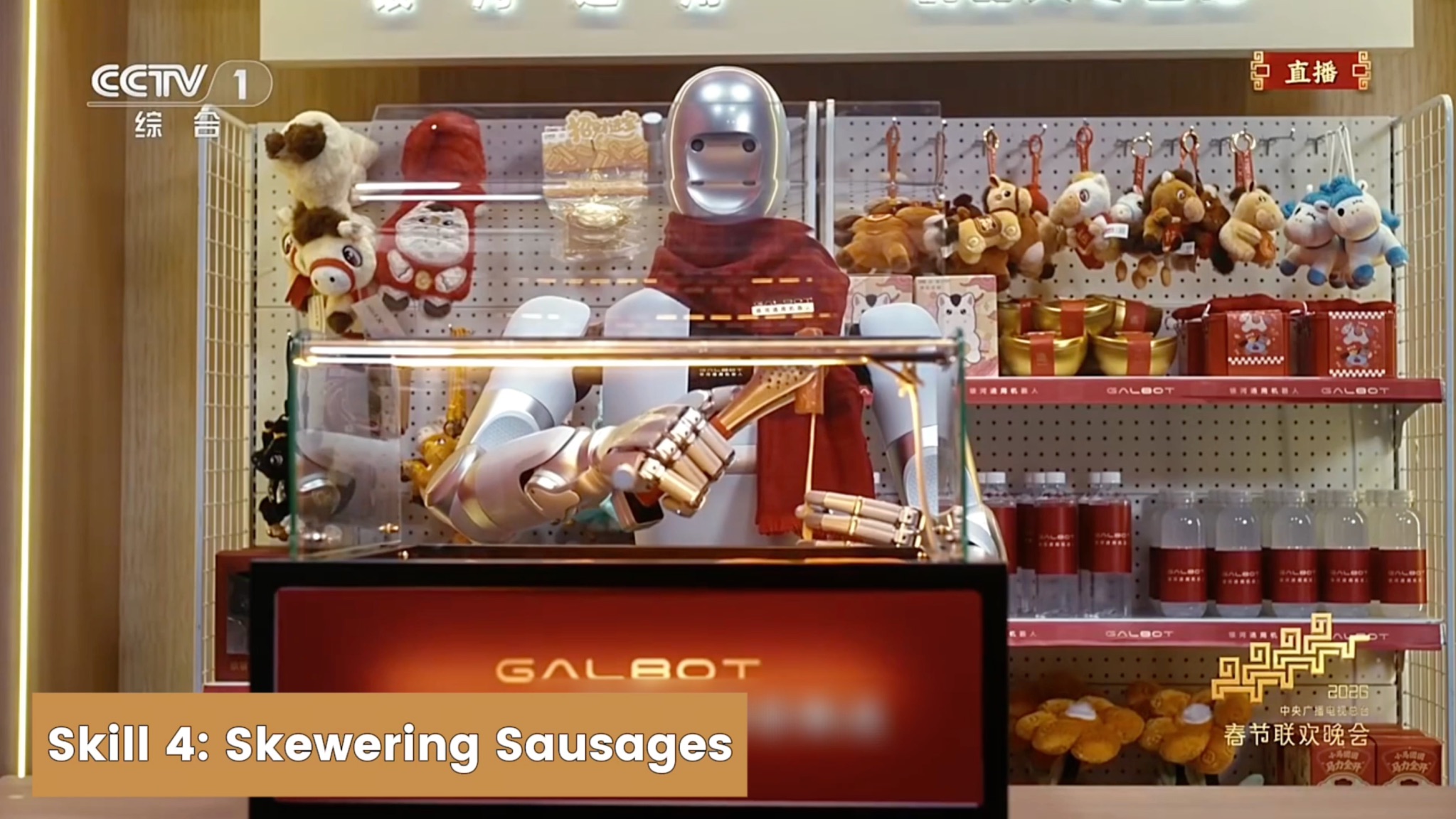
At the 2026 Spring Festival Gala, Galbot’s humanoid robot Galbot G1 delivered a striking series of demonstrations that captivated audiences nationwide. From rolling walnuts in its palm and picking up scattered glass fragments, to retrieving items from dense retail shelves and performing everyday tasks such as folding clothes and skewering sausages, the robot executed each operation with dexterity, fluidity, and natural, human-like motion.
Unlike conventional robot performances that rely on pre-programmed routines, Galbot’s Spring Festival Gala showcase was powered by an end-to-end autonomy pipeline—real-time perception, decision-making, and execution without scripted trajectories. Behind these “signature skills” lies Galbot’s large-model path that diverges fundamentally from traditional modular robotics.
A New Paradigm: Training Embodied Intelligence with Massive Real-and-Virtual Data
Galbot attributes its core capability to a proprietary new paradigm: end-to-end training of an embodied foundation model through ultra-large-scale mixed real-and-simulated data, enabling coordination between “brain” and “cerebellum”-like subsystems for whole-body and whole-hand control.
At the center of this approach is AstraBrain—the world’s first integrated end-to-end, whole-body-and-hand embodied large model that unifies “brain–cerebellum–neural control” into a single model architecture. Built on a self-constructed, tens-of-billions-scale embodied intelligence dataset, AstraBrain enables robots to move beyond “memorized scripts” toward generalizable competence across tasks and environments.
Real-time Autonomous Performance: Five Signature Skills, Five Technical Breakthroughs
On the Gala stage, every action demonstrated by Galbot G1 was not a pre-written program, but the result of AstraBrain’s real-time autonomous decision-making. Below are the five representative skills and the technical innovations behind them.
Skill 1: Rolling Walnuts
When the robot placed two walnuts in its palm and rolled them with agile finger motions, it tackled a world-class dexterous manipulation challenge. Walnuts have irregular surfaces and uneven mass distribution; as the walnuts move, the force contact points across fingers shift continuously. Even slight torque deviations can cause slippage.
Galbot explains that AstraBrain’s "cerebellum"-like control component enables highly stable micro-adjustments at the fingertip level—providing a human-like "feel" for maintaining secure and precise in-hand motion.
Skill 2: Picking Up Glass Fragments
On stage, the robot was asked to pick up scattered glass shards from a light-colored tabletop—an operation that is risky even for humans and a dual stress test for robotic perception and control.
Transparent objects are nearly “invisible” in RGB vision, especially against bright backgrounds, where edges, thickness cues, and specular reflections blend into the environment. Traditional vision pipelines struggle to estimate the 3D contour, pose, and grasp points.
Galbot states that AstraBrain overcomes this through massive-scale synthetic generation of transparent-object data in simulation—glass fragments with varied thickness, fracture patterns, and lighting conditions—so the robot has effectively “seen” countless transparency cases in a virtual world. With multi-modal perception fusion, the robot can detect subtle reflective edges and shadow changes, then plan a grasp strategy.
Equally critical is force-aware control: upon contact, the robot detects hardness and slip tendencies, applying just the right grip—firm enough to lift, gentle enough to avoid crushing or dropping.
Galbot notes this capability opens new possibilities for handling transparent objects in scenarios such as home cleaning and industrial recycling.
Skill 3: Product Retrieval from Packed Shelves
In another highlight, the robot retrieved a bottle of mineral water from a shelf where items were tightly packed with minimal spacing—an error-prone setting where even small misalignment can knock adjacent items over or cause a failed grasp.
Galbot explains that AstraBrain’s reinforcement learning framework let the robot undergo massive-scale trial-and-error in simulation, with penalties for colliding with nearby items and rewards for successful retrieval. Over extensive self-improvement, the robot discovered an efficient strategy: hook the bottle near the cap area with delicate finger placement, tilt slightly to avoid neighboring goods, adjust angle in response to resistance, and then draw the bottle out smoothly.
Crucially, this is not a preset path. Each micro-movement—hooking, tilting, re-angling, extracting—is a real-time decision made within milliseconds based on the current scene state.
Skill 4: Folding Clothes
Folding garments is widely regarded as one of robotics’ hardest manipulation problems because fabric has no fixed shape; every lift produces a different configuration.
AstraBrain generates tens of thousands of deformable-object state variations in simulation, allowing the robot to learn how to map a current fabric state to an optimal action sequence. When the robot smoothed corners and executed a clean fold, it was not following code—it was calling upon a learned decision policy grounded in large-scale simulated experience, reflecting true “generalization” rather than rote memorization.
Skill 5: Skewering Sausages
If rolling walnuts tests single-hand dexterity, skewering sausages pushes the limits of bimanual coordination and tool use.
On stage, the robot used one hand to operate tongs for grilling while the other controlled a skewer, coordinating two independent force-control channels and spatial trajectories before handing the finished item to a celebrity. Galbot emphasizes that the smooth sequence required not only dual-hand spatial coordination and independent force modulation, but also an embodied understanding of tools as an extension of the body.
AstraBrain's Core Philosophy: From “Memorization” to “Generalization”
Across these tasks, a clear theme emerges: AstraBrain is designed to reject rigid, task-specific scripting and instead build a general-purpose competence transferable to new scenes and new tasks. The model is trained through a unified pipeline that combines a small amount of human demonstration to capture task intent, massive high-fidelity simulation and synthetic data to expose the robot to diverse scenes and object states, reinforcement learning to refine precision and collision-free behavior through trial-and-error, and finally lightweight real-world fine-tuning to close the sim-to-real gap—together enabling real-time autonomy that adapts to new environments rather than “memorizing” fixed routines.
From Stage to Scale: Turning Technical Leadership into Real Productivity
Galbot emphasizes that technical leadership must translate into real-world productivity. Its robots are already widely deployed beyond the lab across industrial manufacturing, logistics, retail, tourism, and healthcare, with over a year of real-world deployments validating robust reliability and scalable commercialization.
In manufacturing, Galbot has formed partnerships with global and domestic industry leaders—including CATL, Bosch, Toyota, Hyundai, BAIC, SAIC, Zeekr, and Great Wall Motor—and states that deployments have progressed from pilots to production-facing use cases.
In retail and logistics, Galbot describes sustained, around-the-clock autonomous operation in robot-run stores, warehouses, and smart pharmacies, where Galbot G1 handles inventory checking, picking, and handoff workflows across thousands of SKUs. Beyond retail, Galbot says it is expanding embodied intelligence into city-level consumer experiences and hospital applications, aiming to reduce frontline workload and improve service accessibility in everyday settings.