Next-Generation Humanoid Robots Expand Market Reach and Drive Long-Term Recurring Revenue
Advances in AI, mobility, and human–robot interaction are accelerating adoption across healthcare, enterprise, and industrial markets as major players scale deployments.
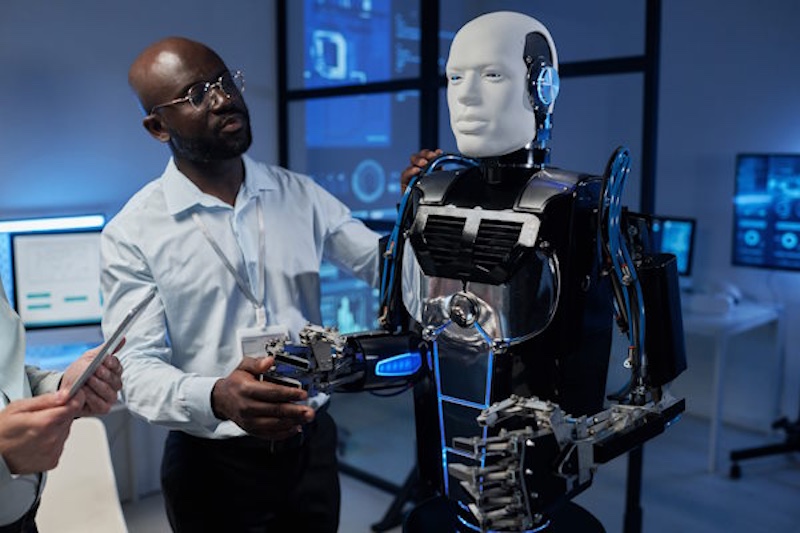
Image Courtesy: Public Domain
Next-generation robotics platforms are expanding addressable markets and unlocking long-term recurring revenue potential
The humanoid robot industry is influenced by evolving needs in personal assistance, healthcare, and industrial automation. Trends such as AI-driven human–robot interaction, advanced mobility and dexterity, and integration with IoT and cloud platforms directly enhance functionality and user experience. These advancements drive end-user demand for reliable assistance, improved productivity, and enhanced customer engagement, shaping deployment strategies and accelerating the growth of humanoid robot developers and solution providers such as: Realbotix Corp. (OTCQB: XBOTF) (TSX-V: XBOT), Serve Robotics Inc. (NASDAQ: SERV), Tesla, Inc. (NASDAQ: TSLA), NVIDIA Corporation (NASDAQ: NVDA) and Richtech Robotics Inc. (NASDAQ: RR).
A recent report from MarketsAndMarkets said that: "The global humanoid robot market is projected to grow from USD 2.92 billion in 2025 to USD 15.26 billion by 2030, registering a CAGR of 39.2%. Growth is being propelled by rising adoption of humanoid robots in personal assistance, caregiving, and healthcare applications, alongside increasing deployment in manufacturing, retail, and logistics for workforce augmentation. The market is further supported by rapid advancements in artificial intelligence, natural language processing, and human–robot interaction, coupled with large-scale R&D investments, pilot deployments, and strong government initiatives in Asia Pacific, North America, and Europe aimed at accelerating robotics adoption across industries."
The MarketsAndMarkets report continued: "The humanoid robot market is segmented into hardware, software, and services. The software segment is expected to grow at the highest CAGR, driven by advancements in artificial intelligence, natural language processing, and computer vision that enable enhanced human–robot interaction and autonomous decision-making. This growth is further supported by increasing demand for cloud-based analytics, real-time monitoring, and AI-driven personalization, making software a critical enabler for humanoid robots across healthcare, personal assistance, retail, and industrial applications. Hardware continues to dominate in terms of overall market share due to the need for sensors, actuators, and control systems, while services are witnessing steady growth through integration, maintenance, and training support."
Ericsson Deploys Realbotix Humanoid Robot for Workforce and Visitor Engagement - Realbotix Corp. (OTCQB: XBOTF) (TSX-V: XBOT) (Frankfurt: 76M0.F) ("Realbotix" or the "Company"), a leader in AI-powered humanoid robotics, announced Ericsson is deploying an advanced humanoid robot equipped with Realbotix's proprietary vision technology for workforce and visitor engagement. The robots will power workforce training, stakeholder engagement, and interactive experiences at Ericsson's Imagine Studio experience center in Plano, Texas.
Realbotix's vision technology, a proprietary advancement that allows the robot's eyes to autonomously detect movement and emotions, remember faces, recognize colors, and even read, enables the robots to respond accordingly during interactions with humans.
Powered by Realbotix's proprietary modular hardware and AI-agnostic architecture, the robot will serve as a dynamic, adaptable human–robot interface for real-world applications including:
- Workforce Training & HR Guidance – Providing employees with personalized development pathways, making career growth more accessible and data-driven.
- Studio Greeter & Engagement Tool – Serving as an interactive greeter, the Realbotix robot will offer an immersive visitor experience, reflecting innovation in conversational AI and robotics.
- Campus Outreach & Career Guidance – Inspiring students by delivering personalized career guidance and showcasing pathways for success in the tech industry.
"Ericsson's adoption of Realbotix robots underscores the growing confidence in AI-powered humanoid robotics, bridging technology with real-world applications. This milestone represents a leap for Realbotix, positioning our humanoid robots as integral partners that will shape the workplace of the future," said Andrew Kiguel, CEO of Realbotix.
With applications ranging from customer engagement and corporate training to HR analytics and career guidance, Realbotix continues to demonstrate the value of humanoid robotics across industries. Continued… Read this full release for Realbotix by visiting: https://www.realbotix.ai/news
Other recent developments in the robotics industries include:
Serve Robotics Inc. (NASDAQ: SERV), a leading autonomous robotics company, announced that it has entered into an agreement to acquire Diligent Robotics, Inc. ("Diligent"), a pioneering provider of AI-powered robot assistants for the healthcare industry. The transaction marks the first expansion of Serve's autonomy platform into indoor environments, with hospitals as one of the most high-impact settings for robotics.
Diligent was founded in 2017 by Andrea Thomaz and Vivian Chu, world-renowned social roboticists, with the vision of creating socially intelligent robot assistants that improve human labor productivity. Since its inception, Diligent has raised over $100 million in financing from investors including Tiger Global, Canaan, and True Ventures.
The Optimus project is expected to operate under the Tesla, Inc. (NASDAQ: TSLA) umbrella, aligning it with a broader trend among automakers exploring humanoid robotics, such as Hyundai's work with Atlas. Tesla's humanoid robot is positioned as a general-purpose assistant capable of performing physically demanding or potentially hazardous tasks. Musk has previously targeted a price of around $20,000 for Optimus – roughly half the cost of an entry-level Tesla Model 3.
If Musk succeeds in selling one million Optimus units, it would satisfy one of the key targets tied to his proposed $1 trillion compensation package. Calacanis, who claims to have visited Tesla's Optimus lab, expressed optimism in the project's potential, suggesting that Musk could ultimately produce not just a million, but a "billion" robots. He went so far as to call it "the most transformative technology product ever made in the history of humanity."
NVIDIA Corporation (NASDAQ: NVDA) recently announced new open models, frameworks and AI infrastructure for physical AI, and unveiled robots for every industry from global partners. The new NVIDIA technologies speed workflows across the entire robot development lifecycle to accelerate the next wave of robotics, including building generalist-specialist robots that can quickly learn many tasks.
Global industry leaders including Boston Dynamics, Caterpillar, Franka Robotics, Humanoid, LG Electronics and NEURA Robotics are using the NVIDIA robotics stack to debut new AI-driven robots. "The ChatGPT moment for robotics is here. Breakthroughs in physical AI -- models that understand the real world, reason and plan actions -- are unlocking entirely new applications," said Jensen Huang, founder and CEO of NVIDIA. "NVIDIA's full stack of Jetson robotics processors, CUDA, Omniverse and open physical AI models empowers our global ecosystem of partners to transform industries with AI-driven robotics."
Richtech Robotics Inc. (NASDAQ: RR), a U.S.-based provider of AI-driven robots operating in commercial and industrial environments, recently announced that it demonstrated its robotics solution platform, presented by humanoid robot Dex, at CES 2026 which was held from January 6 to 9, 2026, at the Las Vegas Convention Center (LVCC).
Accelerated by the NVIDIA Jetson Thor, Dex is capable of operating in dynamic environments, adapting with real time reasoning, and performing complex tasks with detailed precision, all while operating for four hours on a single charge. Dex also has been simulated and trained in NVIDIA's open-source, reference frameworks NVIDIA Isaac Sim and NVIDIA Isaac Lab.