Medra Launches AI Experimentalist to Accelerate Autonomous Scientific Discovery
Backed by a DARPA-funded project, Medra’s AI Experimentalist transforms scientific goals into autonomous, machine-executable experiments across the full research lifecycle.
Image Courtesy: Public Domain
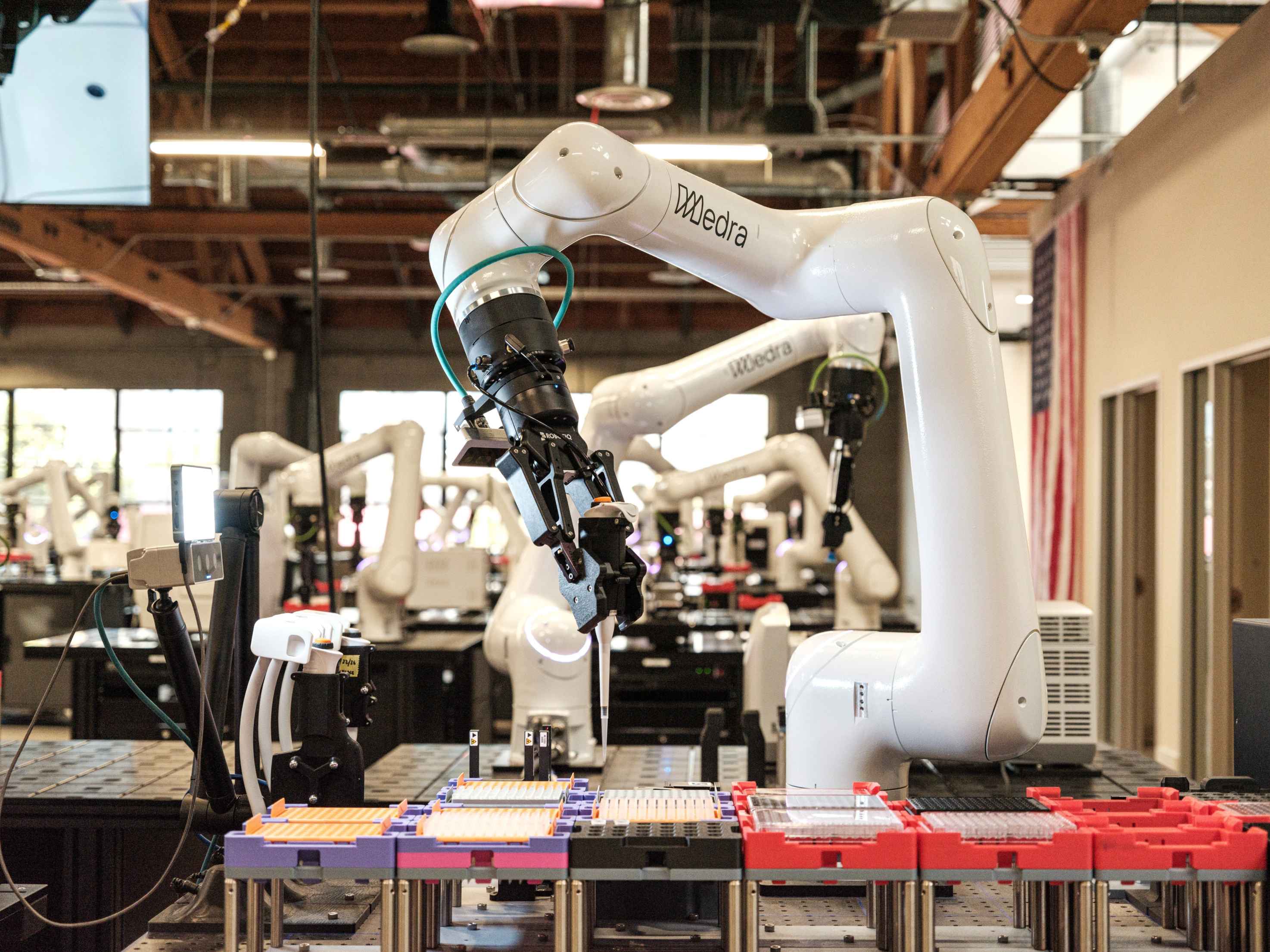
Medra, an autonomous science company, launched the AI Experimentalist, the scientific reasoning layer of its Physical AI Scientist Platform, and announced a project funded by the Defense Advanced Research Projects Agency (DARPA). As part of this DARPA-funded project, Medra is advancing its platform’s capabilities to translate natural-language scientific goals and human-written protocols into machine-executable experiments that can be measured, learned from, and improved over time. DARPA is an independent research and development agency within the U.S. Department of Defense responsible for breakthrough technologies for national security.
Scientists can specify high-level research objectives, and Medra’s AI Experimentalist translates them into executable experimental plans. Unlike AI tools that focus on a single stage of the scientific workflow, the AI Experimentalist spans the full experimental cycle: from reviewing literature and designing experiments to coordinating wet-lab execution, analyzing results, and refining protocols for subsequent runs. By closing the loop between planning, execution, and learning, it enables experiments to be carried out with minimal human intervention while keeping scientists in control of research goals.
The AI Experimentalist works in concert with Medra’s Physical AI Lab, a wet-lab execution layer. Together they form the Physical AI Scientist platform, a closed-loop system that tightly couples scientific reasoning and experimentation. With a model-agnostic agentic harness and a multi-agent architecture, the platform can incorporate frontier AI capabilities alongside scientific agents and prediction models.
Partners can access Medra’s AI Experimentalist through Physical AI Labs deployed on site at customer facilities or operated remotely through Medra Lab 001 (ML001), Medra's flagship autonomous science laboratory. Built in 77 days and opened in April 2026, select closed-beta projects are now live across academia, biopharma, and government, including DARPA. ML001 is currently running and developing assays in antibody discovery, protein engineering, gene editing, and cell biology.
“With frontier models becoming increasingly capable of predicting novel molecules and generating scientific hypotheses, the bottleneck in science is shifting toward the ability to validate those predictions,” said Michelle Lee, founder and CEO of Medra. “But running experiments is not just about robotic execution. Assay development and parameter tuning often take months of experimentation and refinement. The AI Experimentalist enables autonomous, end-to-end experimental design with a Physical AI lab in the loop.”