Genesis AI Introduces GENE-26.5 Robotic Brain Enabling Human-Level Dexterity in General-Purpose Robots
New full-stack robotics platform combines advanced AI foundation models, human-matched robotic hands, and scalable data systems to unlock next-generation robotic manipulation and automation.
Image Courtesy: Public Domain
Genesis AI, a global full-stack robotics company, announced GENE-26.5, the first robotic brain to give robots human-level physical manipulation capabilities. Alongside it, Genesis AI introduced a first-of-its-kind system to unlock unlimited amounts of data and train GENE-26.5 at scale. The system combines two proprietary components: a human-scale dexterous robotic hand that enables direct skill transfer from humans to robots and a powerful new data engine. Together, these innovations overcome the fundamental bottleneck in data that has constrained robotics foundation models, paving the way for a new generation of highly-productive general-purpose robots.
"The brain and hand are the two most valuable and complex pieces of robotics, and today we are presenting the industry's most advanced versions of both," said Zhou Xian, Co-Founder and CEO of Genesis AI. "For the first time ever, we're enabling robots to do what only human hands could, and do it reliably, at scale."
Reimagining Robotic Intelligence
GENE-26.5 is an AI foundation model, purpose-built for robotics and designed to absorb massive amounts of data and environments. It enables robots to perform complex, long-horizon tasks with unmatched dexterity in order to achieve human-level capabilities. With GENE-26.5, Genesis AI is advancing a future where robots can be instantly deployed, and adapt to new environments and unfamiliar tasks.
To demonstrate GENE-26.5's superior performance, the company revealed today a video showcasing a collection of the most complex tasks ever performed by robots. The video includes Genesis AI's robotic system mastering the following difficult activities with human-level control and accuracy, demonstrating fluid, human-like dexterity and precise, coordinated hand movements:
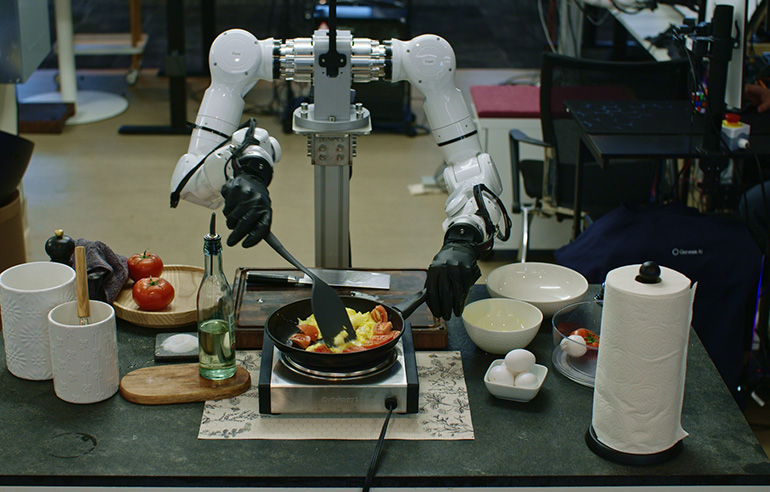
- Cooking a 20-step meal, including chopping tomatoes, one-handed egg cracking and seamless two-hand coordination.
- Preparing a smoothie, including ingredient handling, pouring, blending and mid-air serving with coordinated two-hand control.
- Conducting high-precision lab experiments with delicate instrumentation including pipetting, liquid transfer and mid-air manipulation.
- Wire harnessing, arranging and securing wires into organized bundles, one of the most difficult electronics and electrical engineering tasks.
- Solving a Rubik's Cube, using continuous in-air manipulation requiring coordinated, high-speed reasoning and precise wrist control.
- Single-handed multi-object grasping, simultaneously handling 4 objects of varying sizes and sorting them into designated bins.
- Playing the piano at a human level, performing an ultra-fast, highly complex composition.
With this video, Genesis AI has proven that GENE-26.5 can empower robots with a wide range of complex skills and a level of physical manipulation that was not possible before.
"General-purpose robotics stands to reshape the global economy while opening an entirely new chapter for AI," said Eric Schmidt, former CEO of Google and Genesis AI investor. "Genesis is introducing a paradigm shift in robotics. This marks an important milestone for their team and the robotics industry more broadly."
Learning Powered by Unlimited Human Data
The embodiment gap, or the difference between the human form and robotic form, has always drastically limited robots' performance and ability to learn from human data. Genesis AI is shattering those limitations with its proprietary hardware that exactly matches the human hand.
Genesis AI's dexterous robotic hand mirrors the human hand in form and function, and pairs with a data collection glove equipped with tactile-sensing electronic skin. When worn by a human, the glove allows for a 1:1:1 mapping between the glove itself, the human's hand and the robotic hand. This allows humans to seamlessly provide GENE-26.5 with high-quality data at scale that translates into robotic skills. The result is natural, human-like movement that generalizes reliably across complex physical tasks, use cases and environments.
Genesis AI's glove is 100 times cheaper than typical options in terms of hardware cost, and in internal testing it has demonstrated up to five times greater data collection efficiency with better quality, compared to traditional teleoperation methods. This approach enables a cost structure that makes continuous, large-scale robotics training viable for the first time. To put this data collection into action, Genesis AI is engaging with partners to deploy the glove in real-world work environments. By simply wearing the glove while working as usual, everyday tasks performed at real facilities become abundant sources of new training data. This unlocks the ability to collect entirely new categories of data directly on the job and will help Genesis AI build the world's largest human skill library.
In addition to glove data, Genesis AI's data engine taps into egocentric video data from humans wearing cameras to capture how they interact with the world, and massive amounts of human-based internet videos. Having closed the embodiment gap, Genesis AI can leverage these types of data more effectively than any other company. Genesis AI's approach drives a step change in a foundation model's ability to learn more efficiently and allows robots to perform more complex tasks.
"At Genesis, we believe winning in robotics requires excellence at every level," said Theophile Gervet, Co-Founder and President of Genesis AI. "That's why we're obsessed with innovating across the full-stack, from AI to hardware. By controlling every layer, we can build a cohesive system and solve the problem holistically. Our approach gives us a huge competitive advantage by harnessing unprecedented amounts of data as that ultimately defines what foundation models can achieve."
Genesis AI's Simulation Accelerates GENE-26.5
While robots exist to automate the physical world, robot development has always been one of the most manual processes in engineering. Genesis AI is changing this with its next-generation simulation system. Genesis AI's simulation delivers a never-before-seen level of realism, narrowing the sim-to-real gap. The sim-to-real gap, or the difference between the virtual and real world, has historically limited the usefulness of simulated training. By creating a uniquely accurate and reliable representation of real-world conditions with a rendering engine and physics that are hyper-realistic, robots perform similarly in the simulation as they do on the same tasks in the real world.
The simulation is the ultimate accelerator, allowing the entire stack to be developed, tested and improved in a self-evolving cycle where AI trains the AI in a fully virtual environment. This dramatically increases speed and scale, making it possible for teams to train and evaluate models orders of magnitude faster than traditional physical testing, which is often slow, expensive and difficult to scale.
"Genesis is changing the trajectory of robotics, bringing us closer to AI that can operate in the real world," said Vinod Khosla, Founder of Khosla Ventures and Genesis AI investor. "Genesis's groundbreaking foundation model powered by its human-centric data engine and its first-of-its-kind simulation are poised to dramatically increase development speeds and enable instant deployment with commercial customers."
Genesis AI will soon unveil its first general-purpose robot that will serve as the ultimate culmination of the technology unveiled today. The company continues to push the boundaries of full-stack robotics having raised $105 million in seed funding. It is backed by Eclipse, Khosla Ventures, Bpifrance and HSG, as well as visionary leaders including Eric Schmidt and Xavier Niel, and AI pioneers Daniela Rus and Vladlen Koltun.