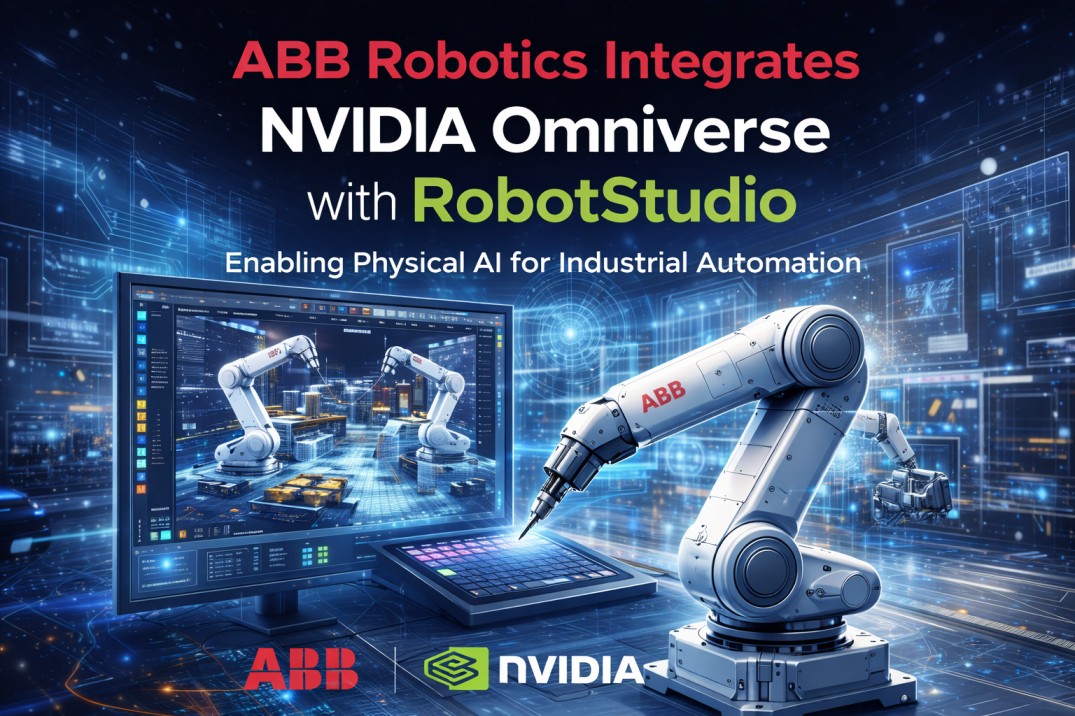
ABB Robotics Integrates NVIDIA Omniverse with RobotStudio to Enable Physical AI for Industrial Automation
New RobotStudio HyperReality platform bridges the sim-to-real gap with up to 99% accuracy, enabling faster deployment of AI-driven robots and reducing manufacturing costs by up to 40%.
Image Courtesy: Public Domain
- ABB Robotics integrates NVIDIA Omniverse libraries into RobotStudio® to deliver physical AI for industry, closing the gap from virtual training to real-world deployment with up to 99% accuracy
- New RobotStudio HyperReality, available second half of 2026, will fundamentally change how quickly and reliably manufacturers can scale production, reducing costs by up to 40% and accelerating time-to-market by 50%
- Full range and breadth of industrial applications, with real-world pilot being conducted by Foxconn in consumer electronics assembly
- At NVIDIA GTC, the robotic workforce company WORKR will showcase how it’s using the solution to help manufacturers across the U.S. addressing critical labor shortages
ABB Robotics announced it is integrating NVIDIA Omniverse libraries into ABB Robotics’ RobotStudio® to help manufacturers deploy physical AI in real world robotics applications.
“Today, using NVIDIA accelerated computing and simulation technologies, we have removed the last barriers to making industrial and physical AI a reality at a global scale by closing the sim-to-real gap,” said Marc Segura, President of ABB Robotics. “For more than 50 years, ABB Robotics has led the evolution of intelligent industrial automation, from pioneering the first generation of fully electric industrial robots to advancing digital twin simulation through RobotStudio® and shaping a new area of autonomous and versatile mobile robots. Today’s announcement with NVIDIA brings physical AI to industry at scale.”
The collaboration focuses on combining ABB Robotics’ software programming, design and simulation suite, RobotStudio, with the physically accurate simulation power of NVIDIA Omniverse libraries to close technology's long-standing 'sim-to-real’ gap. Developers can simulate robots in digital twins and generate synthetic data to train their physical AI models, enabling businesses of all types and sizes to deploy AI-driven robotics for various industrial workflows.
Called RobotStudio HyperReality, the resulting physically accurate simulations and foundation models are endlessly optimized with real-world data feedback continuously improving the system. These models can be used to train any number of ABB robots, anywhere in the world, with the reliability and accuracy demanded by industry.
“The industrial sector needs physically accurate simulation to bridge the gap between virtual training and the real-world deployment of AI-driven robotics at scale,” said Deepu Talla, vice president of robotics and edge AI at NVIDIA. “Integrating NVIDIA Omniverse libraries into RobotStudio brings advanced simulation and accelerated computing to ABB Robotics’ unique virtual controller technology, accelerating how manufacturers of all sizes bring complex products to market.”
Closing the ‘sim-to-real’ gap
The long-standing deficit between simulation accuracy and real-world lighting, materials and environments is known as the ‘sim-to-real’ gap. For decades, this gap has limited the ability of manufacturers to design and develop advanced manufacturing processes in the virtual world.
By integrating NVIDIA Omniverse libraries into RobotStudio, ABB Robotics will deliver unprecedented robotics simulation and synthetic data generation capabilities that will allow intelligent robots to bridge this gap with up to 99 percent accuracy. ABB is the only robot manufacturer with a virtual controller running the same firmware as the hardware, ensuring near‑perfect correlation between simulation and real‑world performance. Combined with ABB Robotics’ Absolute Accuracy technology, which reduces positioning errors from 8–15 mm to around 0.5 mm, ABB delivers unmatched precision in both virtual and physical environments, making it suited to high-precision industrial-grade applications.
This innovation enables manufacturers to design, test, and optimize production lines virtually, cutting setup and commissioning times by up to 80 percent, reducing costs by up to 40 percent by eliminating the need for physical prototypes, and accelerating time-to-market for complex products such as consumer electronics by 50 percent1.
ABB Robotics is also assessing the potential to integrate the NVIDIA Jetson edge computing platform into its Omnicore controller to achieve real-time AI inference at the edge for its extensive robot portfolio. Today’s announcement builds upon ABB Robotics’ long-standing work with NVIDIA, including the previous integration of NVIDIA Jetson into ABB Robotics’ VSLAM autonomous mobile robots as well as the development of gigawatt-scale AI data centers.
Real-world applications, today
RobotStudio HyperReality will serve industrial clients at any scale, across a breadth of industries and applications, with select customers already testing its capabilities ahead of a full release to ABB Robotics’ 60,000 RobotStudio customers worldwide in the second half of 2026.
Foxconn, the world’s largest electronics contract manufacturer, is piloting the first joint use case in consumer electronics assembly. Automating the assembly of a tiny piece in consumer electronics is challenging, as multiple device variants require different production methods and the delicate metal structure requires precise pick-and-place and assembly control, as well as fine-tuned setup, often demanding additional debugging time and engineering resources. Using RobotStudio HyperReality, Foxconn’s assembly robots are trained virtually, using synthetic data to perfect multiple real-world production processes in various scenarios, before moving them to the production line with 99 percent accuracy. By optimizing production lines virtually, Foxconn will reduce set-up times and costs by eliminating physical training and tests, and accelerate time-to-market for consumer electronics.
“Precision is everything in consumer electronics manufacturing and until now, this level of accuracy and fidelity just wasn’t possible in simulation and digital twins,” said Dr. Zhe Shi, Chief Digital Officer of Foxconn. “We’re incredibly excited by the potential of ABB Robotics and NVIDIA’s collaboration, which enables parallel engineering for better designs, faster production ramp‑up and greater product evolution through advanced AI inference and understanding.”
WORKR, a California based robotic workforce company that delivers robotic manufacturing solutions to industry, is extending the reach of this technology to small and medium manufacturers across the United States. At NVIDIA GTC 2026 (March 16-19, San Jose, CA), WORKR will demonstrate AI- powered robotic systems built on ABB technology, trained with synthetic data using NVIDIA Omniverse libraries, and deployed without operators needing to know any programming. By combining ABB's industrial grade robotics with its proprietary WorkrCore™ AI platform, the company is helping manufacturers address critical labor shortages with its robotic workforce that can learn new tasks in minutes and be operated by anyone.
"This collaboration is about making industrial AI deployable today,” said Ken Macken, CEO & Founder of WORKR. “Together with ABB and NVIDIA, we're proving that advanced automation can work for manufacturers of any size."