Otto Group and Sereact Deploy Physical AI Robots for Automated Returns Processing
The partnership will introduce 10 AI-controlled dual-arm robotic systems at Otto Group’s Polish logistics center, with plans to scale to 25 robots using Sereact’s Cortex Physical AI model and NVIDIA simulation technologies.
Image Courtesy: Public Domain
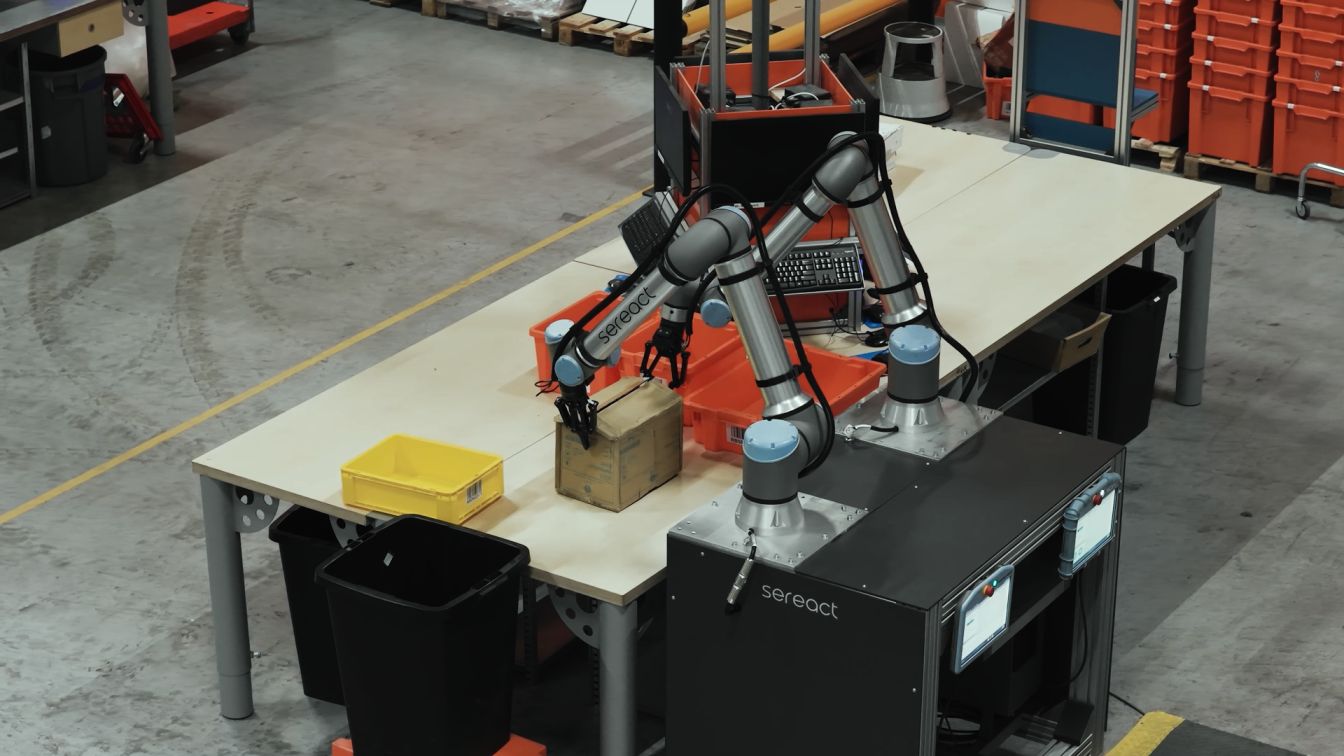
- At Otto Group’s logistics center in Poland, returns will be grasped, identified, assessed, and sorted by up to 25 AI-controlled dual-arm robots from Sereact.
- The robots run on Cortex, Sereact's Physical AI model, which can recognize and handle items it has never encountered – no product-specific teaching, no fixed item catalog.
- Cortex is trained and validated with NVIDIA Isaac Sim, NVIDIA Isaac Lab and NVIDIA Cosmos, so lessons from the returns line reach the robots in days, not weeks.
- Under a Robotics-as-a-Service model, Sereact operates and maintains the systems. Employees hand over repetitive grasping and lifting and take on supervision, exception handling and quality checks.
Otto Group and robotics software company Sereact announced a two-phase approach for AI-controlled robots in one of retail's most complex manual tasks: inspecting and sorting returned customer orders.
Initially, ten AI-controlled dual-arm systems will be deployed at Otto Group’s logistics center in Poland. In a second phase, 15 more robotic arms are planned to be added based on initial results, scaling the program to a total of 25. The two companies are jointly developing and refining the technology as part of the project, with Otto Group evaluating the potential for a broader rollout across its logistics network if the second phase is successful.
Few processes in e-commerce are as hard to automate as returns – items come back folded, crumpled, repackaged, and the assortment of a multi-category retailer never stops changing. Traditional automation depends on known products and predictable presentation, neither of which exists in returns. Cortex, Sereact's Physical AI model, is built for exactly this challenge: it generalizes objects it has never encountered and decides in real time how to grasp each item, assess its condition, and route it accordingly.
Cortex is built on NVIDIA’s physical AI stack. Sereact uses NVIDIA Isaac Sim and NVIDIA Isaac Lab to turn real picks from the returns line into thousands of simulated variants, and NVIDIA Cosmos world foundation models to re-render them across garment states, packaging, materials and lighting. New policies are post-trained on NVIDIA Blackwell GPUs and tested against held-out cases before they reach the robots. When a robot struggles with an item, the fix can come back as a tested update within days instead of weeks.
The robots will be introduced in stages over the course of the project. Each stage will generate operational feedback that the partners can use to improve the systems and adapt them to the requirements of large-scale returns processing. This shared development process is intended to establish whether the technology can meet the reliability, flexibility, and quality standards required for broader use.
Working hand in hand with robots, people stay at the center of the process: employees will shift away from repetitive grasping and lifting toward supervision, exception handling, and final quality decisions – tasks that depend on experience and judgment.
“Our customers expect returns to be simple and fast – behind that lies a process that is time-critical and laborious, both for customers and for our business. Returns are notoriously hard to automate, and Physical AI has the potential to change that. This project lets us find out, at real scale, how far Physical AI can take us – an important step towards a more flexible and resilient supply chain,” says Martin Umland, Group Vice President Supply Chain Management at Otto Group.
“A robot that only knows yesterday's catalog is of little use in a returns center. Cortex has to deal with whatever comes out of the next parcel. Every return the systems handle makes the model better at the next one,” Dr. Ralf Gulde, CEO and Co-Founder, Sereact.
The partnership builds on Otto Group's series of investments in robotics across its logistics operations and forms part of the company’s medium-term commitment to invest €350 million in technology and AI.