Orbbec Introduces Pulsar MH24 3D LiDAR for Mobile Robotics and Autonomous Systems
The compact 24-channel LiDAR delivers 360-degree scanning and outdoor-ready sensing, while Orbbec showcases depth cameras, RGB vision systems and global robot manufacturing services at the 140th Canton Fair.
Image Courtesy: Public Domain
- Orbbec launches its new Pulsar MH24 3D LiDAR and showcases depth cameras, RGB cameras, and contract manufacturing services at the 140th Canton Fair.
- The Pulsar MH24 features a compact design, 24-channel 3D sensing with detailed point cloud output, and reliable performance in challenging environments.
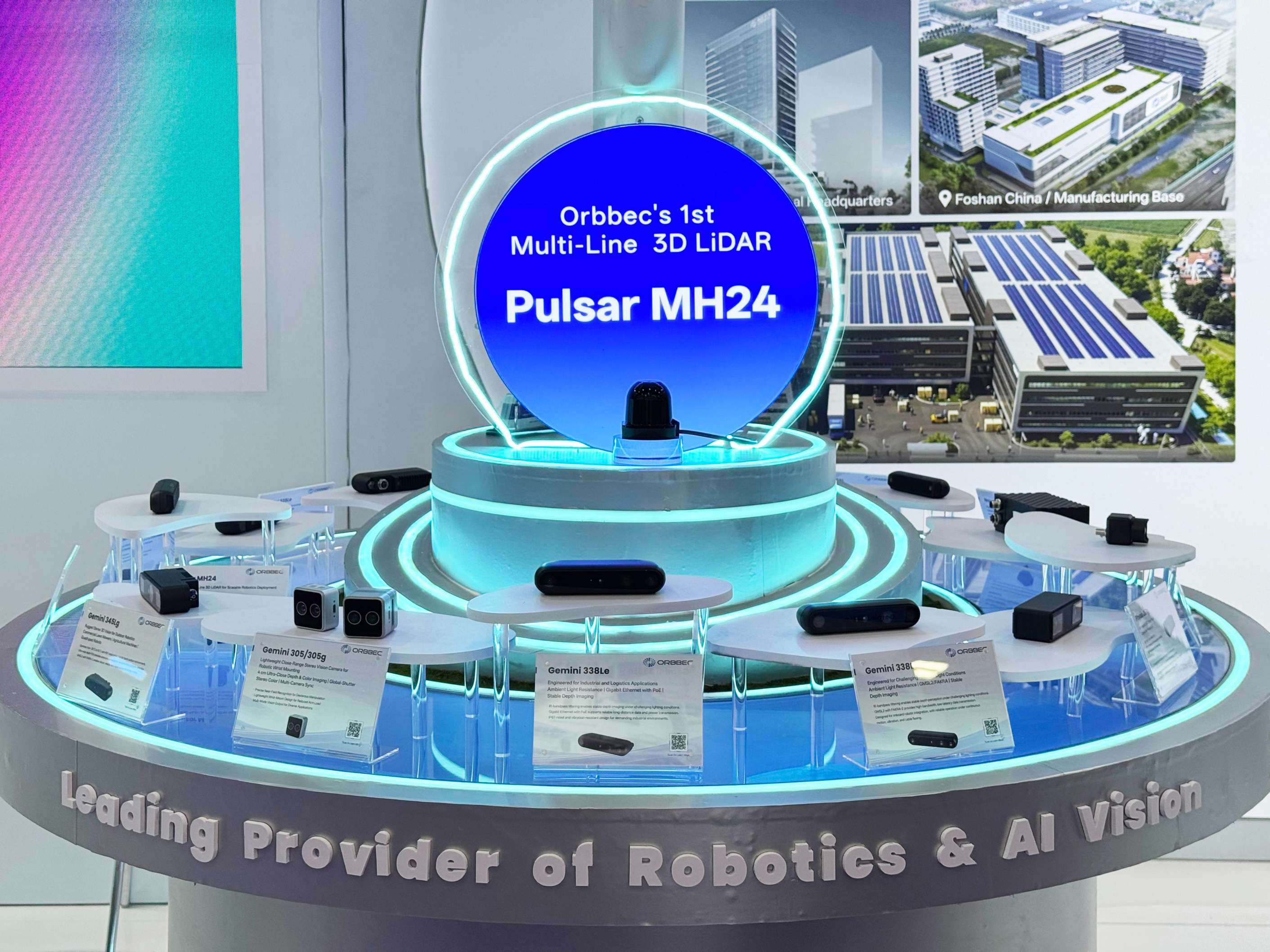
Orbbec, a leading provider of robotics and AI vision, unveiled the Pulsar MH24, a compact, high-performance 24-channel 3D LiDAR designed for reliable robotic perception across indoor and outdoor environments.
Debuting at the 140th China Import and Export Fair (Canton Fair), the Pulsar MH24 addresses the integration, sensing performance, and reliability requirements of robotic lawnmowers, autonomous mobile robots (AMRs), delivery robots, and other mobile robotic platforms. Orbbec also showcased its depth cameras and RGB cameras, and presented its contract manufacturing (CM) services for complete robots and components.
Pulsar MH24: A Compact 3D LiDAR for Large-Scale Robot Deployment
As mobile robots take on more demanding tasks across diverse environments, sensing systems must deliver consistent spatial data while meeting increasingly stringent size, power, and integration requirements. To tackle these challenges, the Pulsar MH24 combines 24-channel 3D sensing with a compact mechanical design, making it well-suited for robot deployment at scale.
- Compact Design, Detailed Point Clouds
The Pulsar MH24 measures 66.6 × 62.1 × 66 mm, weighs approximately 210 g, and features a 21 mm-high optical window, allowing integration into space-constrained robotic platforms. It delivers 24-channel scanning with 360° horizontal coverage. In applications such as robotic lawn mowing and delivery, a mobile robot equipped with the Pulsar MH24 can cover an operating area of approximately 15,000 m².
In structured indoor environments, its point clouds capture well-defined edges and geometric features, including walls, shelving, and equipment, supporting mapping, localization, and obstacle avoidance. A minimum effective detection range of 0.1 m allows point cloud capture close to the robot, helping reduce near-field sensing gaps.
- Reliable Perception in Challenging Environments
For outdoor applications, the Pulsar MH24 supports operation under ambient light levels of ≥100,000 lux, with an IP6K6 ingress protection rating, a vibration-resistant design, and an operating temperature range of -20°C to +60°C. Together, these features address exposure to intense sunlight, dust, water jets, and temperature fluctuations.
An anti-crosstalk design reduces interference when multiple LiDAR units or robots operate nearby. The Pulsar MH24 supports a 9–28 V DC input range for varied robotic power architectures, while typical power consumption below 4 W helps meet the power constraints of battery-powered robotic platforms.
- Complementary LiDAR and Vision Perception
The Pulsar MH24 can be integrated with Orbbec vision sensors through Orbbec SDK v2, enabling unified sensor access and coordinated development. This integration combines LiDAR's strengths in wide-area ranging and spatial mapping with visual and depth data for object recognition, scene understanding, and close-range detail capture, creating an integrated perception architecture that leverages the complementary capabilities of LiDAR and vision.
At the Canton Fair, Orbbec also showcased its product portfolio for embodied robot multimodal perception, including Gemini 338Le and Gemini 338Lg depth cameras and Physis 257g and Physis 157g RGB cameras.
CM Services: From NPI to Volume Production and Global Delivery
Beyond sensors, Orbbec provides flexible and reliable CM services for complete robots and key components, drawing on its manufacturing experience across humanoid, industrial, and service robots, as well as robotic arms and dexterous hands.
With more than a decade of industry experience, Orbbec's NPI engineering team supports design for manufacturability (DFM), process optimization, pilot builds, customized production testing, and multi-sensor and robot-level calibration. Orbbec also coordinates with suppliers and uses a manufacturing execution system (MES) to enable traceability of incoming materials, production processes, and finished units, supporting quality control throughout production.
Orbbec currently operates its intelligent manufacturing base in Foshan, China, and is developing the RVMC Factory in Bac Ninh, Vietnam, scheduled to begin operations in 2027. With unified manufacturing systems and quality standards, Orbbec aims to replicate NPI processes and testing across multiple sites, enabling single-site NPI and global production and delivery with consistent quality. Together, the two manufacturing sites are planned to have a combined annual production capacity of over six million robots, providing greater manufacturing flexibility and regional delivery options for global customers.
To date, Orbbec has served over 7,000 customers across nearly 100 countries and regions, including more than 1,600 robotics companies. Looking ahead, Orbbec will continue to leverage its expanding portfolio of robotics and AI vision technologies and its global manufacturing footprint to help customers worldwide bring reliable robotic systems from development to production.