Building the Future of Physical AI for Smarter, Safer Industrial Automation
17 July 2026 | Interaction | By Editor Robotics Business NEWS <editor@rbnpress.com>
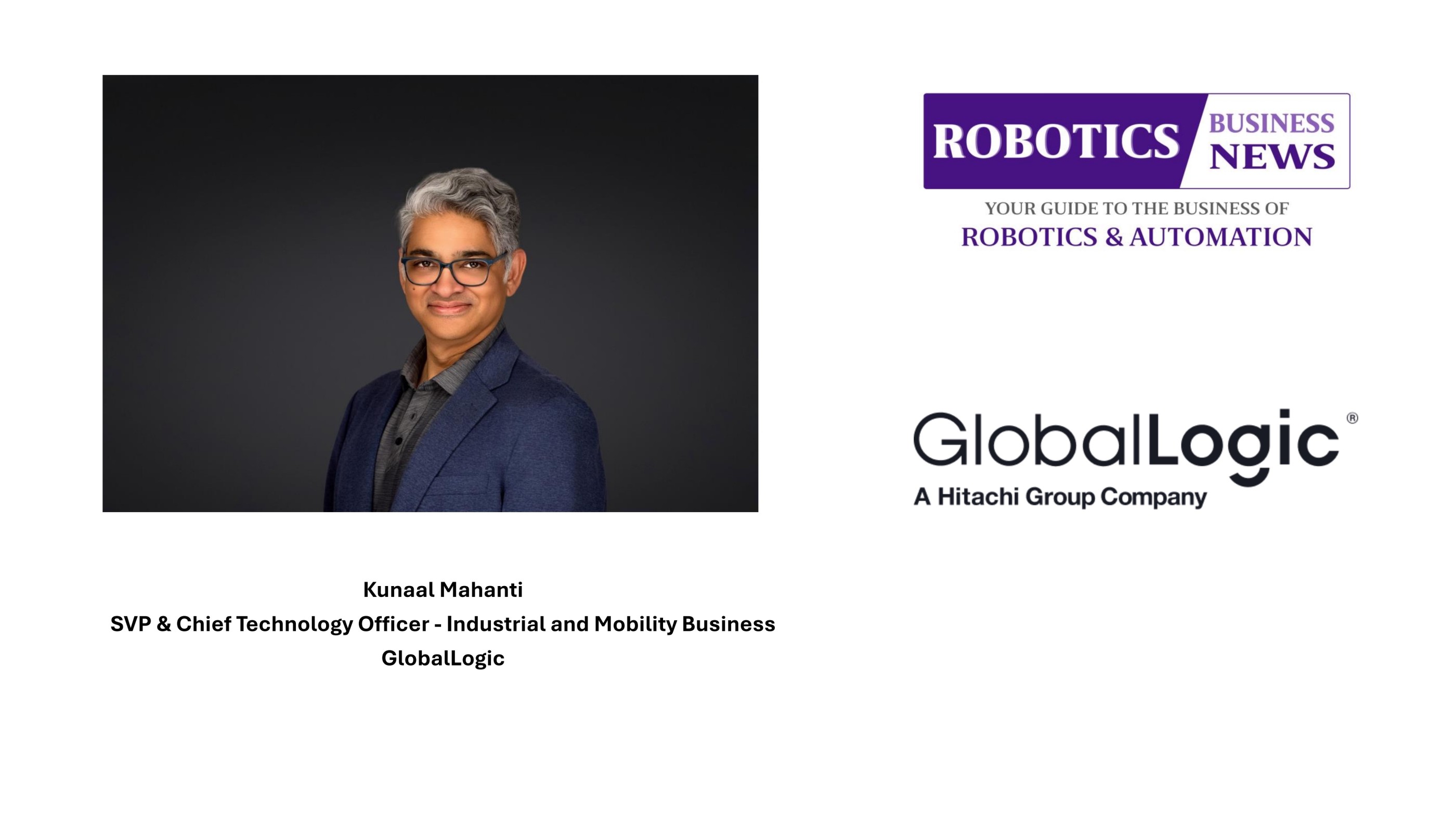
Kunaal Mahanti, SVP & Chief Technology Officer - Industrial and Mobility Business, at GlobalLogic, discusses how Physical AI, autonomous robotics, and intelligent engineering are transforming heavy industries through AI-powered automation.
As Physical AI reshapes industrial operations, Kunaal Mahanti, SVP & Chief Technology Officer - Industrial and Mobility Business, at GlobalLogic, speaks with Robotics Business News, about how the company's collaboration with thyssenkrupp and the broader Hitachi ecosystem is accelerating intelligent automation. In this interview, he explores the role of autonomous robotics, edge AI, digital engineering, and scalable industrial intelligence in creating safer, smarter, and more efficient manufacturing environments while outlining GlobalLogic's vision for the next generation of AI-powered industries.
GlobalLogic has partnered with thyssenkrupp to bring Physical AI into heavy industry. How does this alliance reflect GlobalLogic's long-term vision for engineering intelligent industrial systems?
Heavy industrial manufacturing features complex environments that continue to rely on manual processing. Physical AI, advanced robotics, embodied intelligence, and digital-physical workflow orchestration are key to unlocking next level worker safety and operational efficiencies.
By applying the learnings from Hitachi’s own Physical AI deployments to thyssenkrupp’s use cases, we will be solving a broad set of challenges. We will establish a scalable blueprint to address the broader needs of heavy industry globally, fulfilling the core promise of Hitachi's Lumada 3.0 vision.
The partnership combines GlobalLogic's AI and digital engineering expertise with thyssenkrupp's industrial capabilities. What unique value does this combination deliver to manufacturers pursuing digital transformation?
The unique value lies in our ability to orchestrate seamless digital-physical workflows in complex heavy industrial environments that have historically relied heavily on manual processing.
The combination of thyssenkrupp’s operational expertise with GlobalLogic and Hitachi’s Physical AI frameworks, will deliver a cohesive architecture that traditional IT or standalone OT cannot achieve alone. Through technologies like our Unified Data Layer (UDL), we can safely introduce advanced robotics and intelligence directly onto the factory floor.
This combination allows manufacturers to protect frontline workers, eliminate operational bottlenecks, and turn complex, unstructured field data into measurable industrial ROI.
The alliance introduces a 'Lab-to-Scale' model for deploying Physical AI. How does this approach help bridge the gap between research innovation and real-world industrial deployment?
Most Physical AI projects today get stuck exploring 'the art of the possible,' with organizations trying to answer the basic question of what this technology can do. We have answered that question through our Hitachi 'customer-zero' approach, where we have used our own global industrial footprint to test and validate these solutions.
The 'Lab-to-Scale' model is how we move beyond experimentation into true industrial deployment. The combination of deep domain knowledge, strategic design, research, and AI engineering capabilities with Hitachi and thyssenkrupp’s operational context and expertise shifts the conversation away from isolated proofs-of-concept and moves into real-world execution.
GlobalLogic has extensive experience in AI, software engineering, and intelligent products. How are these capabilities evolving to support autonomous robotics and industrial automation?
Our engineering capabilities are evolving from building software platforms and pipelines to orchestrating advanced, autonomous edge ecosystems. We are applying the foundational platforms we've already built—such as enterprise-grade agent orchestration, context-aware knowledge engines, and scaled data intelligence solutions—to serve as a robust backbone for Physical AI.
Simultaneously, we are innovating heavily in specialized vision systems and micro-models to embed intelligence directly at the edge. This extends the capabilities of mobile robots and traditional collaborative robots (cobots). Rather than relying on rigid, pre-programmed 'record and play' routines, these systems are transformed into adaptive, intelligent assets.
By embedding edge intelligence, both mobile systems and traditional robots can dynamically perceive their surroundings, understand context, and make split-second, safe operational decisions right on the factory floor.
Physical AI requires the integration of robotics, edge computing, AI models, and industrial data. What are the biggest technical challenges in bringing these technologies together at enterprise scale?
Beyond the obvious and traditional IT and OT data silos, the complex engineering hurdles of executing enterprise-scale Physical AI can be broken down into three major areas:
The Semantic & Namespace Unification: Shop floors operate across decades of legacy, heterogeneous systems. The first challenge is establishing a unified namespace across all assets to ensure real-time, continuous data is normalized and semantically aligned. Without this common data model or ontology, scaling is impossible.
The Reliability and Safety Gap: Traditional Large Language Models and transformer architectures are inherently non-deterministic. In a high-stakes, heavy industrial environment, unreliability is a critical safety hazard. Bridging this requires a multi-pronged approach and wrapping AI within strict, deterministic safety and edge-centric guardrails.
The Human and Hardware Abstraction: We face the challenge of digitalizing the unwritten 'tribal knowledge' from experienced human operators into our context-aware knowledge engines. Simultaneously, on the machine side, we need to abstract diverse, complex robotics hardware into a unified notion of a 'physical agent.' This software abstraction allows us to manage varied robotic assets under a single, cohesive AI orchestration layer rather than relying on rigid, custom integrations for every machine.
How important is the collaboration with Method and Hitachi America R&D in creating an end-to-end innovation ecosystem for industrial AI?
Collaboration between GlobalLogic, Method and Hitachi America R&D is the foundation of our approach. Innovation in industrial AI cannot happen in silos; it requires a highly synchronized ecosystem of distinct capabilities. By blending advanced foundational research, human-centered strategic design, deep domain knowledge, and robust AI engineering capabilities from across the entire Hitachi ecosystem, we are able to address every layer of the deployment lifecycle.
While foundational research provides the underlying technological breakthroughs, the strategic design capabilities enable the critical service and process redesign, and change management required to ensure that advanced AI seamlessly integrates into legacy workflows. This ensures the technology is intuitive and actually serves the frontline human workers who interact with these systems daily.
Which industries beyond heavy manufacturing do you believe will benefit most from Physical AI over the next decade, and what market trends are driving this opportunity?
Beyond heavy engineering, the most impact of Physical AI over the next decade will be felt in Mobility, Energy & Utilities, and Healthcare. These core sectors represent the backbone of global infrastructure, and they are currently being reshaped by macro market trends prioritizing sustainability, human wellbeing, and elevated social experiences.
This transition is in lockstep with Hitachi’s broader Social Innovation Business and our Lumada 3.0 vision, which focuses on utilizing data and AI to build a sustainable society.
In Mobility, Physical AI will orchestrate safer, autonomous mass transit systems. In Energy & Utilities, it will manage the complex low-latency decision-making required to stabilize smart grids and accelerate decarbonization. In Healthcare, it will power the next generation of patient care.
Looking ahead, what are GlobalLogic's key priorities for advancing Physical AI, autonomous robotics, and industrial intelligence as demand for AI-powered automation continues to grow?
As demand for AI-powered automation grows, our key priority is to continuously explore the frontiers of technology to find safer, more intelligent ways to solve both legacy and emerging industrial challenges. Moving forward, our roadmap centers on three main pillars:
Commercializing Frontier Innovation: We will continue to act as an execution engine that brings the best of Hitachi's advanced breakthroughs and deep-tech investments in Physical AI into industrial environments.
Engineering 'Reliable AI' at the Edge: We are focused on bridging the digital and physical workflow gap by developing highly dependable, deterministic AI frameworks and advanced edge-based vision systems. This ensures that autonomous assets can solve high-consequence problems locally and safely, without the risks of latency or model non-reliability.
Digitalizing Institutional Intelligence: We will prioritize our ability to capture, structure, and incorporate unwritten enterprise and tribal knowledge into our context-aware engines.
By turning human operational expertise into scalable software intelligence, we are ensuring that the next generation of autonomous robotics is built on a foundation of trust, safety, and measurable value.