How Ambi Robotics Is Advancing Physical AI for Smarter Warehouse Automation
13 July 2026 | Interaction | By Editor Robotics Business NEWS <editor@rbnpress.com>
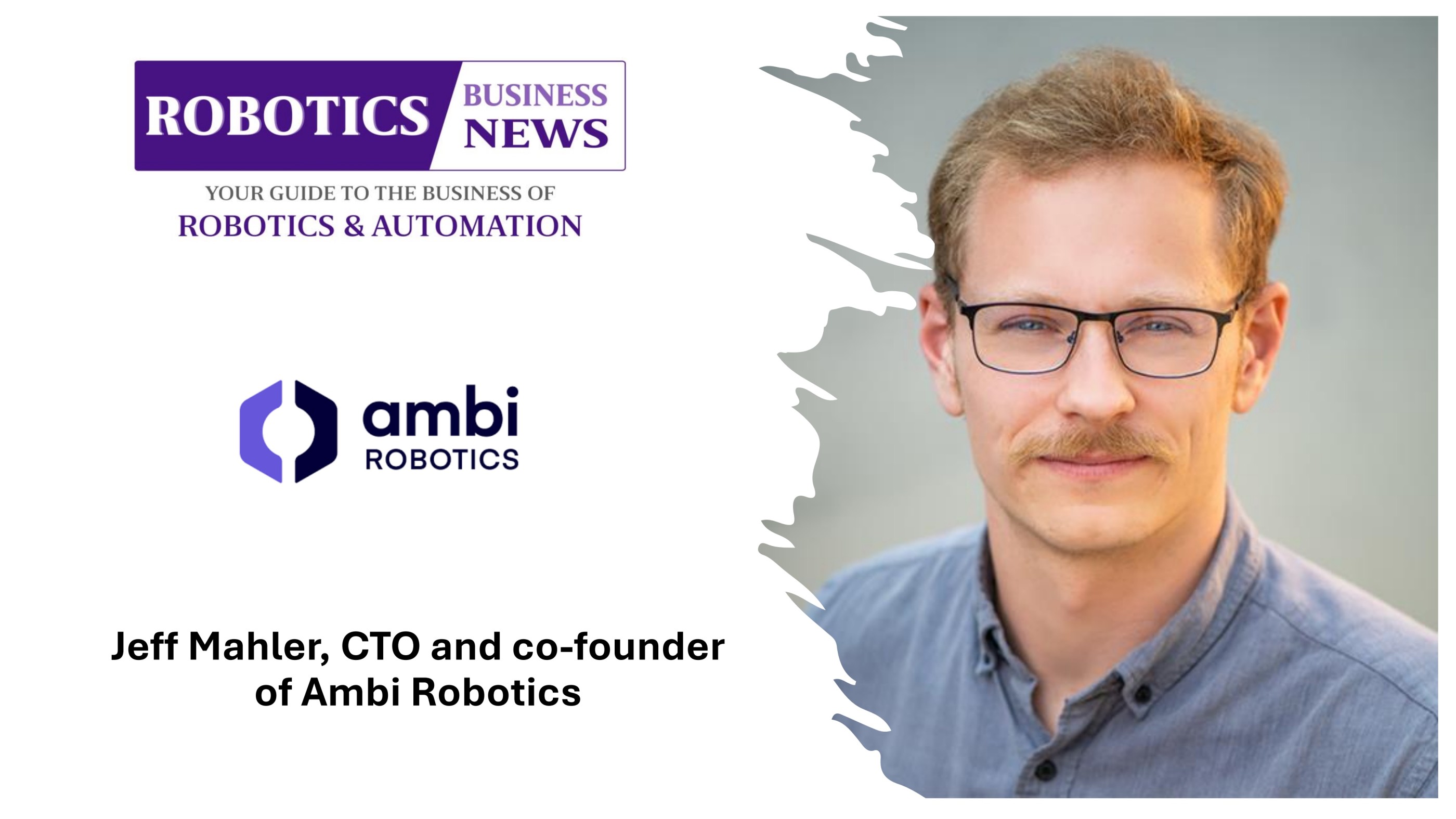
In this exclusive Robotics Business News conversation, Jeff Mahler, CTO and co-founder of Ambi Robotics, discusses how Physical AI, AmbiOS, and AI-powered robotics are driving the future of intelligent warehouse automation.
In an exclusive conversation with Robotics Business News, Jeff Mahler, CTO and co-founder of Ambi Robotics, discusses how the company is advancing Physical AI through its AmbiOS platform, AI-powered robotics, and continuous real-world learning. He explains how production-scale automation, robots-as-a-service, simulation-to-reality AI, and data-driven intelligence are helping logistics and e-commerce companies improve efficiency, scalability, and operational resilience while shaping the next generation of warehouse automation.
Ambi Robotics has been named the Overall Robotics Company of the Year by the AI Breakthrough Awards. What does this recognition represent for your team, and how does it validate your long-term vision for Physical AI in warehouse automation?
We built Ambi Robotics on the philosophy that robots need to work in the real world alongside humans, not just in simulation. Internally, we’ve felt strongly about our robotics solutions for years, and receiving this external validation from our industry peers reinforces the impact that our business model and approach is having on the future of warehouse and supply chain operations.
Your AmbiOS platform and AI-powered robotics solutions have been recognized for delivering production-scale automation. What key innovations have enabled Ambi Robotics to stand out in an increasingly competitive robotics market?
This year, we focused a lot of effort on our AmbiOS platform, which allows select customers and enterprises to license our production-proven AI skills for use on their own hardware systems. The AI Skill Suite innovation came from customer demand and a gap we identified in the market, which is that many companies need specialized AI applications, but don’t have the data, time, and financial commitment to build it themselves.
We have also continued to advance our robots-as-a-Service (RaaS) business model, a monthly subscription pricing model that gives companies an easier way to leverage the latest technology without constant reinvestment. RaaS accelerates automation adoption and helps businesses remain competitive in such a fast-paced industry, while also making AI-powered warehouse robotics more accessible to logistics companies.
Reliable automation in commercial operations requires operational excellence long after installation. Our Spare Parts Program was developed to maximize system uptime by ensuring customers have on-site and on-demand access to critical hardware components and 24/7 customer support. Combined with proactive service and continuous software improvement through AmbiOS, the program helps customers reduce downtime, maintain peak throughput during demanding warehouse operations, and maximize the long-term value of their investments in automation.
Ambi Robotics has expanded from robotic parcel sorting to intelligent stacking and AI-powered item perception. How does this broader product portfolio support your strategy of becoming a comprehensive Physical AI platform provider?
Our goal with physical AI has always been to provide holistic solutions that can seamlessly integrate into multiple industries, rather than automating a singular warehouse task. With each robotic solution that we introduce to the market, we gain the ability to collect more real-world data that furthers our repository for real-world physical AI training data - data from the initial AmbiSort deployments helped us successfully launch AmbiStack, both of which were made possible because of AmbiOS, and so on. This product portfolio also allows us to reach a wider customer base by offering scalable solutions that can fit a wide variety of different business needs, no matter where the customer is in the automation process.
Your robots continuously improve using real-world operational data and simulation-to-reality AI. How important is this learning loop in delivering measurable ROI for logistics and e-commerce customers?
Physical AI is fundamentally a data problem. The more experience a robot gains in the real world, the better it becomes at understanding and interacting with it. Every package our robots pick, sort, and stack contributes to a continuous data flywheel that strengthens our AI models. Those improvements are delivered back to our entire fleet through AmbiOS, meaning every deployment benefits from the collective experience of all the others.
Simulation-to-reality AI is the starting point of our data flywheel. We use simulation to develop production-ready AI capabilities before large-scale real-world data exists. Once deployed, our robots continuously learn from live warehouse operations, generating the real-world data needed to improve future models. Every deployment expands our dataset, making each new generation of AI more capable than the last. It's a compounding advantage that becomes stronger with every customer deployment.
This is what delivers long-term ROI for customers. Instead of investing in automation that remains fixed after installation, customers deploy a Physical AI platform that gets smarter over time. As our AI continues to learn, customers benefit from higher throughput, improved accuracy, fewer exceptions, and greater operational resilience without replacing hardware or disrupting operations.
Warehouse operators are looking for automation that is flexible, scalable, and easy to deploy. What are the biggest challenges customers face today, and how is Ambi Robotics addressing them through AI-driven robotics?
It’s well-known that this year has been tough for the supply chain industry, as geopolitical instabilities have increased costs for our customers across all industries. While some cost increases such as fuel are unavoidable, implementing warehouse automation provides an internal consistency for precision and optimization that wouldn’t otherwise exist. Through our RaaS business model and AmbiOS software, we’re able to help more companies adopt automation and control as many costs as they can.
As Physical AI adoption accelerates, how do you see foundation models, computer vision, and reinforcement learning reshaping warehouse robotics over the next five years?
Warehouse robots are evolving from task-specific automation to AI systems that can generalize across a much broader range of objects, workflows, and operating conditions. Foundation models, computer vision, and reinforcement learning are enabling robots to understand and interact with a wider variety of objects and warehouse environments without requiring extensive task-specific programming. This will make automation faster to deploy, easier to scale, and capable of handling far greater operational complexity.
Reinforcement learning and real-world operational data will fundamentally change how warehouse robots improve over time. Rather than relying on static software updates, robots will continuously refine their behavior through simulation and production deployments, becoming more efficient, reliable, and adaptable with experience. The companies that can combine foundation models, simulation, and large-scale operational data into a continuous learning flywheel will define the next generation of Physical AI.
Ambi Robotics has earned multiple industry recognitions, including RBR50 and AI Breakthrough Awards. How do these achievements strengthen customer confidence and support your global growth strategy?
Being recognized for awards like RBR50 and the AI Breakthrough Awards help reinforce what our customers already see firsthand: AI-powered robotics solutions delivering results in commercial environments starting on day one. Our customers invest in solutions that they know will perform in real-world warehouse environments. Recognition from respected industry organizations provide another layer of confidence that they’re partnering with a company delivering proven AI capabilities at scale.
As we continue to grow, these award recognitions help validate our approach, increase awareness of our technology and support conversations with prospective customers and partners leading the industry. More importantly, they reflect our commitment to developing AI software and hardware solutions that solve real operational challenges and help warehouse teams build more resilient and efficient operations.
Looking ahead, what are the key milestones customers, partners, and investors should watch from Ambi Robotics as you continue expanding your AI-powered robotics platform and commercial deployments?
We recently announced an integration with Pickle Robot Co., where their trailer-unloading robots work with our AmbiStack multi-purpose stacking solution to automate package movement across inbound logistics operations. Driven by demand from Fortune 500 logistics operators, this deployment provides a glimpse into what an interoperable Physical AI environment looks like in practice: one system unloading mixed freight from trailers and another building pallets downstream, each making independent decisions while contributing to a larger workflow.