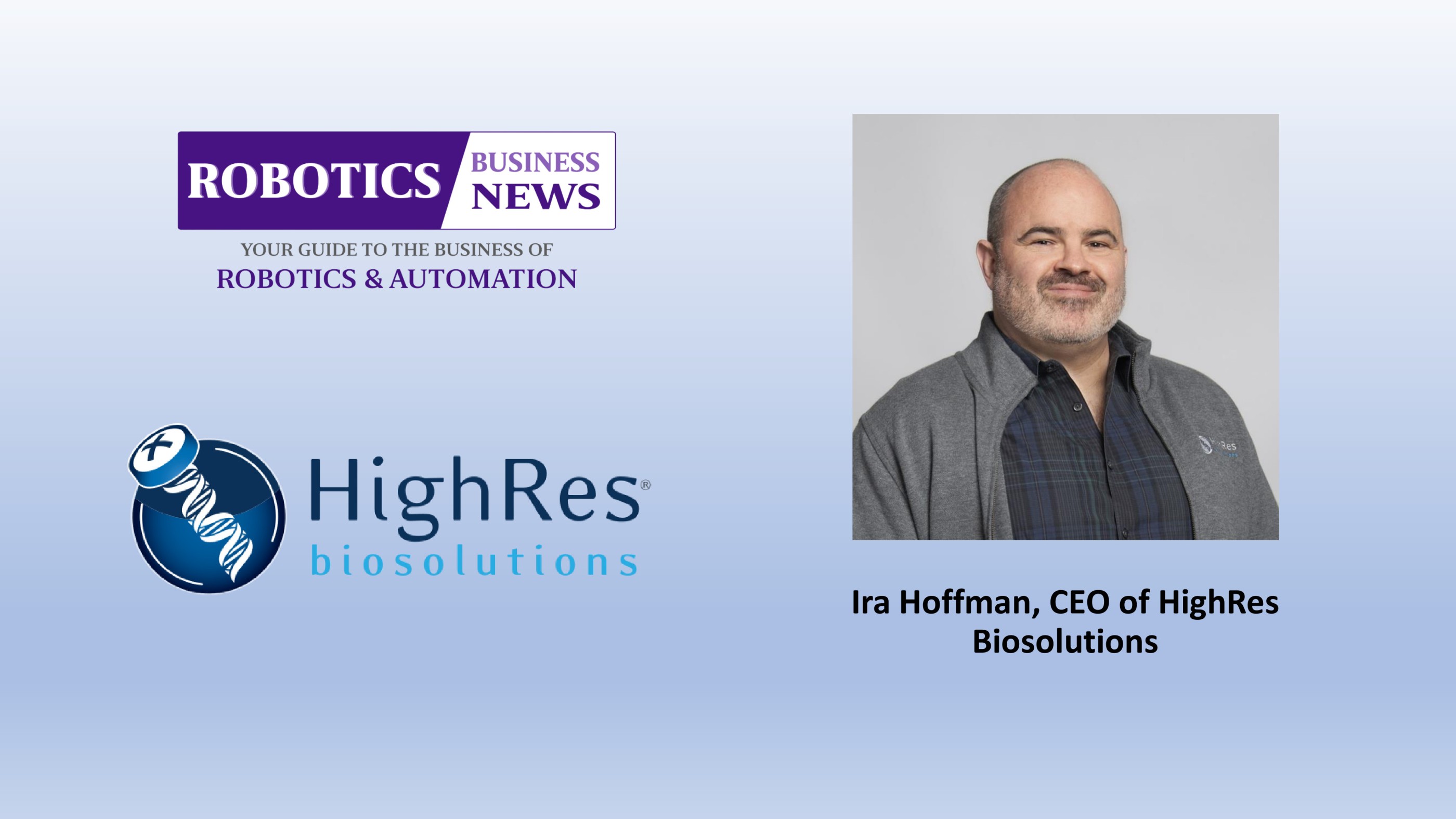
HighRes Biosolutions CEO Ira Hoffman on AI-to-AI Lab Automation Transforming Scientific Workflows
18 March 2026 | Interaction | By Editor Robotics Business NEWS <editor@rbnpress.com>
In an exclusive interview with Robotics Business News, the HighRes Biosolutions CEO highlights how agent-to-agent AI orchestration with Opentrons is accelerating experimentation and transforming lab operations.
In an exclusive interview with Robotics Business News, Ira Hoffman, CEO of HighRes Biosolutions, puts the spotlight on a transformative shift in laboratory automation: AI-to-AI orchestration. By enabling intelligent agents to translate scientific intent into fully executable workflows, HighRes and Opentrons are redefining how experiments are designed, executed, and scaled—unlocking faster timelines, improved reproducibility, and a new era of autonomous lab operations.
1. Can you describe the core vision behind the HighRes partnership with Opentrons and why now is the right time to launch this next-generation AI agent-to-agent lab automation workflow?
HighRes and Opentrons share a vision to increase the accessibility of both physical and digital automation.
A persistent bottleneck in life science research is translating scientific intent into executable workflows across multiple instruments, including complex systems like automated liquid handlers. Today, that translation still requires scripting, domain expertise, and significant manual coordination.
Our partnership focuses on removing that friction. By integrating HighRes’ orchestration platform with Opentrons’ modular, AI-ready liquid handler, we translate experimental intent into coordinated workflows that run reliably across the entire lab.
In the demonstration, Opentrons represents one step within a broader end-to-end workflow. HighRes provides the orchestration layer that coordinates all instruments involved — from preparation to execution to downstream analysis — simplifying how labs access and use automation.
This is the key distinction from AI-generated scripts alone. Generating a protocol for a single instrument is valuable, but real laboratory work spans multiple devices, data systems, and decision points. HighRes connects those steps into a governed workflow that can execute reliably at scale.
What we are introducing is an intelligent orchestration framework accessible through natural language — effectively placing a workflow specialist in the lab. Drawing on more than 20 years of automation expertise, the system interprets intent, coordinates generation of an actionable AI-generated Python script from Opentrons AI, and executes it within a governed orchestration environment.
The agent-to-agent demonstration showcases this capability: our AI lab assistant communicates with the Opentrons AI scripting tool, and then the Opentrons Flex executes it, and HighRes coordinates the surrounding workflow — closing the loop between intent and real laboratory execution.
By enabling specialized AI agents to collaborate, each contributing domain expertise, we can orchestrate sophisticated, multi-instrument workflows that are greater than the sum of their parts. The promise is AI-generated experimentation that dramatically compresses intent-to-execution timelines, often by an order of magnitude, while broadening access to advanced instrumentation.
2. What differentiates this agent-to-agent workflow from existing lab automation approaches, and how will it fundamentally change how experiments are planned and executed?
Traditional lab automation is largely script-based and static. Workflows are manually programmed, validated, and executed in predefined sequences. If something changes — a parameter, plate layout, or experimental condition — the workflow typically must be rewritten by a specialist.
The agent-to-agent model introduces a new layer of intelligence between intent and execution. Instead of manually programming every step, scientists describe what they want to accomplish, and the system translates that intent into an executable workflow — not just for a single instrument, but across the broader experimental process.
What fundamentally changes is how experiments are planned and iterated. Rather than designing workflows at the code level, labs operate at the outcome level. Adjustments become faster, iteration cycles shorten, and automation becomes adaptive instead of rigid.
It’s a shift from automation that requires experts to automation that creates experts — and ultimately democratizes access to advanced laboratory infrastructure.
3. Which specific capabilities from HighRes and Opentrons were most critical for enabling this integration?
From HighRes, the critical capability is orchestration combined with accumulated automation intelligence. We provide the enterprise-grade framework that coordinates over 500 lab instruments, governs workflow logic, manages data, and ensures traceability across complex environments.
This intelligence is embodied in Cellario Atlas — a knowledge layer synthesized from more than two decades of delivering successful automation programs. Atlas informs how workflows are constructed, which decisions matter, and how automation should be implemented to operate reliably in real laboratory settings.
That experience is essential when translating AI-generated intent into real execution. It enables the system to make informed choices about workflow structure, sequencing, and exception handling — effectively embedding automation expertise into the platform.
From Opentrons, the key capability is deep liquid-handling intelligence derived from large-scale real-world use. With more than 10,000 systems deployed globally, an extensive open repository of protocol code, and hundreds of thousands of executed runs, Opentrons has accumulated uniquely rich data on protocol structure, parameterization, and performance. This foundation powers a highly sophisticated AI protocol generation capability that can translate experimental intent into robust, execution-ready liquid handling workflows.
The integration works because HighRes provides structured orchestration, workflow governance, and institutional automation intelligence, while Opentrons contributes deeply informed, AI-native liquid handling expertise derived from real-world scale. Together, this enables AI-assisted reasoning to translate into controlled robotic action across complete workflows, not isolated scripts.
4. How does this AI-driven workflow improve reproducibility, throughput, and adaptability compared to manually configured automation?
Reproducibility improves because execution is governed by an orchestration layer supported by digital SOPs. Workflows generated through natural language are translated into structured, executable steps, and the system guides users through execution with full traceability. This ensures consistency across operators while maintaining complete auditability.
Throughput increases because workflow creation and modification happen at the intent level. This is particularly impactful for complex activities like design of experiments, which traditionally require significant bespoke programming for each new assay. By expressing experimental intent in natural language, the system can generate and execute DOE-driven workflows without rebuilding automation logic from scratch.
Adaptability improves because workflows are no longer rigid. Parameters can be adjusted quickly, and intelligent orchestration enables controlled changes without full reprogramming. Automation becomes more resilient to variation and evolving experimental needs.
In short, we are shifting from manually configured automation to orchestrated, intelligence-assisted execution — delivering greater consistency, speed, and flexibility.
5. What are the top real-world use cases HighRes expects this combined solution to address first?
The common thread is any laboratory running complex workflows that span multiple standalone instruments or automation systems. When coordination across devices, data systems, and teams becomes the bottleneck, intelligent orchestration delivers immediate value.
This includes high-throughput screening and Design–Make–Test–Analyze workflows, compound management environments coordinating storage and assay execution, and cell line development programs that require multi-stage, iterative workflows with conditional logic over extended timelines.
Biobanking operations benefit from orchestration that ensures strict traceability and consistent sample handling at scale. Informatics-heavy environments, including ELN-integrated labs, gain digital continuity by connecting experimental intent directly to execution and returning contextualized data automatically. Clinical genomics laboratories benefit from centralized execution control while maintaining regulatory traceability.
At the enterprise level, pharmaceutical organizations use orchestration to coordinate distributed automation systems across sites. Increasingly, labs focused on utilization and capacity optimization leverage orchestration data to identify bottlenecks, maximize throughput, and guide smarter automation investments.
Across all of these use cases, the challenge is coordinating complexity. The solution is a unifying orchestration layer that connects digital intent to physical execution and makes sophisticated automation accessible to more scientists.
6. How will labs interact with the agent-to-agent workflow in practice?
Labs interact with the system at two levels.
Scientists and assay developers operate at the intent level, describing what they want to accomplish rather than writing low-level code. Through natural language interfaces and guided workflow tools, they define objectives, adjust parameters, and generate executable protocols without deep programming expertise.
Automation engineers remain essential. They design automation architecture, validate workflows, manage integrations, and ensure systems operate within governance and compliance requirements. The agent-to-agent workflow does not remove expertise — it amplifies it.
By embedding orchestration logic, digital SOPs, and institutional automation intelligence into the platform, we make expert knowledge scalable and accessible. In that sense, the system becomes a tool that democratizes access to complex laboratory infrastructure.
Scientists focus on science. The orchestration layer manages execution complexity within a structured, controlled framework.
7. How does HighRes plan to measure and communicate ROI?
We focus on measurable operational outcomes.
At the workflow level, we track reductions in experiment setup time, faster protocol iteration, improved instrument utilization, and increased samples processed per day or week. Because orchestration captures execution metadata in context, we can quantify improvements in cycle time, error reduction, and throughput.
We also measure reductions in manual intervention — fewer scripting changes, fewer operator-dependent variations, and less downtime caused by reconfiguration.
At the strategic level, ROI is about acceleration — most notably compression of intent-to-execution timelines. In many environments, this represents order-of-magnitude improvements in how quickly workflows move from concept to reliable automated execution.
We communicate gains through quantified case studies, baseline-versus-post implementation comparisons, and operational dashboards that make improvements visible over time.
Ultimately, ROI is measured in speed, reliability, and capacity unlocked.
8. Looking ahead, what future innovations do you envision for AI-to-AI communication in automated laboratories?
We see this as the foundation for increasingly autonomous laboratory ecosystems.
Today, we demonstrate how an AI lab assistant translates intent into executable workflows. The next phase is deeper AI-to-AI coordination, where scheduling systems, analytics platforms, robotics controllers, and informatics tools communicate continuously within a governed orchestration framework.
This enables true closed-loop experimentation: execution data informs models in real time, which then adjust downstream workflow parameters without manual reconfiguration.
Digital twins will play a critical role by allowing labs to design, visualize, and simulate workflows virtually before physical execution. Combined with contextualized execution data, this creates a continuously learning operational system.
Knowledge layers such as Atlas will become increasingly important, allowing AI-driven workflows to incorporate institutional learning while maintaining governance, traceability, and reproducibility.
The future lab will not just be automated. It will be intelligently coordinated, continuously improving, and capable of operating at the speed of scientific discovery.