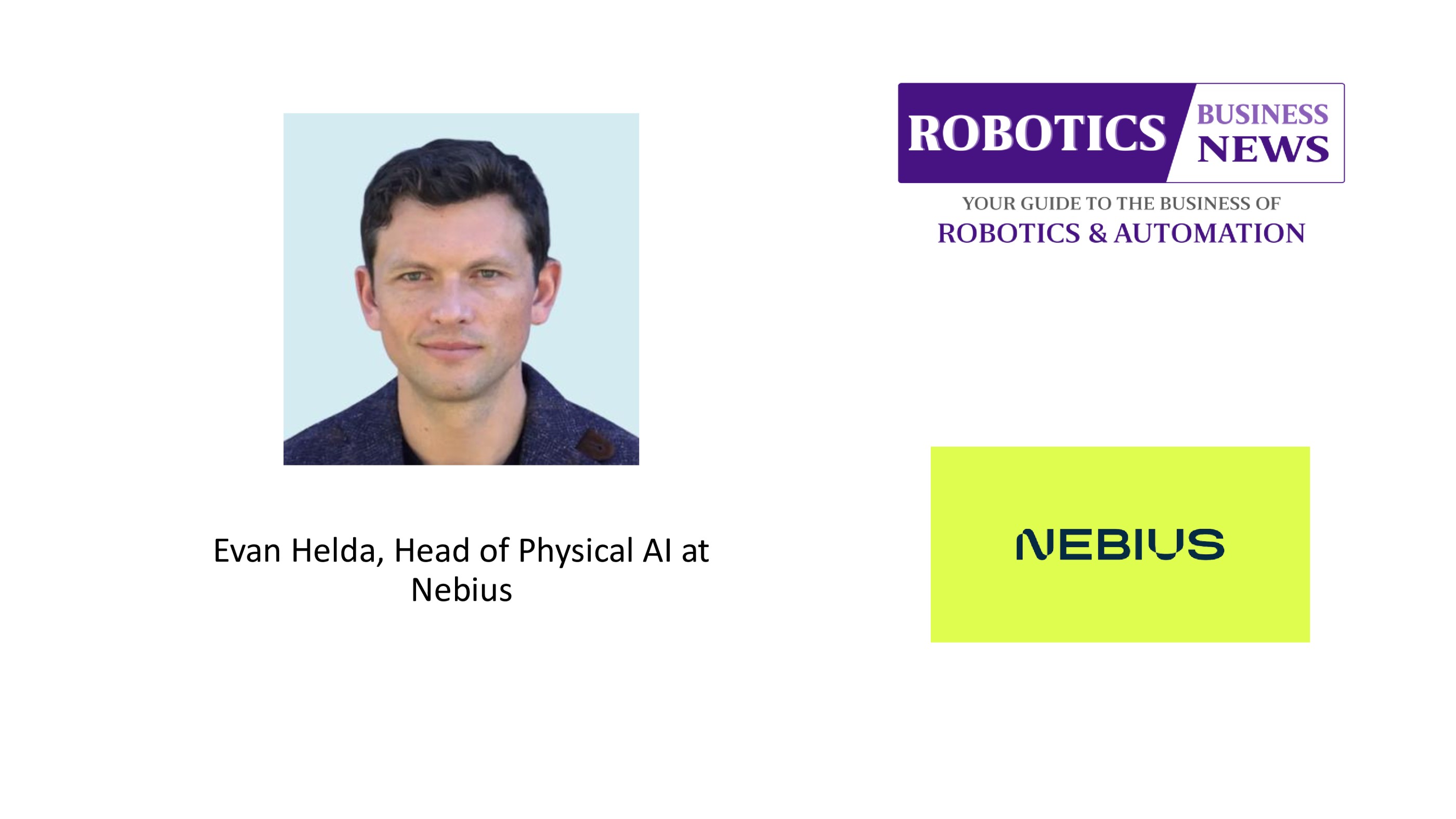
Building Europe's Physical AI Future: A Conversation with Evan Helda, Head of Physical AI at Nebius
02 July 2026 | Interaction | By Editor Robotics Business NEWS <editor@rbnpress.com>
Nebius' Evan Helda discusses the Physical AI Living Lab, robotics cloud infrastructure, NVIDIA-powered simulation, and accelerating Europe's next generation of intelligent robots.
What inspired Nebius to launch the Physical AI Living Lab, and what industry gaps are you aiming to address for European robotics startups?
Supporting the AI builder community is core to how Nebius operates — from the Nebius for Startups program to research credits to direct engineering partnerships. The Physical AI Living Lab is the latest expression of that commitment, applied to robotics.
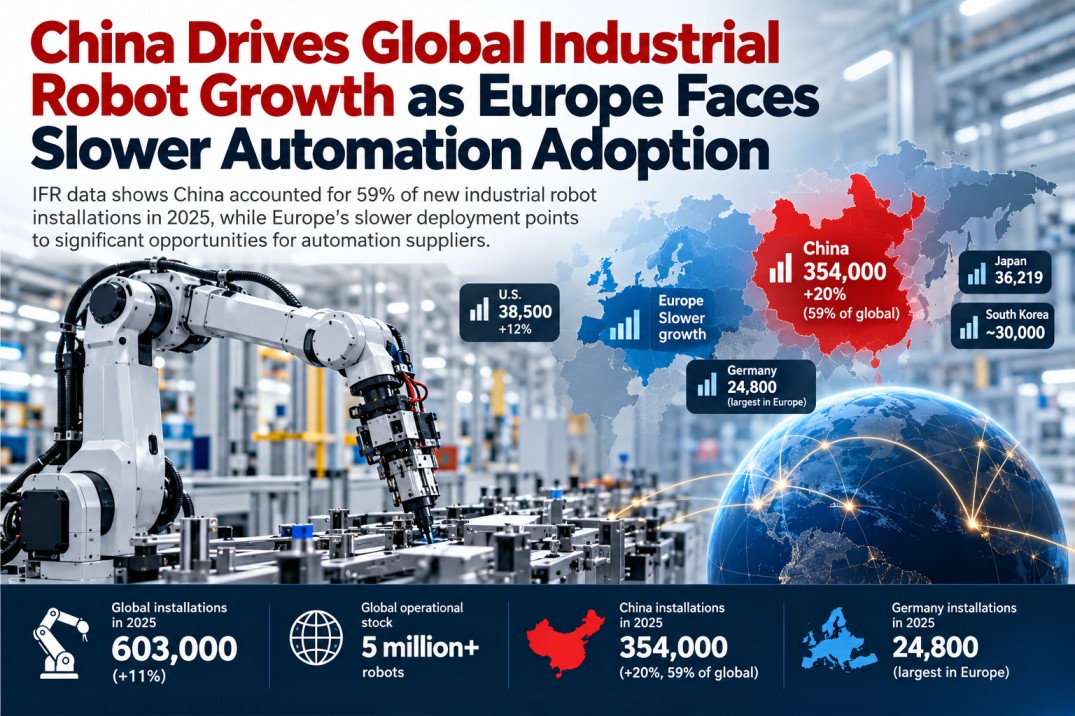
Europe is the right place to start. The continent is the world's most robot-dense manufacturing region outside Asia, home to global leaders like ABB, KUKA, and Universal Robots. The European robotics market is valued at €16.1 billion in 2026 and growing — the warehouse robotics segment alone is expanding at 15.7% annually and the collaborative robotics segment at a 19.8% CAGR. In the UK specifically, robotics was the second most funded sector in Q1 2026 with $1.4 billion invested— a clear signal of where market conviction is moving.
Yet SVRC's 2026 report highlights a structural disadvantage that defines the gap we're targeting: despite this industrial depth, Europe captured only 14% of global robotics venture capital in 2025. The constraint for most early-stage teams isn't ideas or talent — it's access to the simulation capacity, synthetic data pipelines, and compute infrastructure that physical AI development demands. Assembling those independently is expensive, slow, and not what founders should be spending their time on. The Living Lab removes that barrier.
Many robotics startups struggle with access to large-scale simulation, synthetic data, and compute resources. How does the Living Lab help accelerate the journey from prototype to real-world deployment?
The core problem is fragmentation. Physical AI development spans data ingestion, synthetic data generation, simulation, training, evaluation, and deployment — each stage with its own tooling requirements. Engineering teams routinely spend 30 to 40 percent of their time stitching these pieces together rather than improving robot behavior. That's the hidden tax on physical AI development, and it compounds quickly for early-stage teams without large engineering resources.
The Living Lab gives participants access to a fully integrated, end-to-end stack on Nebius AI Cloud — so they move through the complete development loop without standing up or maintaining any of the underlying infrastructure. The impact can be significant: RoboForce cut pipeline setup time by more than 70% and reduced iteration cycles from weeks to days after adopting the Nebius and NVIDIA joint solution.
Beyond the tooling, participants get direct engineering support from Nebius and NVIDIA throughout the six months — guidance informed by hands-on experience running physical AI workloads across a broad range of robotics companies and deployment environments.
Cloud credits alone don't close the gap — teams need engineers who understand the specific challenges of their hardware, data, and deployment environment, working alongside them in real time. That's what separates an accelerator from an infrastructure discount.
The program provides access to NVIDIA Cosmos, Isaac Sim, Isaac Lab, and the Nebius Physical AI Workbench. How do these technologies work together to create a complete physical AI development stack?
Each component addresses a specific stage of the physical AI learning loop — the continuous cycle from data through training to deployed behavior and back again.
Isaac Sim and Isaac Lab form the simulation foundation. Isaac Sim provides a physics-accurate, photorealistic environment for training and evaluating robot policies at scale; Isaac Lab is the reinforcement learning framework built on top of it. Together they allow teams to validate robot behaviors across thousands of parallel virtual scenarios — tests that would be impractical or impossible to run on physical hardware.
NVIDIA Cosmos world foundation models extend what simulation can produce by generating physics-grounded synthetic data at scale — including the rare, dangerous, or edge-case scenarios that real-world collection will never adequately cover. Synthetic data is how teams close the long-tail gap that determines real-world performance.
The Nebius Physical AI Workbench is the orchestration layer that ties the full stack together. Rather than forcing teams to stand up and integrate multiple tools independently, the Workbench provides a curated set of pre-validated physical AI tools — including NVIDIA Cosmos, Isaac Sim, and Isaac GR00T — unified on a shared data layer and driven by a CLI, SDK, and agents. Every tool reads and writes through the same shared storage using standard formats, so data flows between stages with no conversion overhead. Teams compose workflows from synthetic data generation through to evaluation in a single environment, and focus on building robot behavior rather than managing infrastructure.
The result is a complete runtime — from synthetic data generation to real-world inference — that participants consume as a service rather than build themselves.
Why did Nebius choose a hands-on, six-month accelerator-style model instead of simply offering cloud credits or infrastructure access to startups?
Nebius is genuinely committed to the growth of the robotics startup community — from the UK Living Lab to Ultimate Fighting Bots and the Phail Leaderboard, across the globe Nebius is integrated and offering programs where we can grow the community together. We aim to be embedded in founders' journeys, not just adjacent to them. The Living Lab is the fullest expression of that: we're not offering a discount, we're offering our engineers.
Infrastructure access solves the cost problem. It doesn't solve the workflow problem. The bottleneck for most teams is knowing how to structure their data pipelines, optimize simulation runs, and navigate the integration challenges specific to their hardware and deployment environment. That requires experienced engineers working alongside you, and that's what the program provides throughout the full six months, not just at kickoff.
Working closely with teams across different hardware platforms, operating environments, and edge cases makes Nebius better at running physical AI ourselves. That diversity of real-world problems feeds directly into how we develop and improve our platform. This is a key collaboration — and that's by design.
The first phase runs on UK-based infrastructure powered by NVIDIA RTX PRO 6000 Blackwell GPUs. What advantages does this architecture provide for robotics simulation, training, and deployment workloads?
The RTX PRO 6000 Blackwell Server Edition is purpose-built for the specific demands of physical AI simulation — a workload profile that differs meaningfully from standard large-scale model training.
The architecture combines fifth-generation Tensor Cores for AI compute with fourth-generation RT Cores for hardware ray tracing. That pairing matters directly for physical AI: photorealistic, physics-accurate simulation is what enables strong sim-to-real transfer — the degree to which policies trained in simulation perform reliably when deployed on real hardware. The RT Cores accelerate the rendering fidelity that makes simulated environments genuinely useful for training. According to NVIDIA, robotics and simulation workloads on Omniverse run up to 4x faster on this architecture versus the prior-generation L40S.The 96GB of GDDR7 memory per GPU means teams can run large VLA models without splitting across multiple cards.
For Living Lab participants, the practical benefit is running large-scale parallel simulation at a cost structure that works for early-stage companies.
The RTX PRO 6000 architecture is significantly more cost-efficient for simulation workloads than H100 instances — delivering the ray-tracing and rendering performance physical AI demands at a fraction of the cost of general-purpose training GPUs.
Running on UK-based infrastructure also addresses data sovereignty, a real concern for European teams in regulated sectors or handling sensitive operational data.
Physical AI is emerging as the next major frontier after generative AI. Which robotics sectors — industrial automation, logistics, humanoids, healthcare, or autonomous systems — do you expect to benefit most from this initiative?
The Living Lab is deliberately sector-agnostic, and that reflects something important about physical AI: its impact will cut across verticals in a way that makes picking one winner a false choice. The same simulation and synthetic data infrastructure that helps a warehouse robotics team handle diverse SKUs helps a surgical robotics team train on rare procedural edge cases, and helps an agricultural drone company generate data for weather conditions it can't control in the field.
That said, the European context points to clear near-term demand. Industrial automation and logistics are the most immediate opportunity — Europe is the world's largest installed base of industrial robots outside Asia, the warehouse robotics segment is growing at 15.7% annually, and Germany alone has over two million unfilled industrial jobs driving structural demand for automation. Teams solving automation problems in European manufacturing and logistics will be among the first to feel the impact.
Humanoids are the most-watched longer-term category, and we expect European startups to be serious competitors given the continent's depth in robotics hardware and research. Healthcare and autonomous systems are also strong fits — both are data-hungry domains where synthetic generation and large-scale simulation have an outsized effect on development speed.
Nebius has emphasized building a cloud platform specifically optimized for robotics and physical AI. How does the infrastructure required for physical AI differ from traditional AI training environments?
The core difference is that physical AI isn't a single workload — it's a continuous development loop spanning multiple fundamentally different compute environments running in parallel. A team training a language model runs one class of job on one type of infrastructure. A physical AI team is simultaneously running GPU training for VLA models, parallel physics simulation, high-throughput storage operations for multimodal sensor data, and edge deployment preparation..
Managing the dependencies between those stages is where teams lose significant time — which is why Nebius built the Physical AI Workbench to let teams define and run custom workflows, from synthetic data generation through to evaluation, without writing glue code or managing infrastructure.
The data profile alone is structurally different. Physical AI generates multimodal streams — 4K video, LiDAR point clouds, high-frequency joint states, simulation traces — that overwhelm storage systems designed around text datasets. Nebius's storage architecture delivers over 2TB/s of throughput from the all-flash parallel filesystem and up to 2GB/s per GPU from enhanced object storage, specifically to prevent GPU starvation during training.
Simulation adds another layer: running physics at scale requires CPUs, GPUs, memory, and storage to be stressed simultaneously — rendering, logging, and training can all be happening at once. Standard cloud infrastructure hits bottlenecks here that directly slow iteration speed.
Then there's orchestration. In physical AI, the three-computer system — training cluster, simulation environment, edge devices — needs to operate as one continuous loop. When those environments are disconnected, engineers end up writing the glue code that holds the pipeline together. That's the 30 to 40 percent of time spent on integration rather than robot improvement. The infrastructure has to solve for the full loop, not just individual stages — and the Workbench does exactly that
Looking ahead, what are your plans for expanding the Physical AI Living Lab to additional regions, and what role do you see Nebius playing in Europe's growing physical AI ecosystem over the next five years?
The UK is the right starting point — world-class research, a deep startup ecosystem, and a strong concentration of physical AI talent. As Anthony Hills from NVIDIA noted at launch, there's still a real gap between the UK's innovation base and scaled, market-ready physical AI solutions. The first cohort, beginning September 2026, is designed to start closing that gap.
Our intention is to extend the program to additional European regions and bring in further cohorts as the program develops. The infrastructure foundation is already in place across Nebius data centers in the US and Europe — expansion is a matter of sequencing, not capability.
On the five-year view: physical AI is moving fast, driven by the combination of foundation model advances and purpose-built cloud infrastructure that's finally designed for these workloads. But we're still before the inflection point — the equivalent of the LLM moment for generative AI, where capabilities and deployment compound rapidly together. The companies being built today, including those coming through the Living Lab, will be among those who define what physical AI looks like when it reaches that moment. Five years from now, the deployment footprint of robotics will look dramatically different, and the infrastructure and data decisions being made now will have compounded significantly.
Nebius's goal is to be the cloud solution backbone for the most ambitious physical AI companies being built in Europe and globally — a genuine long-term partner in translating European research excellence into commercial deployment at scale.