twAIn Robotics Emerges as TWAIN’s Next Evolution Toward a Unified Communication Standard for Robotics and AI
11 December 2025 | Interaction | By editor@rbnpress.com
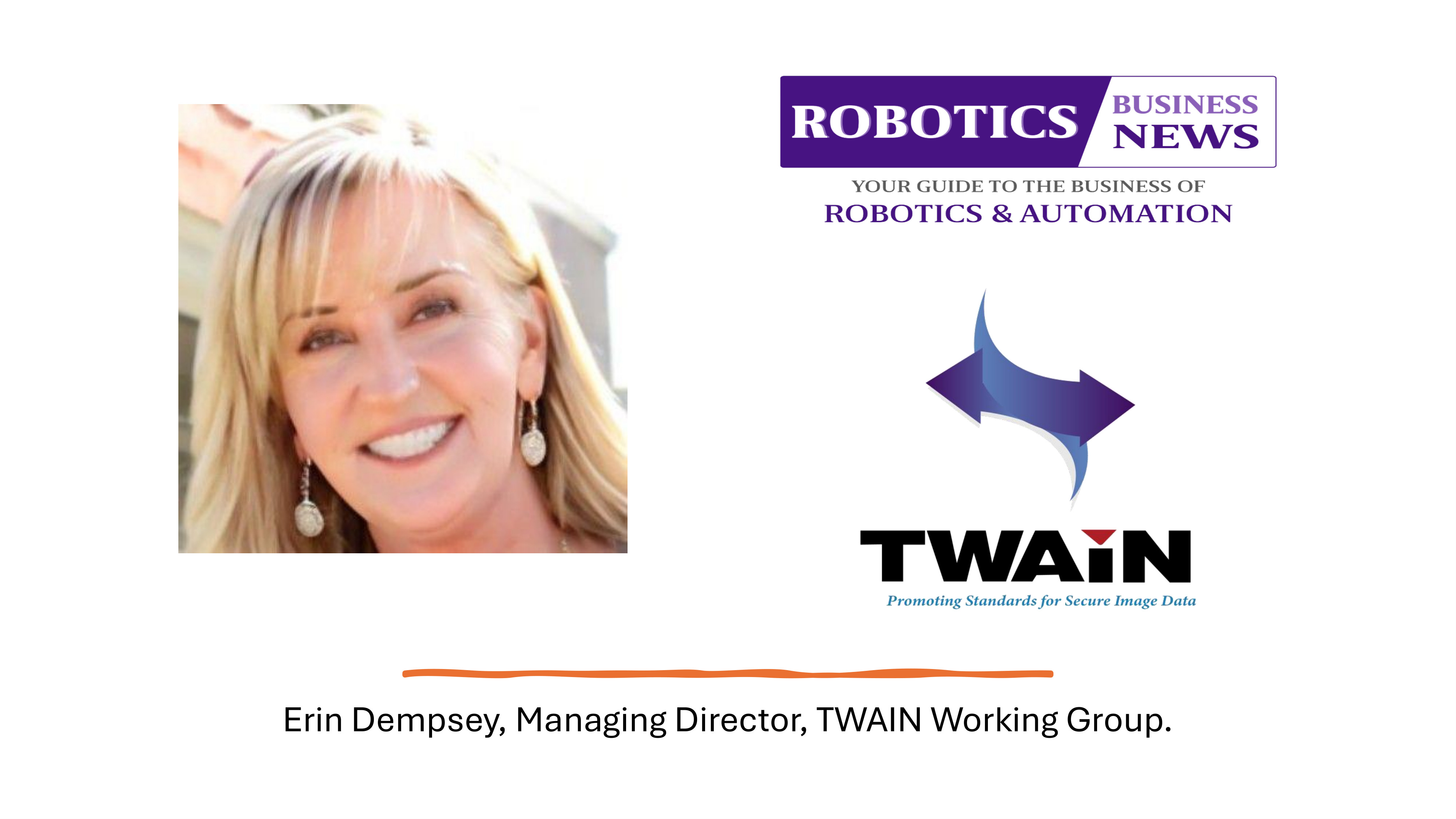
Erin Dempsey speaks with Robotics Business News about the mission behind twAIn Robotics and the collaborative framework TWAIN hopes will unify developers, manufacturers, and AI systems worldwide.
In this RoboticsBusinessNews interview, Erin Dempsey, Managing Director of the TWAIN Working Group, outlines the technical foundations behind twAIn Robotics—an initiative developed in response to mounting industry demand for unified communication protocols across robotics and AI systems. Leveraging decades of standards engineering, TWAIN aims to introduce an extensible, secure, and hardware-agnostic communication layer designed to streamline data exchange, enhance system interoperability, reduce integration overhead, and support scalable deployment of autonomous technologies across manufacturing, logistics, and next-generation intelligent systems.
1. What prompted the TWAIN Working Group — originally focused on imaging standards — to expand into robotics and AI with the twAIn Robotics initiative?
The TWAIN Working Group's expansion into robotics and AI with the twAIn Robotics initiative was prompted by:
- Industry demand validated at TWAIN Converge 2025: The November 12-13, 2025 conference in Safety Harbor, Florida revealed "rapidly growing industry demand for an open source communication standard for Robotics and Artificial Intelligence"
- Natural evolution of TWAIN's mission: As Executive Director Kevin Neal stated, this is "the next logical evolution" of bringing "order, interoperability, and trust" to a new technology domain
- Recognition of fragmentation in robotics: Feedback from manufacturers, developers, and integrators worldwide indicated the industry needs "an open, collaborative standard that accelerates innovation instead of fragmenting it"
- TWAIN's proven track record: With 30+ years of success creating interoperability standards for imaging (embedded in millions of devices capturing billions of documents daily), TWAIN recognized it could apply this same expertise to robotics and AI
2. Could you describe the core goals of twAIn Robotics: what kind of open-source communication standard are you aiming to build, and which parts of robotics/AI workflows will it cover?
The core goals are to:
- Create an open, interoperable communication protocol that accelerates innovation in robotics and artificial intelligence
- Organize a collaborative ecosystem bringing together robotics hardware manufacturers, software developers, systems integrators, and end-user organizations
- Apply proven methodologies: Use the same trusted, structured development process TWAIN has employed for 30+ years
Workflows covered: While specific technical details haven't been fully announced, the standard aims to cover communication and data exchange between robotics hardware, software applications, AI systems, and integration layers—similar to how TWAIN created a universal protocol between imaging hardware and software applications
3. How will twAIn Robotics balance the interests of diverse stakeholders — hardware manufacturers, software developers, systems integrators, and end users — when designing a unified standard?
twAIn Robotics will balance stakeholder interests through:
- Established collaborative model: The TWAIN Working Group has 30+ years of experience facilitating consensus among competing hardware manufacturers, software vendors, and end users
- Two-tier membership structure: Offering different participation levels allows organizations of varying sizes and commitments to engage
- Weekly technical and marketing meetings: Regular structured meetings ensure all stakeholders have ongoing voice in development
- Open standards approach: As a nonprofit organization, TWAIN prioritizes industry benefit over individual vendor advantage
- Proven consensus-building: TWAIN's track record shows it can create standards that benefit the entire ecosystem while respecting competitive dynamics
4. What kinds of existing challenges in robotics interoperability, integration, or data exchange do you believe twAIn Robotics is best positioned to solve?
Based on TWAIN's experience and the robotics industry's needs, twAIn Robotics is positioned to solve:
- Interoperability fragmentation: Just as TWAIN solved the "scanner wars" where each device required proprietary drivers, robotics suffers from proprietary communication protocols
- Integration complexity: Connecting diverse robotic hardware with various software platforms, AI systems, and enterprise applications
- Data exchange standardization: Creating consistent formats for sensor data, control commands, and AI model inputs/outputs
- Vendor lock-in: Enabling organizations to mix and match hardware and software from different vendors
- Development efficiency: Reducing the time and cost required to integrate new robotics solutions
- Trust and security: Applying TWAIN's expertise in secure data transmission to robotics communications
5. Your announcement mentions weekly technical and marketing meetings. What is the timeline — in terms of draft standards, release, certification, or first-use cases — that you expect for twAIn Robotics?
Based on the announcement:
- Current status: Sub-working group officially launched December 2025
- Immediate actions: Weekly technical and marketing meetings have begun
- Process: Following the same structured development process used for 30+ years with TWAIN standards
Realistic timeline expectations (based on TWAIN's historical approach):
- Draft specifications: 6-12 months for initial working drafts
- Public review period: Additional 6-12 months for industry feedback
- Initial release: 18-24 months for Version 1.0
- Certification program: Following initial release
- First use cases: Likely early adopters will begin implementation during late draft stages
Note: The announcement emphasizes they're just beginning formal development, so specific dates haven't been published yet.
6. Given that the robotics industry already has middleware and open-source frameworks (e.g. open-source robotics platforms), how will twAIn Robotics differentiate itself? What unique value does TWAIN bring compared with existing initiatives?
twAIn Robotics differentiates itself through:
Unique positioning:
- Standards organization, not a framework provider: Unlike ROS (Robot Operating System) or other middleware, TWAIN creates communication protocols, not complete software frameworks
- Neutral third-party governance: As a nonprofit with no product to sell, TWAIN can maintain true vendor neutrality
- Cross-industry expertise: TWAIN brings decades of experience working across competing vendors in the imaging industry
- Focus on communication layer: Rather than compete with existing frameworks, twAIn Robotics aims to provide the "universal translator" layer that enables these systems to communicate
Complementary approach: twAIn Robotics can work alongside existing frameworks like ROS, providing standardized communication protocols that these platforms can adopt—similar to how TWAIN didn't replace imaging applications but enabled them to communicate with hardware.
7. How do you plan to ensure security, reliability, and backward/forward compatibility in a standard that spans hardware, software and AI — especially given rapid evolution in AI capabilities?
TWAIN's approach to these challenges includes:
Security:
- Leveraging 30+ years of experience in secure image data transmission
- Recent focus on content authenticity (C2PA) and secure data standards
- Partnership with security-focused organizations
Reliability:
- Proven track record: TWAIN standards are embedded in millions of devices with decades of stable operation
- Rigorous testing and certification processes before adoption
Backward/forward compatibility:
- TWAIN's history shows commitment to maintaining compatibility (original TWAIN drivers still work with modern systems)
- Versioning strategies that allow incremental adoption
- Extensible architecture designed to accommodate future AI capabilities without breaking existing implementations
For rapid AI evolution:
- Focus on flexible communication protocols rather than rigid specifications
- Modular approach allowing AI components to evolve independently
- Regular standard updates through the working group process
8. Looking ahead 5–10 years: if twAIn Robotics succeeds, how do you envision its impact on global robotics adoption — in manufacturing, supply-chain, autonomous systems, and beyond?
If twAIn Robotics succeeds, the anticipated impact includes:
Manufacturing:
- Plug-and-play robotics: Mix hardware from different vendors on the same production line
- Reduced integration costs: Standard protocols eliminate custom integration work
- Faster deployment: New robotics solutions integrate in days rather than months
Supply Chain:
- Seamless autonomous system coordination across facilities and companies
- Standardized data exchange enabling real-time optimization
- Interoperable warehouse automation from multiple vendors
Autonomous Systems:
- Universal communication protocols for autonomous vehicles, drones, and mobile robots
- AI models that transfer across different hardware platforms
- Collaborative multi-vendor autonomous systems
Global adoption acceleration:
- Lower barriers to entry: SMBs can adopt robotics without vendor lock-in
- Innovation acceleration: Developers build once, deploy everywhere
- Industry trust: Open standards increase confidence in robotics investments
- Skills portability: Engineers learn one standard applicable across vendors
- Ecosystem growth: Similar to how TWAIN enabled the document imaging industry to explode, twAIn Robotics could catalyze exponential growth in robotics adoption
The ultimate vision: Making robotics and AI integration as straightforward and reliable as connecting a scanner to a computer—trusted, secure, and "just works."