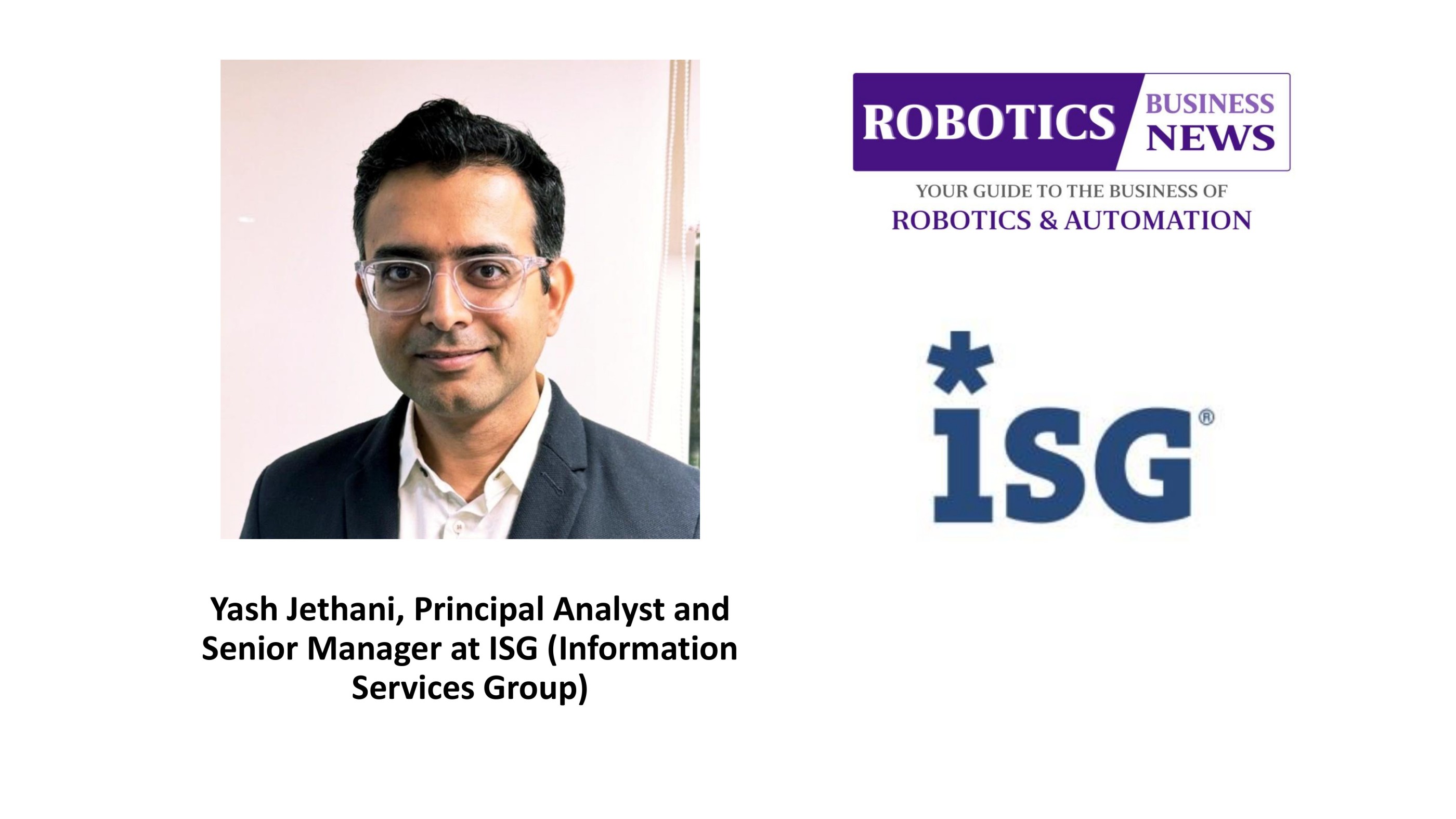
With global providers racing to build “physical AI” platforms and enterprises moving toward connected robotics ecosystems, ISG is stepping in with its first-ever dedicated assessment of the space. Speaking with Robotics Business News, Yash Jethani, Principal Analyst and Senior Manager at ISG, reveals how the study will help buyers cut through market noise, identify real engineering depth, and select partners capable of delivering multi-year, cross-site robotics programs.
What motivated ISG to launch a dedicated study on “Intelligent Robotics and Physical AI Services” at this stage of industry evolution?
We’re seeing robotics move from isolated industrial automation into AI-enabled, connected systems that sit inside mainstream IT and OT architectures. Large providers are now investing in “physical AI” labs and platforms. The timing is right because IT spend is shifting from pure hardware to services around perception, autonomy, orchestration and lifecycle management, and buyers need a clearer view of who can intelligently deliver that end-to-end.
How does this report aim to help enterprise buyers understand and evaluate providers of robotics and physical-AI services?
The report gives buyers a structured way to assess providers on strategy, engineering depth, integration quality, safety/compliance, and managed operations, rather than on robots, per se. So, it gives a view on roadmap to simulation and deployment and finally to the managed operations, and where they are still experimenting with POCs.
The study outlines three quadrants—Consulting & Transformation, Integration & Engineering, and Managed Services/RaaS. How were these categories defined, and what do they reveal about the current market structure?
We defined the categories based on where providers take primary accountability—shaping the roadmap (Quadrant #1), engineering and integration (Q #2), or ongoing fleet performance and commercial models (Q #3). It shows a market that is still fragmented, with relatively few providers strong in more than one quadrant.
From your survey of more than 160 providers, what key capability gaps are emerging among those claiming to deliver robotics and physical-AI solutions?
The study has just been launched, and we have invited 160 providers. But preliminary gaps seem to be around integrated perception, autonomy, orchestration stacks, industrial-grade cybersecurity for OT, and long-term managed services capabilities.
How quickly are enterprises moving beyond isolated automation toward integrated robotics systems that combine hardware, AI and connectivity, and what barriers remain?
We hear activity increasing in logistics, automotive, high-tech manufacturing and mining sectors, but “lights-out” transformation is still unheard of.
For enterprises in regions such as Asia-Pacific (including India), what specific considerations should they keep in mind when selecting vendors for robotics and physical-AI services?
Of course, local regulatory and safety regimes will be an important consideration, but cost focus with Opex and Capex models along with local skilling is important.
How will ISG’s Provider Lens® report differ in methodology or content when covering this emerging robotics and physical-AI category compared to more mature service lines?
Our approach is nuanced – combining perception, embodied intelligence, fleet orchestration, safety, and industrial integration—and all this requires concrete evidence (sites, KPIs, partnerships) against each. Both IT service providers and OEMs are covered to cover a full gamut of controls ecosystems and how value is shared in physical AI space.
Finally, what are your expectations for the full report release in March 2026—particularly regarding its market impact, vendor positioning and customer decision-making?
For providers, it will assess which providers are genuinely ready for large, complex, cross-site engagements, and which are still early-stage or lab-focused. But as always, since IPL is focused on enterprise challenges, it helps enterprises that are moving beyond pilots and need to choose partners for multi-year robotics programs.