Driving the Future of Multi-Agent Robotics Orchestration in Warehousing and Manufacturing
22 June 2026 | Interaction | By Editor Robotics Business NEWS <editor@rbnpress.com>
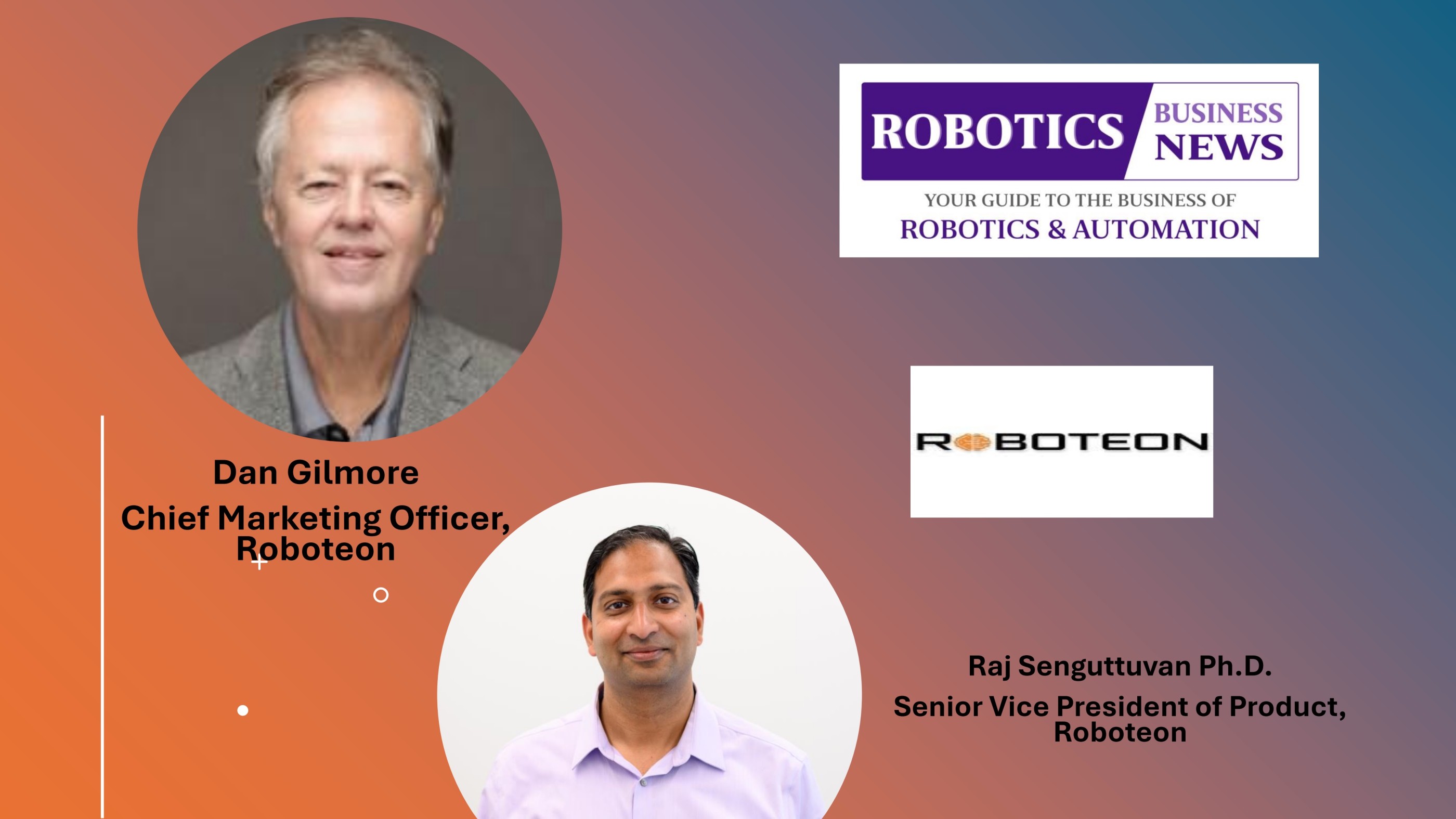
Dan Gilmore, Chief Marketing Officer, and Raj Senguttuvan, SVP Product at Roboteon discuss interoperability, AI-driven orchestration, digital twins, and autonomous supply chains.
As robotics adoption accelerates, seamless coordination between diverse autonomous systems has become a critical challenge for manufacturers and warehouse operators. In this exclusive Robotics Business News interview, Dan Gilmore, Chief Marketing Officer, and Raj Senguttuvan, SVP Product at Roboteon, share insights on multi-agent orchestration, AI-powered automation, digital twins, interoperability, and the future of autonomous supply chains.
The robotics industry is moving rapidly toward heterogeneous automation environments. How does Roboteon's orchestration platform enable seamless coordination between robots from different manufacturers, and why is interoperability becoming a critical requirement for modern warehouses and factories?
With the growing demand for intralogistics robots in warehousing and manufacturing has come dozens of robot vendors with equipment designed with different specs (payloads, speeds, accessories, etc.), with those features being updated frequently.
There will of course also be differences in price points and importantly software capabilities by the robot OEMs well.
So companies will want to deploy the robots that best meet the requirements of each use case over time. That could be different types of robots that need to work together on a given workflow, or changes over time to the source (vendor) for the same type of robot.
Say a company acquires 20 Autonomous Mobile Robots (AMRs) to assist order picking. Two years later, they need 10 more bots due to volume growth. But they find another AMR vendor that meets their operational requirements but at a 20% cost savings.
The company likely will want to keep the 20 AMRs they have now, and add on the new 10 robots, not as a separate fleet but which is seamlessly integrated and managed as if a single fleet.
That is an important example of the type of capabilities that come with Roboteon’s Order Fulfillment and Orchestration Platform, an integrated, vendor-agnostic solution built for heterogenous robotics and other automation, with complete flexibility over time to add the new vendors and technologies they want.
Bye bye “vendor lock-in.”
Garter calls this a Multi-agent Orchestration Platform (MAOP). It’s an evolving concept, but Roboteon has all the MAOP capabilities Gartner has cited and more, in what we sometimes call MAOP+.
Many organizations have invested heavily in automation but still struggle with siloed robotic systems. What are the biggest challenges companies face when integrating multiple autonomous systems, and how does Roboteon address these obstacles?
This is clearly an issue and is a question both of design or approach and also the technology deployed. Has the automation been implemented with an integrated process in mind (even if down the road) and a goal of improving total productivity, or only to solve some specific problem with a narrow objective? Roboteon’s Order Fulfillment and Orchestration Platform natively delivers multi-process workflows, across both automated and non-automated processes, including robotics and other types of automation.
If a process or automation equipment is connected to the platform, it is integrated with all the other services available on the platform, enabling true interoperability of robots of different types and/or vendors.
Our configurable orchestration engine can optimize total system performance in terms of the flow of goods and task release across different types of automation. Importantly this also includes synchronizing human and robotics resources in both distribution and manufacturing environments.
As AI capabilities continue to evolve, how are you incorporating artificial intelligence into robotics orchestration to improve decision-making, task allocation, and operational efficiency?
Our platform uses AI/ML algorithms to enable intelligent real-time decision making for maximizing operational efficiency and throughput.
Integration: The platform uses ML for automated data mapping to streamline and accelerate integration of complex enterprise software (like WMS, ERP or MES) with multi-vendor robotic platforms. This cuts integration times down from months to days.
Real-Time Task Optimization & Labor Balancing: During execution, our AI engine dynamically optimizes order planning and work release based on real-time floor conditions, resource availability, and live congestion data. It synchronizes and assigns tasks seamlessly across heterogeneous robot fleets and human associates to maximize total throughput.
Predictive Simulation: By leveraging advanced AI-driven simulation modeling, our platform allows operators to run tactical scenario planning based on historical or forecasted data, model demand fluctuations, and proactively solve floor bottlenecks before they impact throughput.
Digital twins are becoming increasingly important in industrial automation. How does Roboteon leverage simulation and digital twin technologies to help customers optimize workflows before deploying robots in live environments?
Warehouse and manufacturing plant operators can use our easy-to-use simulation and digital twin tool to support critical decision making across multiple operational time horizons.
Strategic Design: Our advanced simulation tool builds a virtual, 3D replica of the customer's layout—including specific aisles, zones, and slotting setups. By ingesting actual historical order data or generating synthetic demand profiles, the tool can simulate how different combinations of multi-vendor robots and human associates will perform in the virtual setup. Operators can test "what-if" scenarios, and analyze different scenarios using many different KPIs for analysis.
Tactical Capacity Planning: The Roboteon platform enables operators to alter operations to model the impact of peak season requirements, layout expansions, or new product introductions. This ensures that labor-to-robot ratios are well balanced ahead of time.
Real-Time Digital Twin Execution: Once live, the tool enables the visualization of the facility as a real-time digital twin. It continuously ingests data on current demand and floor resources (robots and RTLS-tagged assets), allowing the operator to visualize operations and dynamically adjust to alleviate aisle congestion or address other scenarios.
Scalability is often a concern for enterprises expanding automation across multiple sites. What lessons have you learned from large-scale deployments, and how does your platform support growth from a few robots to hundreds or even thousands of autonomous systems?
Achieving scalability is all about building the right technology foundation. The Roboteon platform is designed with a modular, microservices based architecture to handle computational and operational growth moving from a localized pilot to an enterprise-wide rollout of thousands of systems.
Computation and decision making is intelligently split between the cloud and edge, often depending upon the use case. For example, time-critical, low-latency decisions such as traffic management at intersections, roll-up door handshakes, and collision avoidance can be handled by local edge servers, while high-level global task allocation, data integrations, and fleet-wide analytics are processed in the cloud. We also use our advanced simulation tool to virtually scale mixed-vendor fleets in new layouts, and stress-test workflow execution to identify bottlenecks or other issues associated with scaling before deploying hardware.
Manufacturing and warehousing have different operational requirements. How does Roboteon tailor its orchestration capabilities to meet the unique demands of these two sectors while maintaining a unified platform approach?
While warehousing and manufacturing are very different environments, the basics in terms of workflow creation, task optimization, and human-robot synchronization (among others) can be leveraged and deployed in very similar ways for both scenarios.
Part of it is just supporting different use cases. Ecommerce fulfillment, for example, is commonplace in warehousing but uncommon in factories.
Let’s consider Roboteon’s simulation tool referenced above, used across multiple time horizons, from the strategic/design phase through tactical planning to real-time daily planning and execution.
This simulation tool includes the ability to model a current or planned warehouse facility, setting up the overall design, storage and picking areas, distances, zones etc. to run the simulation against.
We soon found the tool could just as easily model a manufacturing environment, with storage areas, work cells, production lines, and other features for use in the simulation runs.
By creating a platform that was designed from the start to support both warehousing and manufacturing applications, Roboteon strongly supports both application/use cases.
Looking ahead, what role do you see robotics orchestration software playing in the broader development of autonomous supply chains and smart factories over the next five years?
Robotics orchestration software will expand beyond basic material handling to manage more complex industrial processes. It will synchronize diverse automated assets—such as AGVs, robotic picking cobots, and line-replenishment AMRs—across multi-vendor ecosystems. By breaking down proprietary hardware silos, orchestration will be the engine that translates high-level ERP or MES commands into efficient execution.
Our belief is that in the future, the robotics orchestration platforms will increasingly leverage AI for continuous learning of the work environment and autonomous self-optimization: predicting physical bottlenecks, automatically reallocating tasks between humans and diverse machine fleets, forecast disruptions and take corrective action before disruption.
As you showcase Roboteon's solutions at Automate 2026, what emerging trends in robotics and industrial automation are you most excited about, and how are they influencing your product roadmap and long-term vision?
Modern facilities are no longer single-vendor environments. Operations are realizing they need a heterogeneous mix of hardware and human associates. The automation landscape is also in the early stages of adopting Agentic AI to autonomously run operations on the floor. This shift validates Roboteon’s focus on interoperability and multi-agent orchestration.
We are investing in expanding our platform’s capability to abstract away integration complexities and leveraging machine learning directly in our core execution engine. Roboteon is also actively expanding its certified, native integrations with major enterprise platforms, such as SAP EWM and Microsoft Dynamics 365.