XTEND Expands Physical AI with AtlasROVER and Multi-Domain Robotics Ecosystem
21 September 2026 | Interaction | By Editor Robotics Business NEWS <editor@rbnpress.com>
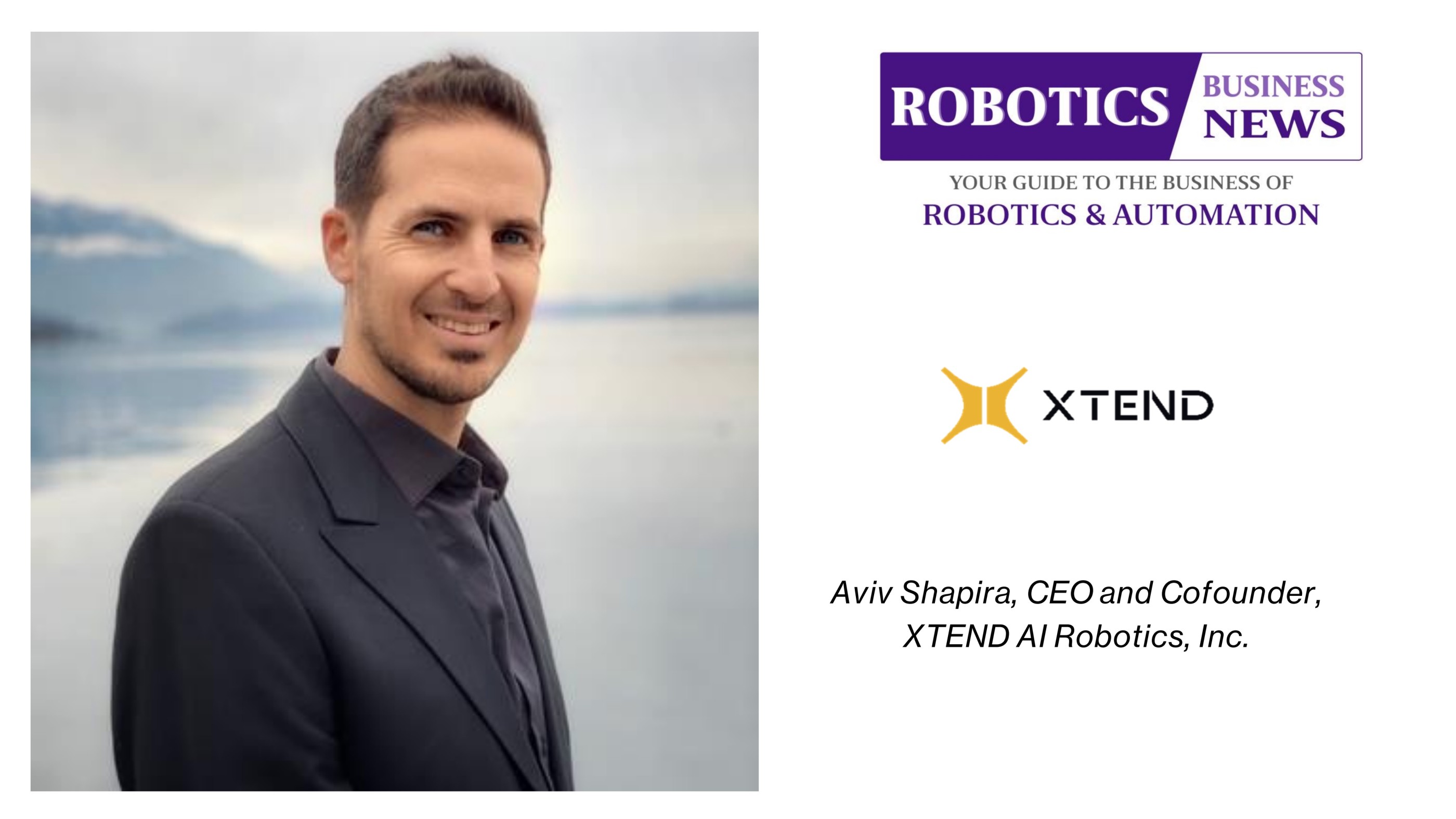
Aviv Shapira discusses XTEND’s XOS platform, AtlasROVER, human-guided autonomy and the company’s vision for connected air, ground and maritime robotics.
In this conversation with Robotics Business News, Aviv Shapira, CEO and Cofounder of XTEND AI Robotics, discusses the company’s expansion into ground robotics with AtlasROVER and its vision for XOS as a common software foundation for Physical AI. He shares insights into multi-domain autonomy, human-guided robotics, mission coordination and the future of connected aerial, ground and maritime robotic systems.
XTEND's expansion into ground robotics with AtlasROVER marks an important evolution for the company. What strategic factors drove the decision to extend the XOS ecosystem beyond aerial robotics?
"Our expansion into ground robotics was driven by a simple operational reality. Customers do not experience missions in separate silos. They face complex environments where they need to sense, understand and act across multiple domains and reducing risk to personnel during those missions is a priority.
XTEND has built XOS as the operating system for Physical AI. It’s a versatile, hardware-agnostic foundation that combines AI capabilities, mission applications and operator workflows into a single platform that can be applied widely. AtlasROVER gives us a capable ground defense platform that can operate in complex environments and support multiple mission payloads, while benefiting from the same software architecture that supports our aerial and other systems.
The goal is to give customers a more coherent way to deploy, manage and improve robotic operations, not simply to add another robot to a portfolio. By bringing ground platforms into XOS, we aim to create greater consistency in how missions are planned, how operators interact with systems, how data is shared and how new capabilities are deployed over time."
XOS is designed as a common operating system for Physical AI across different robotic platforms. What are the biggest technical challenges in creating software that can operate across aerial, ground and eventually maritime systems?
"The biggest challenge is to create real software commonality understanding that an aerial drone, a ground robot and a future maritime platform don’t face the same physics, sensing conditions, or failure modes.
Each domain has distinct demands. Aerial systems must manage flight dynamics, battery constraints, altitude and navigation in three dimensions. Ground systems must interpret terrain, obstacles, traction, confined spaces and more complex mobility conditions. Maritime systems introduce another set of variables, including weather, water movement, communications and navigation in a dynamic environment.
Our approach is to separate what is shared between the domains from what must remain platform-specific. XOS provides shared layers for mission planning, operator workflows, AI-enabled applications, data management and human-guided autonomy. Underneath that, each vehicle retains the controls, perception models, safety mechanisms and mission logic required for its own domain.
The technical work is therefore about standardizing interfaces, data models, command structures and user experiences while preserving the platform-specific intelligence needed to operate safely and effectively. The result is an operating system that is genuinely hardware-agnostic, rather than merely a collection of disconnected integrations."
What does the first customer deployment of an XOS-powered AtlasROVER in the Asia-Pacific region demonstrate about market demand for multi-domain robotic capabilities?
"The first XOS-powered AtlasROVER deployment in the Asia-Pacific region is an important milestone. It shows that customers are looking beyond individual platforms and increasingly evaluating robotics through the lens of mission outcomes, interoperability and long-term scalability.
This deployment reflects customer interest for a ground robotic capability operating within a broader software ecosystem, one in which customers can apply common AI capabilities, mission applications and operator workflows across different platforms.
Asia-Pacific is also a strategically important market for autonomous systems. XTEND has already announced an XOS-enabled aerial-drone contract in the region, and this ground deployment reinforces that customers are interested in expanding operational capabilities across more than one physical domain."
AtlasROVER combines autonomous capabilities with XTEND's human-guided autonomy approach. How do you see the balance between human control and autonomous decision-making evolving as robotic systems become more capable?
"We see human-guided autonomy as the right model for the foreseeable future. As robotic systems become more capable, autonomy should increasingly handle the tasks machines do best, like stabilizing, navigating, detecting, tracking, avoiding obstacles, optimizing routes and executing repeatable elements of a mission.
Greater autonomy doesn’t eliminate the importance of human judgment, it makes that judgment more valuable. The operator should define intent, establish mission boundaries and retain authority over consequential decisions. The system's role is to help execute that intent more effectively, more safely and with less cognitive burden.
Over time, we expect the human role to shift from continuous manual control toward higher-level supervision, exception management and mission command. The shift is not toward taking humans out of the loop, but toward ensuring they have the right touchpoints and remain focused on decisions that require context, accountability and judgment, while the platform manages the speed and complexity of execution."
How does integrating AtlasROVER into the XOS ecosystem improve mission planning, situational awareness and coordination when multiple robotic platforms are operating together?
"Integrating AtlasROVER into XOS improves coordination by giving operators and mission teams a common operational framework rather than separate, platform-by-platform control environments.
In practical terms, XOS is designed to enable missions to be planned at the mission level and coordinated across the most appropriate assets. An aerial system may provide wide-area situational awareness, route reconnaissance or overwatch, while a ground platform investigates an area in greater detail, carries a payload or operates persistently in a location that is difficult or unsafe for people to access.
A shared software environment also improves situational awareness because operators can bring together data, alerts, maps, mission status and workflows instead of managing them through disconnected systems. The value comes from operators being able to understand and direct multiple robots as part of one coordinated mission.
XOS's larger premise is to connect platforms, AI and operators through a common intelligent software foundation for coordinated missions across air, ground and maritime domains."
What were the most significant engineering and software integration challenges involved in adapting XOS from aerial platforms to a ground-based robotic system?
"Adapting XOS from aerial platforms to a ground robotic system required us to address several layers of integration at once.
Ground mobility is fundamentally different from flight, so the system needs to account for and track terrain, wheel, behavior, slope, obstacle geometry, traction, clearance and route feasibility. Perception and navigation also need to be adjusted for a ground-level operating perspective in cluttered, confined and highly variable environments. And the operator experience must remain intuitive even as it adds the controls, data and safeguards a ground vehicle requires.
The engineering objective was to preserve the common XOS foundation, including shared AI capabilities, mission applications, and workflows, while adapting the autonomy, vehicle-control and perception layers to the requirements of AtlasROVER, rather than forcing an aerial software model onto a ground platform.
The core discipline of our multi-domain architecture is to build a common foundation to coordinate missions while respecting the real-world differences of each platform and mission environment."
XTEND has highlighted its ambition to build a common software layer across air, ground and, eventually, maritime robotics. What will a fully connected multi-domain robotic ecosystem look like in practical real-world operations?
"A fully connected multi-domain robotic ecosystem should feel less like managing a collection of individual machines and more like commanding a coordinated team.
In a real-world operation, an operator or mission commander could establish an objective, for example securing a perimeter, inspecting a hazardous area, conducting search and rescue, monitoring critical infrastructure or supporting a tactical reconnaissance mission. XOS would help orchestrate the available assets around that objective.
An aerial platform could quickly survey the area and identify points of interest. A ground robot could move closer to inspect, deliver a sensor or payload, or operate in environments that are unsuitable for people. Future maritime systems could extend that same operational picture to ports, waterways or offshore infrastructure. The operator would have a unified view of mission status, platform health, sensor feeds, alerts and decision points.
The critical principle is that every robot does not need to do every job. The ecosystem becomes powerful when each platform contributes its comparative advantage, while a common software layer enables them to share intelligence and operate toward the same mission outcome."
Looking ahead, what are XTEND's priorities for expanding the XOS-powered robotics ecosystem, and which industries or applications do you believe will present the strongest growth opportunities for AtlasROVER and future ground robotic platforms?
"Our priority is to expand the XOS-powered robotics ecosystem across a broader range of applications, including law enforcement, homeland security, critical infrastructure, security and emergency response. We’re focused on integrating AtlasROVER and other platforms into a shared ecosystem where robotics companies, AI developers, software providers and payload partners can bring new capabilities to customers through a common operating environment.
For AtlasROVER specifically, we see strong potential in missions where ground robots can improve safety and operational effectiveness, from hazardous-environment inspection and site security to emergency response and complex or repetitive operations. The goal is not autonomy for its own sake, but applying Physical AI where it solves a real customer problem and gives operators a clear mission advantage.”