Miller Electric Advances Adaptive Welding Automation with AI and Robotics
18 September 2026 | Interaction | By Editor Robotics Business NEWS <editor@rbnpress.com>
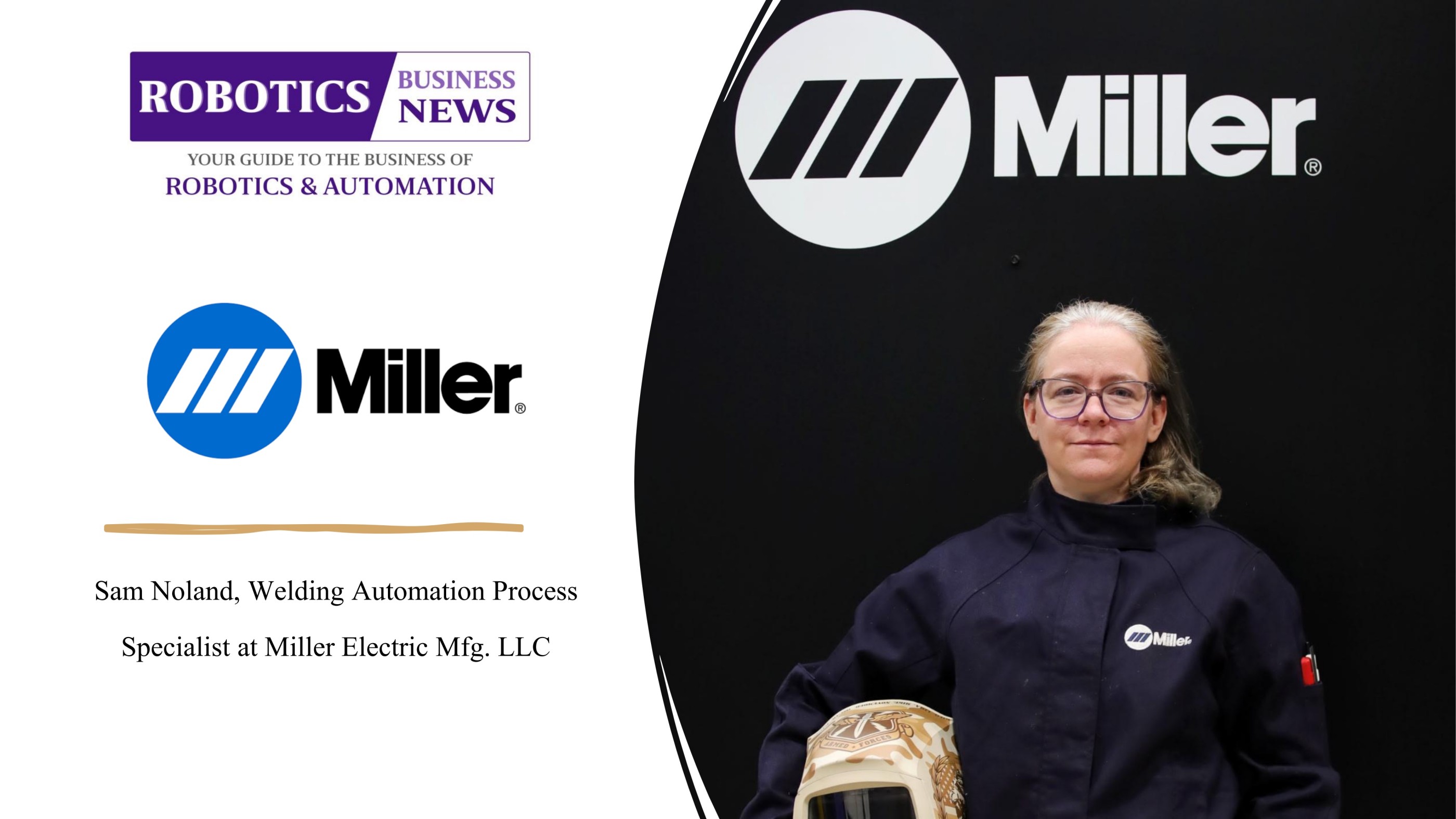
Sam Noland, Welding Automation Process Specialist at Miller Electric, discusses adaptive intelligence, Physical AI, weld consistency, and the future of robotic welding.
As manufacturers face skilled-welder shortages and increasing production demands, adaptive robotics and Physical AI are opening new possibilities for welding automation. In this Robotics Business News interview, Sam Noland, Welding Automation Process Specialist at Miller Electric, discusses how Copilot Builder with Blue iQ Powered by NovAI helps manufacturers manage weld variation, improve consistency, support skilled workers, and automate complex fabrication applications.
What motivated Miller to develop the Copilot Builder with Blue iQ, and what specific limitations of conventional robotic welding were you seeking to overcome?
As welding equipment suppliers and automation experts, one of the most common requests we hear is, "How can we make the machine create the same weld with every operator?" In other words, customers want us to "download the brain" of their best welder, capturing that expertise in a way that can be consistently applied across shifts, operators, and facilities. The same challenge exists in automation. Weld quality is still highly dependent on the programmer and how they account for variations in the part. To simplify startup and standardize results, many programmers compensate for gaps, tack locations, and part variation by overwelding and cleaning up afterward. Another common approach is to program the ideal weld and then perform repairs whenever the variation pushes the result out of spec. If neither of those options is acceptable, automation often isn't pursued at all, leaving manufacturers dependent on manual welders at a time when skilled welders are increasingly difficult to find. Copilot™ Builder™ with Blue iQ™ Powered by NovAI™ was developed to help overcome these limitations by making welding decisions more consistent, adaptable, and less dependent on individual operator or programmer expertise.
Many fabrication environments involve inconsistent fit-up, gaps, tack welds and changing joint conditions. How does adaptive intelligence change the economics and practicality of automating these applications?
In many fabrication environments, welding is affected by inconsistencies created earlier in the process, whether that's from manual work or variation from heavy material fabrication. To deal with those challenges, programmers and welding teams often have to invest extra time, material, and labor to weld parts successfully. Overwelding is a common solution. It helps ensure gaps are covered when they occur and can sometimes be unavoidable when using techniques like through-arc seam tracking that require weaving. Tack welds have traditionally been something manufacturers either control through very strict pre-weldout processes or simply accept as a source of variation in weld appearance and quality from part to part, or even within the same weld. With Blue iQ, we can significantly expand the range of acceptable part variation while still producing a consistent weld. Instead of compensating with extra weld material, repairs, or extensive part preparation, the system adapts to the conditions it sees and adjusts in real time. The result is less wasted material, scrap, labor, and inspection and rework time, while often requiring very little change from the welding processes that are already being used manually today.
How important was the ability to adapt to weld variation in real time, without extensive reprogramming or expensive fixtures, when designing the new Copilot Builder?
This was a critical requirement. We design our Copilot systems to be as simple and efficient as possible for welders, with minimal changes to the way they already work. The goal is to make automation easy to learn, quick to use, and practical on the shop floor. We applied the same philosophy when developing Blue iQ. Real-time adaptation to weld variation had to happen without adding programming complexity, increasing cycle time, or requiring extensive training. We wanted users to be able to turn the technology on or off as needed and integrate it into their existing welding process with as little disruption as possible. By allowing the system to adapt to part variation on its own, manufacturers can achieve more consistent results without relying on expensive fixtures, frequent reprogramming, or additional setup time.
The system is designed for large and complex fabrications and can be deployed in existing workspaces. How does this flexibility change the types of manufacturers that can realistically adopt robotic welding?
This system was designed specifically for our Copilot™ Builder™ with Blue iQ™ Powered by NovAI™ platform and features an 8-meter (approximately 26-foot) cable bundle between the robot arm/feeder and the controller/power supply. This gives customers the flexibility to integrate the system into the shop environments they work in today from standard components to large and complex fabrications. The robot arm can be mounted in a variety of ways, including on a magnetic base, track, table, gantry, or side beam, depending on what works best for the application. Rather than forcing manufacturers to redesign their workspace around the automation, we focused on making the system adaptable to a wide range of existing setups. This flexibility makes robotic welding a practical option for manufacturers who may have previously considered automation too difficult or restrictive. Our goal was to keep the system portable and easy to deploy while still delivering a true "hook-it-up-and-weld" solution that fits naturally into existing production environments.
Skilled-welder shortages remain a major challenge for manufacturers. How do you see Copilot Builder supporting skilled workers rather than simply replacing them?
Skilled welders bring a lot of value to a shop, and their time is often better spent on complex fabrication and challenging welds than making the same multipass weld on a base plate all day. The reality is that a significant portion of welding work is repetitive, and those jobs don't always make the best use of a highly skilled welder's expertise. We see Copilot Builder and Blue iQ as tools that support welders, not replace them. This equipment gives experienced welders a way to pass their years of technique knowledge to help program and support the system. For someone who may be a few years away from hanging up their hood, it can also provide a more ergonomic way to stay involved and continue putting that experience to use. By taking repetitive, predictable welds off their plate, skilled welders can focus on the work that requires more experience, problem-solving, and craftsmanship. There will still be a need for people to load parts, tack and fixture assemblies, and oversee production. In many cases, these systems also create an opportunity for people who are new to welding or interested in entering the trade. They can operate and support the system while gaining experience and developing their skills, helping manufacturers build a stronger workforce for the future.
What role does the data generated during welding play in improving productivity, quality control and process optimization over time?
Because we monitor so many aspects of the welding process, the data does much more than simply track production. It helps identify potential quality issues, flag welds that may need additional review, and provide greater visibility into what is happening during the weld in real time. We can capture video of the weld as it's being made, allowing users to review exactly what happened if a question or issue comes up later. We can also connect customer quality records and reporting systems to the weld data, creating a complete history that can be referenced whenever needed. Over time, this creates a level of weld traceability that helps manufacturers connect what happened during production with downstream quality results. This gives them a deeper understanding of what drives successful welds and what creates challenges in their process. They can use that information to improve training, refine weld schedules, support quoting and cost estimating, optimize production planning, and make more informed decisions across their operation. The more data they collect, the better positioned they are to continuously improve productivity, quality, and overall welding performance.
Miller is working with Novarc to bring Physical AI into welding automation. What have you learned from this collaboration about the role AI can play in making industrial robots more adaptable?
One of the biggest lessons from this collaboration is that success depends less on the amount of data and more on selecting the right data and understanding what information the system needs to make good decisions. We also learned that some of the most important knowledge comes from things experienced welders and automation experts do without even thinking about it. A large part of the development process was identifying and defining these "unknown-knowns" so they could be properly taught to system. That is where the collaboration between Miller and Novarc was especially valuable. Miller brings decades of welding process knowledge, while Novarc brings deep expertise in applying AI to welding. Bringing those capabilities together allows the technology to be built around the realities of the weld rather than applying adaptive intelligence as a layer on top of conventional robotics. Combining real-world welding expertise with adaptive intelligence development allowed us to better understand what makes a successful weld and how to help the system adapt to changing conditions. The result is a solution that can respond more intelligently to variation and operate more like an experienced welder would when faced with real-world fabrication challenges.
Looking ahead, what applications or areas of fabrication do you believe could become newly automatable as adaptive welding technology matures?
As adaptive welding technology continues to mature, we believe some of the biggest opportunities for automation will be in larger, heavier fabrications and formed parts. These pieces are often difficult to fit up and align consistently because of their size and weight. Variations introduced during forming, cutting, or other upstream processes can create gaps, and when parts are positioned with cranes or hoists, the fit-up is rarely exactly the same every time. Those challenges have traditionally made automation more difficult. What we commonly see are relatively straightforward welds where the real challenge isn't the weld itself, but the variation in the joint. Bevel gaps may change along the length of the weld, formed parts may not fit perfectly, or occasional gaps can appear during assembly. As adaptive welding technology becomes more capable, those types of applications become much more practical to automate because the system can adjust to the real-world conditions it encounters rather than requiring every part to be perfectly consistent. Ultimately, this opens the door for manufacturers to automate weldments that were previously considered too variable or difficult for robotics, particularly in large-scale fabrication where consistency has always been one of the biggest challenges.